What Is a Marathon and Why Is It 26.2 Miles?
From a legendary Greek messenger to Olympic royalty, the story behind the marathon's exact distance is stranger than most runners know — and the science of what happens to the body over 26.2 miles is remarkable.
The Legend That Started It All
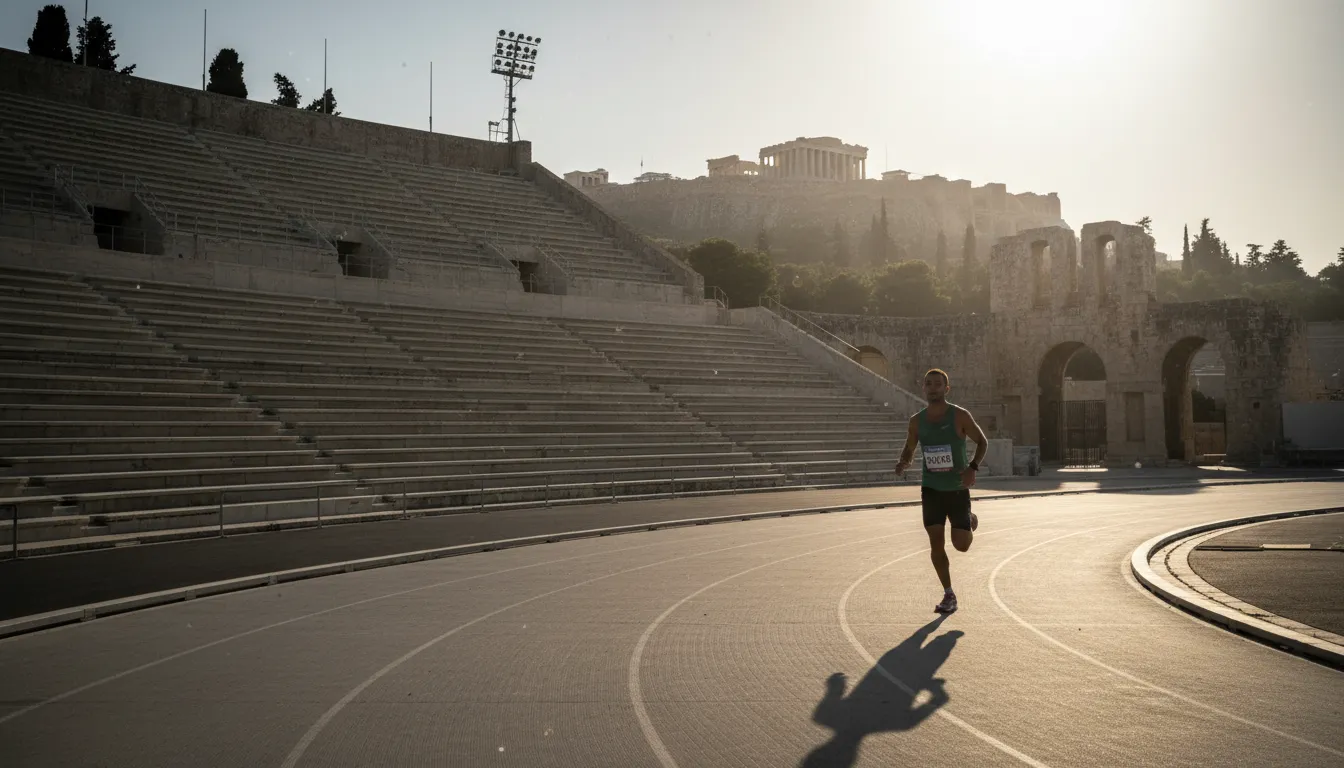
The marathon's origin story is one of the most famous in sport — and one of the most embellished. According to popular tradition, a Greek messenger named Pheidippides ran from the battlefield of Marathon to Athens in 490 BC to announce victory over the Persian army, gasped "Rejoice, we conquer!" and promptly died. The story is compelling. It is also largely a 19th-century invention.
As historian National Geographic notes, the ancient historian Herodotus describes Pheidippides as a courier sent to Sparta — some 240 km away — to seek military aid before the battle, not after it. The dramatic death scene was popularised by the poet Robert Browning in 1879, more than 2,300 years after the supposed event. Nevertheless, the legend proved irresistible to the organizers of the first modern Olympic Games.
How the Modern Race Was Born
The marathon as a competitive event was the brainchild of French philologist Michel Bréal, who proposed it for the 1896 Athens Olympics specifically to evoke ancient Greek glory. That first modern marathon covered roughly 40 km — about 25 miles — from the town of Marathon to Athens. A Greek water-carrier named Spyridon Louis won it in 2 hours 58 minutes and 50 seconds, becoming a national hero overnight.
For the next twelve years, marathon distances varied wildly between races. Then came London 1908, and with it, one of sport's strangest bureaucratic decisions.
Why Exactly 26.2 Miles?
The 26.2-mile (42.195 km) standard was set at the 1908 London Olympics — and it had nothing to do with ancient Greece. Organisers laid out a course from Windsor Castle to the Olympic stadium in White City. The start was moved to the castle's East Lawn so that the royal children could watch from the nursery window, and the finish was adjusted so that King Edward VII and Queen Alexandra could see it clearly from the royal box. That added up to precisely 26 miles and 385 yards.
The distance was not officially standardised until 1921, when the International Association of Athletics Federations (now World Athletics) locked it in permanently. Every world record, every Olympic gold, every finisher's medal since then has covered the same quirky royal distance.
What the Race Does to the Human Body
Running 42 km in one go is a significant physiological challenge, regardless of pace. According to research published in PubMed and the Wikipedia article on marathon physiology, the race demands a sustained 10–15-fold increase in metabolic rate over hours.
- Glycogen depletion — "hitting the wall": Muscles store carbohydrate as glycogen, which is the primary fuel for running. Most runners carry enough for roughly 20 miles. When stores run out, the body struggles to produce energy fast enough, causing the sudden fatigue, shakiness, and confusion runners call "bonking."
- Cardiovascular stress: Heart rate stays elevated for hours. In later miles, a phenomenon called cardiac drift can cause heart rate to rise even without increased effort, as the volume of blood pumped per beat decreases due to dehydration.
- Temperature regulation: The body generates enormous heat. Sweating is the primary cooling mechanism, but in hot or humid conditions this can fail, leading to hyperthermia — a genuine medical emergency at races worldwide.
- Muscle and tissue damage: Every footstrike on pavement micro-damages muscle fibres. By the final miles, runners recruit fast-twitch fibres usually reserved for sprinting, accelerating fatigue. Post-race biomarkers can resemble those seen in mild organ stress, though most normalise within a week.
The World Marathon Majors
Today, marathon running is a global mass-participation sport. The Abbott World Marathon Majors — launched in 2006 — brings together the seven most prestigious races: Tokyo, Boston, London, Sydney, Berlin, Chicago, and New York City. Together they attract hundreds of thousands of runners per year and millions of spectators.
The Boston Marathon, first run in 1897, is the oldest annual marathon in the world. New York City's race, born in 1970 with just 127 entrants running loops of Central Park, now fields over 50,000 runners across all five boroughs. Runners who complete all six original Majors earn a coveted Six Star Medal, a goal that drives recreational runners to plan trips across continents.
Why Millions Run It
The marathon occupies a unique place in sport: it is simultaneously an elite athletic contest and an inclusive mass event. A professional runner can finish in just over two hours; a first-timer may take six or more. Both cross the same finish line. That democratising quality, combined with the race's mythic origin story and the genuine physical challenge it represents, has made the marathon one of the world's most enduring sporting traditions — even if the legend behind it is mostly fiction.