What Is Coltan and Why It's in Every Smartphone
Coltan is a rare mineral found largely in the Democratic Republic of Congo that is refined into tantalum — a critical component inside nearly every modern electronic device. Its extraction comes with a devastating human and environmental cost.
The Mineral Inside Your Pocket
Every time you pick up a smartphone, swipe a laptop trackpad, or start a car, you are almost certainly using a mineral most people have never heard of: coltan. Short for columbite-tantalite, it is a dull, black metallic ore that, once refined, becomes tantalum — one of the most valuable and contested materials in modern industry.
Tantalum's unique properties — exceptional heat resistance, high electrical conductivity, and the ability to hold a large electrical charge in an extremely small space — make it irreplaceable in the manufacture of tantalum capacitors. These tiny components regulate and store electrical current on circuit boards. Without them, the miniaturisation that defines modern consumer electronics would not be possible.
Where Coltan Comes From
The Democratic Republic of Congo (DRC) holds an estimated 64 percent of the world's known coltan reserves and produced roughly 41 percent of global tantalum supply in 2023, according to the US Geological Survey. Rwanda, Brazil, Australia, and Canada are other significant producers, but eastern Congo remains the dominant source by a wide margin.
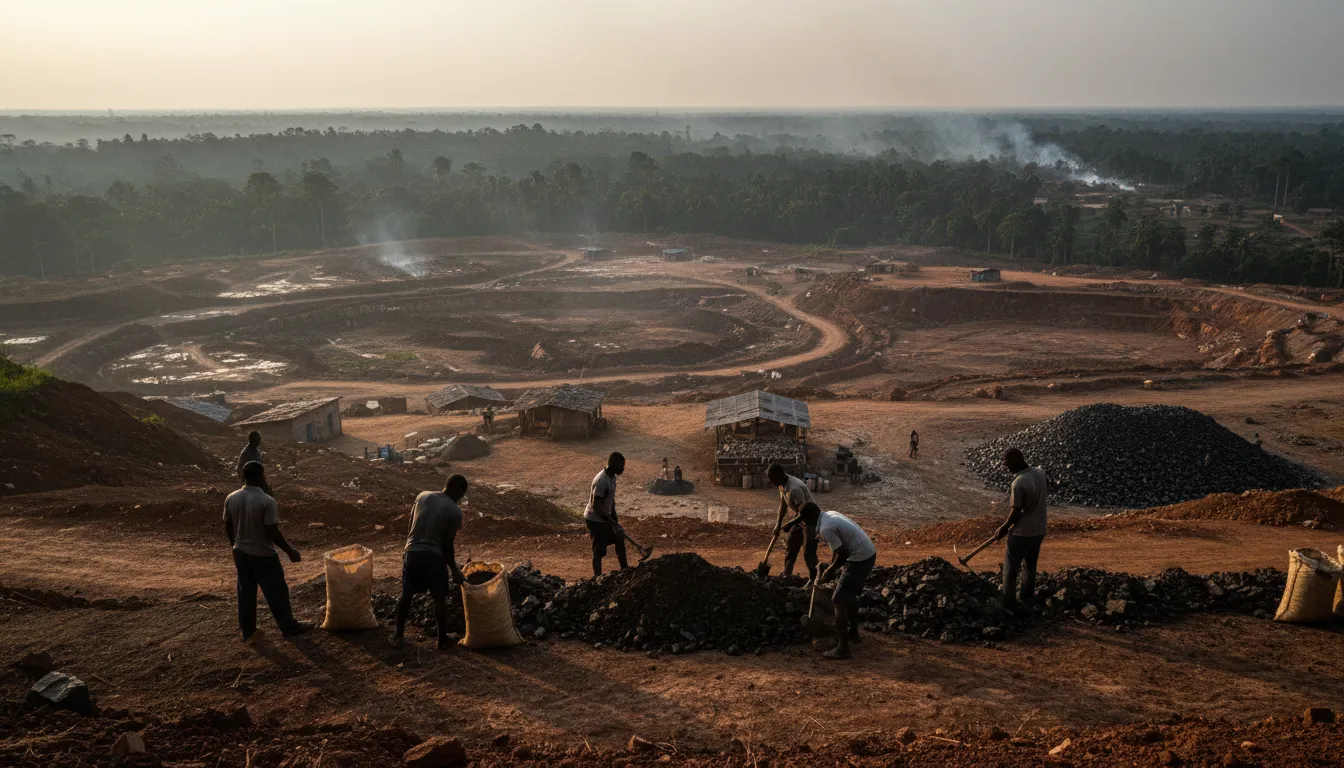
Most Congolese coltan is extracted by artisanal and small-scale miners — individuals and small teams working by hand with basic tools in remote, forested highlands. The ore is dug from open pits, washed in streams to separate it from sediment, then sold to local traders who aggregate material and ship it to regional export hubs and, ultimately, to smelters in Asia and Europe where it is refined into tantalum powder or metal.
From there, manufacturers such as Apple, Samsung, and Sony incorporate tantalum capacitors into the circuit boards of smartphones, laptops, gaming consoles, digital cameras, medical pacemakers, and automotive safety systems. An estimated 60 to 70 percent of all tantalum produced worldwide ends up in capacitors, according to industry data compiled by the Investing News Network.
Why It Is Called a Conflict Mineral
The term conflict mineral refers to natural resources whose extraction and trade directly finance armed groups involved in human rights abuses. Coltan — alongside tin, tungsten, and gold (collectively known as 3TG minerals) — has been at the centre of this problem for decades in eastern DRC.
Armed militias have long taxed or outright controlled coltan mining sites, using revenues to fund weapons, soldiers, and ongoing civil conflict. The Rubaya mining complex, one of the DRC's largest coltan-producing sites, has been controlled by M23 rebels since 2024 and reportedly generates more than $800,000 per month in mineral taxes for the armed group, according to Global Witness.
Beyond the funding of violence, the mining sector in eastern DRC is associated with severe labour abuses. The Global Forest Coalition estimates that over 40,000 child miners continue to work illegally in Congolese mines despite reforms introduced in the country's mining code in 2017. Workers operate without safety equipment in tunnels prone to collapse, and are paid poverty wages.
The Environmental Toll
Coltan extraction also carries a heavy environmental price. Open-pit mining in the Congo Basin drives deforestation, destroys habitat for endangered species including the eastern lowland gorilla, and pollutes rivers with chemical runoff. The Global Forest Watch platform found the DRC has lost 8.6 percent of its tree cover since 2000, with mining identified as a major driver alongside agriculture.
What Regulations Exist?
International pressure has produced two significant legal frameworks. In the United States, Section 1502 of the 2010 Dodd-Frank Act requires publicly listed companies to audit their supply chains and disclose to the SEC whether their products contain 3TG minerals sourced from conflict-affected regions of the DRC or neighbouring countries. The EU Conflict Minerals Regulation, which came into force in 2021, extends similar due diligence obligations to all EU importers of these raw materials from conflict-affected zones worldwide.
Critics argue enforcement remains weak. Certain elements of the Dodd-Frank conflict minerals reporting requirements have not been actively enforced since 2017, and the opacity of multi-tier global supply chains makes independent verification difficult, as noted by Global Witness.
Can the Problem Be Solved?
Researchers and advocacy groups point to several potential paths forward: improving traceability technology such as blockchain-based mineral tracking, expanding certification programmes for responsibly sourced tantalum, and investing in alternative sources of supply such as recycling tantalum from end-of-life electronics. Some manufacturers have begun sourcing from audited smelters, but the scale of artisanal mining in the DRC makes clean supply chains difficult to guarantee.
Until demand for consumer electronics is paired with credible accountability for the minerals that enable it, the human and environmental cost of the world's digital economy will continue to be paid most heavily by communities in eastern Congo.