What Is Gaganyaan: India's First Human Spaceflight
Gaganyaan is India's ambitious crewed space mission, designed to carry three astronauts to low Earth orbit and return them safely — making India only the fourth nation to independently launch humans into space.
A Mission Named for the Sky
The word Gaganyaan comes from Sanskrit: gagana (sky) and yaan (vehicle). The name fits. India's first human spaceflight programme aims to carry a crew of three astronauts to low Earth orbit at an altitude of 400 kilometres, keep them there for three days, and bring them home safely. If successful, India will join an exclusive club — only the Soviet Union, the United States, and China have independently launched humans into space.
How the Programme Began
The roots of Gaganyaan stretch back to 2006, when the Indian Space Research Organisation (ISRO) began preliminary studies under the working name "Orbital Vehicle." The project moved in fits and starts for over a decade before Prime Minister Narendra Modi formally announced the mission on India's Independence Day, 15 August 2018, setting an initial crewed launch target of 2022.
The timeline has since been revised multiple times — partly due to the COVID-19 pandemic, which disrupted training schedules — but the ambition has never wavered. A budget of roughly ₹10,000 crore (approximately $1.2 billion) was approved, making Gaganyaan one of ISRO's most expensive and complex undertakings.
How the Spacecraft Works
The Gaganyaan spacecraft consists of two main sections:
- Crew Module (CM): A truncated-cone capsule with double-wall construction that houses the astronauts. It contains the Environmental Control and Life Support System (ECLSS), which maintains Earth-like air pressure, temperature, and oxygen levels during the mission.
- Service Module (SM): Sits beneath the CM and contains the propulsion, power, and thermal control systems that keep the spacecraft operational in orbit.
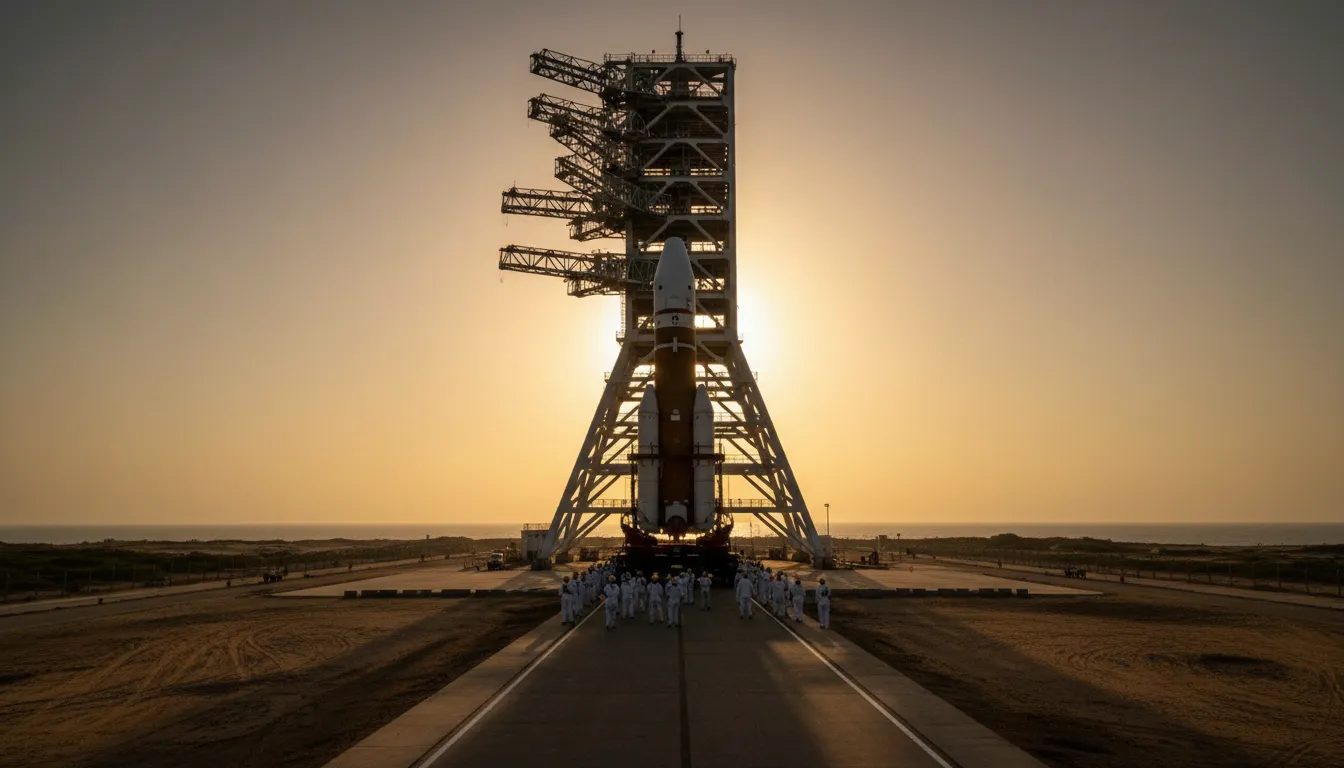
Together these form the Orbital Module, which launches atop the Human Rated LVM3 — a specially modified version of ISRO's most powerful rocket, the Launch Vehicle Mark III. The rocket lifts off from the Satish Dhawan Space Centre on Sriharikota island, off India's southeastern coast. After completing its mission, the crew module separates, re-enters the atmosphere, and splashes down in the Bay of Bengal, where Indian Navy ships recover it.
An equally critical safety feature is the Crew Escape System — a set of solid-fuel motors that can pull the crew module away from the rocket within milliseconds if a launch emergency occurs. ISRO successfully tested this system in 2023.
The Road to a Crewed Flight
ISRO designed a step-by-step test campaign before sending humans aloft. The G1 uncrewed mission — scheduled to carry Vyommitra, a half-humanoid robot built to simulate an astronaut's interactions with onboard systems — is intended to validate life support, avionics, and re-entry systems in orbit. Two more uncrewed flights (G2 and G3) are planned to close remaining technical gaps. According to Encyclopaedia Britannica, the first crewed human flight is now targeted for 2027.
Who Will Fly?
Four Indian Air Force officers were selected as astronaut-designates for the programme:
- Group Captain Prasanth Balakrishnan Nair
- Group Captain Ajit Krishnan
- Group Captain Angad Pratap
- Wing Commander Shubhanshu Shukla
All four are experienced test pilots. They completed generic cosmonaut training at Russia's Yuri Gagarin Cosmonaut Training Centre between February 2020 and March 2021, and have since continued mission-specific training in India. Wing Commander Shukla is also set to fly to the International Space Station aboard a NASA Axiom mission, giving India additional crewed spaceflight experience before Gaganyaan's own debut.
Why It Matters
Beyond national prestige, Gaganyaan is the foundation of India's broader space ambitions. ISRO plans to use Gaganyaan's technology to build an Indian space station by 2035 and eventually support a lunar landing mission. Economically, the programme is expected to stimulate India's aerospace industry and generate thousands of skilled engineering jobs.
According to Space.com, achieving independent human spaceflight would also strengthen India's hand in international space partnerships and negotiations over future deep-space missions. In an era when the space industry is rapidly expanding beyond government agencies, having proven crewed-launch capability gives India a seat at a table it has long observed from afar.