What Is Nowruz and Why 300 Million People Celebrate It
Nowruz, the Persian New Year, is a 3,000-year-old festival rooted in Zoroastrian tradition that marks the spring equinox. Celebrated across Iran, Central Asia, the Caucasus, and beyond, it remains one of the world's oldest and most widely observed cultural holidays.
A Festival Older Than Most Civilizations
Every year, at the precise moment of the Northern Hemisphere's vernal equinox—usually between March 19 and 22—more than 300 million people across dozens of countries mark the beginning of a new year. This is Nowruz, a word meaning "new day" in Persian, and it is one of the oldest continuously celebrated festivals on Earth.
With roots stretching back more than 3,000 years to ancient Zoroastrian and Mithraic traditions, Nowruz predates Islam, Christianity, and most modern nation-states. It survived empires, revolutions, and bans. Today it is recognized by the United Nations, which designated March 21 as International Nowruz Day in 2010, and by UNESCO, which inscribed it on the Representative List of the Intangible Cultural Heritage of Humanity in 2009.
Where Nowruz Is Celebrated
While Iran is Nowruz's cultural heartland, the holiday is observed as a public holiday in Afghanistan, Azerbaijan, Kazakhstan, Kyrgyzstan, Tajikistan, Turkmenistan, and Uzbekistan. Kurdish communities in Iraq, Turkey, and Syria also celebrate it as a central part of their identity. Smaller observances take place among diaspora communities in Europe, North America, and Australia, as well as among Uyghur communities in western China.
The festival's geographic reach mirrors the ancient Silk Roads trade routes, which carried Persian culture and Zoroastrian traditions across Central Asia, the Caucasus, and the Balkans. In Albania, for instance, a version called Nevruz is recognized as a national holiday.
The Haft Sin Table: Seven Symbols of Renewal
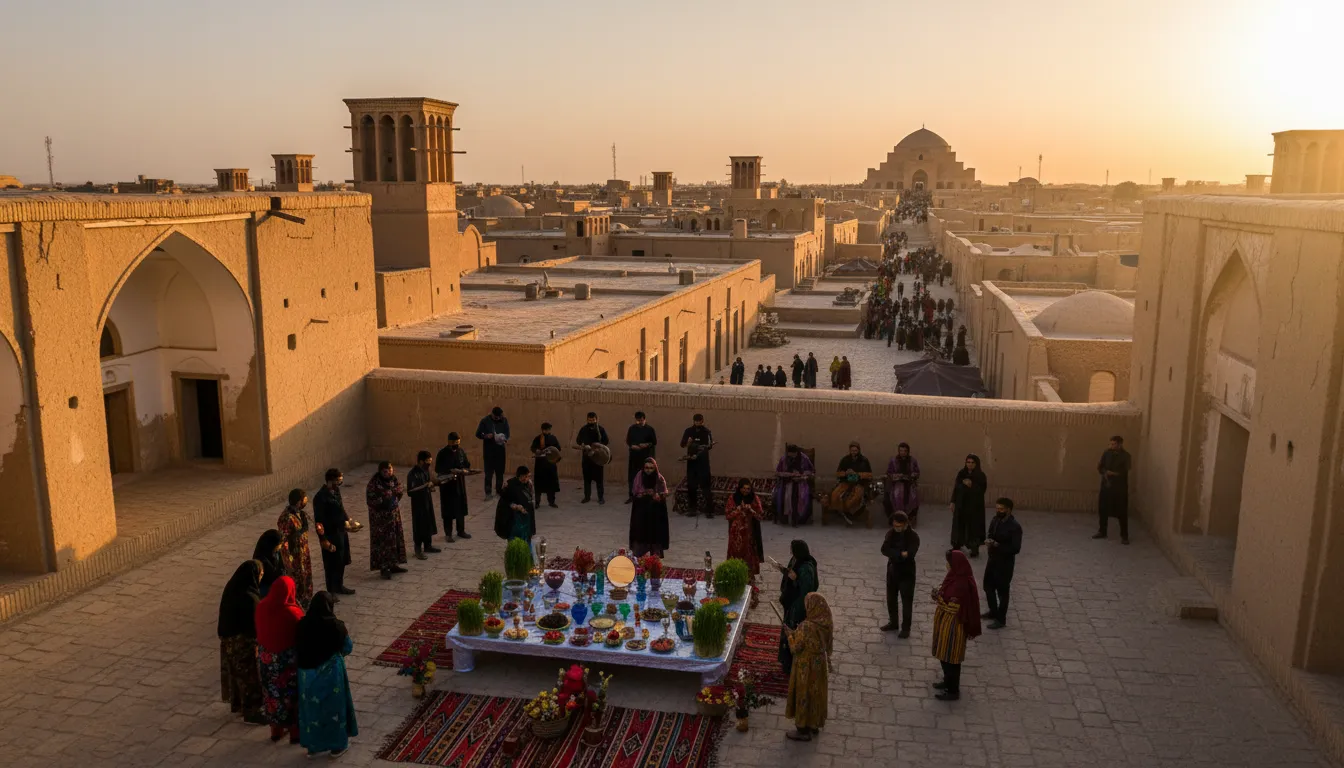
The most recognizable Nowruz tradition is the Haft Sin (هفتسین), a ceremonial table displaying seven items whose names begin with the Persian letter sin (س). Each item carries symbolic meaning:
- Sabzeh (wheat or lentil sprouts) — rebirth and new life
- Samanu (sweet wheat pudding) — abundance and fertility
- Senjed (dried oleaster fruit) — love
- Seer (garlic) — health and medicine
- Seeb (apple) — beauty
- Somāq (sumac) — the sunrise and triumph of good over evil
- Serkeh (vinegar) — patience and the passage of time
Families often add a mirror, candles, painted eggs, a bowl of goldfish, coins, and a copy of a sacred or beloved book. The table serves as a focal point for family gatherings throughout the holiday period.
Key Rituals: Fire, Spring Cleaning, and Picnics
Preparations begin weeks before the equinox. Families perform khāneh-takāni—literally "shaking the house"—a thorough spring cleaning meant to sweep away the old year's dust, both physical and spiritual. New clothes are purchased to symbolize a fresh start.
On the last Tuesday before Nowruz, many Iranians celebrate Chaharshanbe Suri, a fire-jumping festival where people leap over bonfires chanting, "Give me your beautiful red color and take back my sickly pallor." The practice has pre-Islamic, Zoroastrian origins tied to the purifying power of fire.
The festivities officially end on the thirteenth day with Sizdah Bedar, when families picnic outdoors and throw their Haft Sin sprouts into running water—symbolically releasing the previous year's troubles into nature.
Why Nowruz Endures
Unlike many holidays tied to a specific religion or nation, Nowruz is fundamentally secular and astronomical. Its timing is governed by the sun, not a lunar calendar or religious decree. This universality has helped it survive across vastly different political and religious systems—from the Achaemenid Empire of the sixth century BC, where subject nations brought gifts to the King of Kings, to modern-day republics where it remains the most important holiday of the year.
As the United Nations notes, Nowruz promotes "values of peace, solidarity, and reconciliation" and plays a significant role in strengthening ties among peoples based on mutual respect. In a world of deepening divisions, a 3,000-year-old celebration of spring, family, and renewal continues to resonate across borders.