What Is the Antarctic Circumpolar Current and Why It Matters
The Antarctic Circumpolar Current is Earth's most powerful ocean current, carrying 135 times more water than all the world's rivers combined. It regulates global climate, isolates Antarctica's ice, and is now responding to warming in ways that could reshape coastlines worldwide.
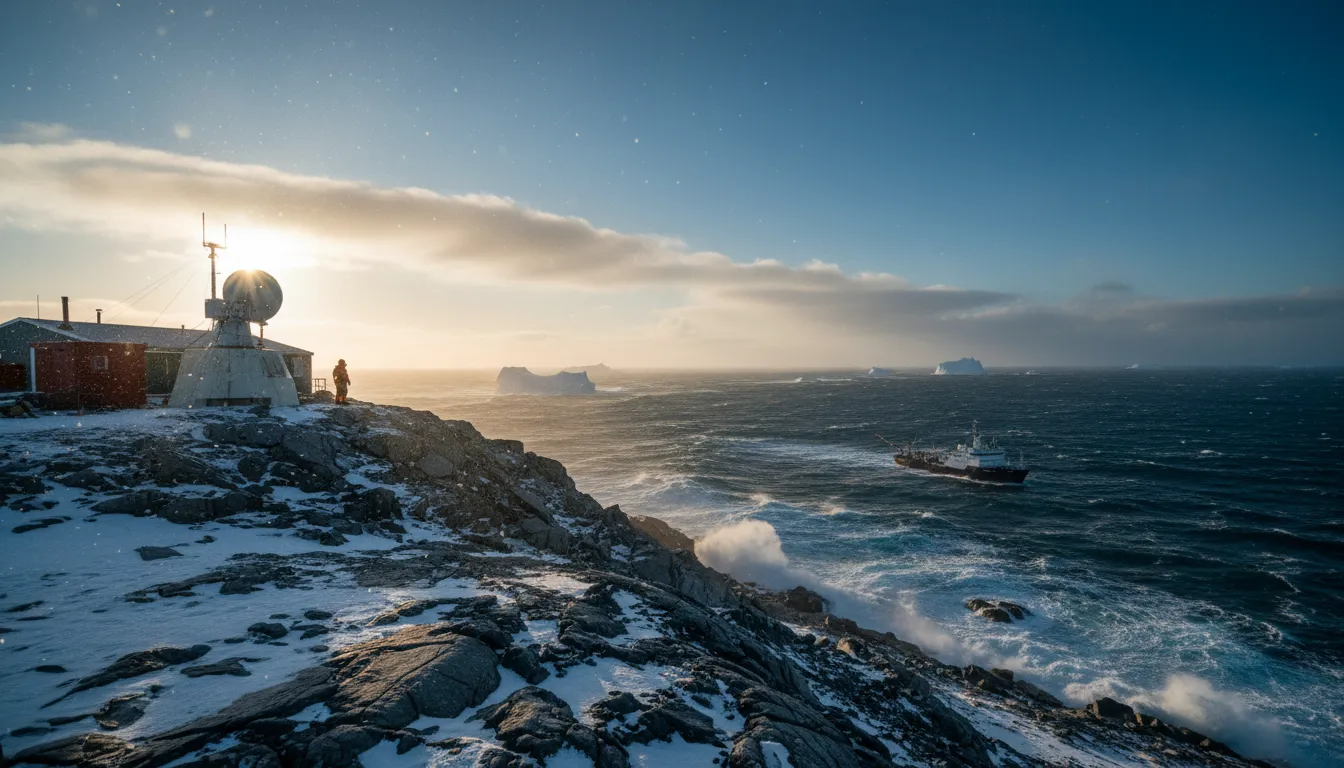
Earth's Mightiest River Has No Banks
Encircling Antarctica in an unbroken loop, the Antarctic Circumpolar Current (ACC) is the largest and most powerful ocean current on the planet. It transports roughly 135 million cubic meters of water per second—about 135 times the combined flow of every river on Earth. No landmass stands in its way, allowing it to connect the Atlantic, Pacific, and Indian Oceans in a single, relentless circuit driven by the fierce westerly winds of the Southern Ocean.
How the ACC Works
The ACC owes its existence to a simple geographic fact: Antarctica is surrounded by open ocean. Between roughly 45°S and 65°S latitude, no continent interrupts the flow of water, so the powerful westerly winds that blow across these latitudes push surface water eastward without obstruction. This creates a broad, deep current organized into several coherent jets, each hundreds of kilometers wide.
Within the current, countless mesoscale eddies—spinning vortices roughly 20 kilometers across—churn constantly. These eddies act as mixers, transporting heat and nutrients between different ocean depths and latitudes. The process is essential to the global thermohaline circulation, often called the "ocean conveyor belt," which redistributes heat from the tropics toward the poles and back again.
A 30-Million-Year History
The ACC has not always existed. Tens of millions of years ago, Antarctica was connected to South America and Australia, blocking any circumpolar flow. As tectonic plates shifted and the Drake Passage between Antarctica and South America opened—estimates range from 34 to 23 million years ago—water began flowing freely around the continent.
Recent research published in Proceedings of the National Academy of Sciences reveals that simply opening these ocean gateways was not enough. The ACC could only develop its full climate-cooling power once the westerly winds shifted southward and aligned with the new passages. Once that happened, the current began thermally isolating Antarctica, helping to lock the continent under ice and pulling carbon dioxide from the atmosphere—contributing to a dramatic global cooling.
Why the ACC Matters for Global Climate
The ACC serves as Earth's primary highway for exchanging heat, carbon dioxide, and nutrients between ocean basins. It acts as a thermal barrier, keeping warm subtropical waters away from Antarctic ice sheets. Without it, Antarctica's massive ice reserves—enough to raise global sea levels by roughly 58 meters if fully melted—would be far more vulnerable.
The current also plays a critical role in carbon absorption. The Southern Ocean absorbs a disproportionately large share of human-produced CO₂, and the ACC's mixing action helps draw that carbon into the deep ocean, slowing the pace of atmospheric warming.
Climate Change Is Altering the Current
Scientists have documented that the ACC is speeding up. Research from Scripps Institution of Oceanography shows that Southern Ocean winds have strengthened by roughly 40% in recent decades, pushing the current faster and pulling warmer water toward Antarctica's floating ice shelves. These warmer waters erode the shelves from below, accelerating ice loss.
A study published in Nature examining five million years of ACC variability confirmed that the current historically speeds up during warm periods and slows during cold ones—each acceleration coinciding with significant Antarctic ice loss. The pattern suggests that today's speedup, driven by human-caused warming, will continue and could hasten sea-level rise.
Paradoxically, the melting ice itself may eventually slow the ACC. Fresh meltwater dilutes the salty, dense water that helps drive deep ocean circulation. Some models project the current could weaken by 20% by 2050 as freshwater influx disrupts the density gradients that power it—a shift that would have cascading effects on marine ecosystems, weather patterns, and the ocean's capacity to absorb carbon.
A Current Worth Watching
The Antarctic Circumpolar Current is far more than a remote oceanic phenomenon. It regulates global temperatures, drives nutrient cycles that sustain marine life from krill to whales, and acts as a critical buffer against the worst effects of climate change. As scientists continue to study how warming reshapes this planetary engine, the ACC remains one of the most important—and most closely watched—forces in Earth's climate system.


