68,000-Year-Old Hand Stencil in Indonesia Is Oldest Cave Art
An international team of archaeologists has identified a 67,800-year-old hand stencil in a limestone cave on Indonesia's Muna island as the oldest known cave art in the world, reshaping our understanding of when humans first began creating symbolic art.
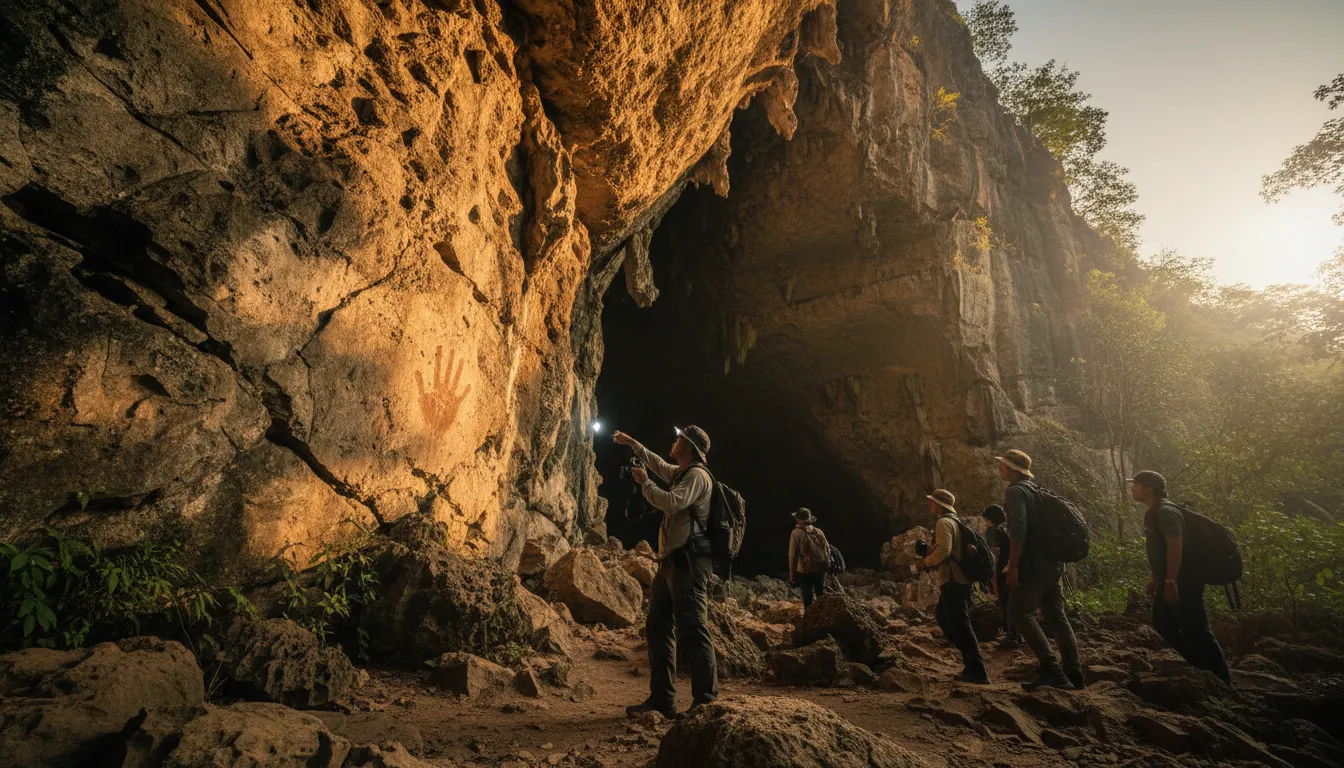
A Faded Handprint Rewrites Art History
A barely visible, salmon-pink hand stencil hidden on the wall of a limestone cave in Indonesia has just claimed the title of the oldest known rock art on Earth. At a minimum age of 67,800 years, the image — found in Liang Metanduno cave on the island of Muna, off southeastern Sulawesi — predates the previous record holder by more than 15,000 years.
The discovery, published in the journal Nature in January 2026, was made by an international team of Indonesian and Australian researchers. It pushes the origins of human symbolic expression far deeper into prehistory and challenges long-held assumptions that Europe was the cradle of artistic creativity.
Hidden Behind Younger Art
Lead author Adhi Agus Oktaviana, a rock art specialist at Indonesia's National Research and Innovation Agency (BRIN), first spotted the faint stencil in 2015. It was partially concealed behind more recent cave paintings, making it easy to overlook. The image — measuring just 14 by 10 centimeters — shows portions of fingers and part of a palm, created by blowing pigment over a hand pressed against the cave wall.
What makes the stencil especially intriguing is its deliberately altered fingertips. The fingers were reshaped to appear elongated and pointed, resembling claws rather than a natural human hand. "It was almost as if they were deliberately trying to transform this image of a human hand into something else — an animal claw perhaps," said Adam Brumm, professor of archaeology at Griffith University in Australia and a co-author of the study.
Dating the Undatable
Rock art is notoriously difficult to date. The team used uranium-series analysis, examining tiny mineral crusts that had gradually formed atop the pigment over millennia. Because these deposits must be younger than the art beneath them, their age provides a minimum date for the stencil.
The same rock panel revealed additional layers of activity: a second hand stencil just 11 centimeters away yielded a minimum age of 60,900 years, while a separate pigment layer above it dated to approximately 21,500 years ago — evidence that humans returned to this cave repeatedly over tens of thousands of years.
Challenging the Eurocentric View
The discovery upends the idea that sophisticated art originated in Ice Age Europe. The previous oldest dated artwork — a narrative scene depicting human-like figures interacting with a pig, found in another Sulawesi cave — was dated by the same team in 2024 at roughly 51,200 years old. Even that find was already older than the famous paintings in France's Chauvet Cave.
"It really just shows how long people have been making rock art in that part of the world. It's a very long time," Brumm told NBC News. He argues the evidence now suggests that "cave art emerging among our species probably [occurred] before we even left Africa."
The finding also carries implications for understanding early human migration. Researchers believe the artists may have been among the modern humans who traveled a maritime route from Borneo through Sulawesi on their way to Australia, suggesting that symbolic thinking was a cognitive toolkit they carried with them rather than something that developed later.
What a Handprint Tells Us
The claw-like modification of the fingers suggests this was no casual mark — it appears to be a deliberate act of artistic transformation, possibly with spiritual or ritualistic meaning. For archaeologists, this kind of intentional symbolism is a hallmark of modern human cognition: the ability to represent ideas abstractly, to imagine something beyond the literal.
At nearly 68,000 years old, a single faded handprint on a cave wall in Southeast Asia now stands as the earliest evidence that our ancestors possessed that extraordinary capacity.