AI's Insatiable Memory Hunger Squeezes Global Chip Supply
High-bandwidth memory used in AI accelerators now consumes three times the wafer capacity of standard DRAM, triggering a global shortage that is driving up prices for PCs, smartphones, and cloud services well into 2027.
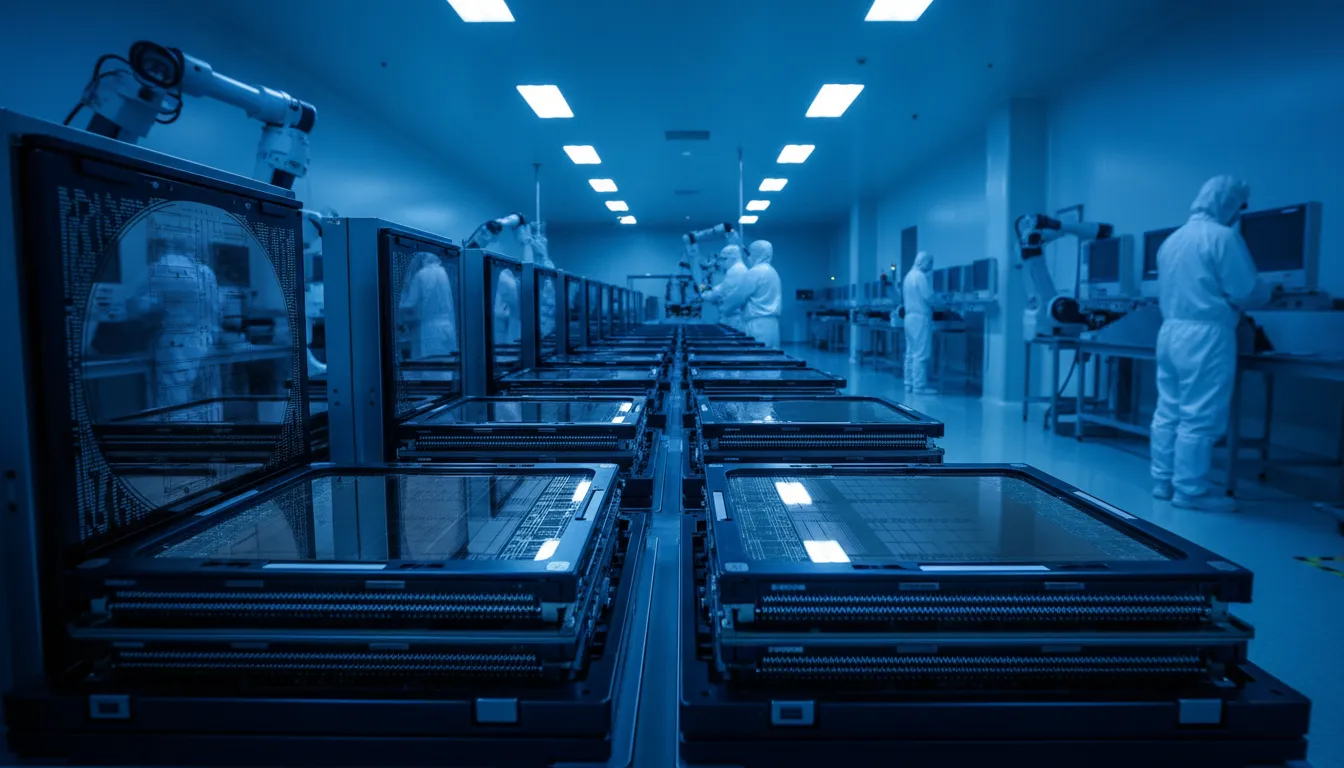
The Bottleneck That Could Slow the AI Revolution
The artificial intelligence boom has an Achilles' heel, and it is made of silicon. High-bandwidth memory (HBM) -- the vertically stacked DRAM chips that feed data to AI accelerators at blistering speeds -- has become the scarcest component in the global semiconductor supply chain. All three major manufacturers -- SK Hynix, Samsung, and Micron -- have sold out their entire HBM production through 2026, and new fabrication capacity will not come online before 2028.
The consequences extend far beyond data centers. As chipmakers redirect wafer capacity toward the high-margin AI memory market, a cascading shortage is hitting consumer electronics, pushing up prices for everything from laptops to budget smartphones.
Why HBM Devours Manufacturing Capacity
Modern AI accelerators can perform trillions of operations per second, but they are only useful if data reaches them fast enough. When NVIDIA CEO Jensen Huang unveiled the Vera Rubin platform at CES 2026, he emphasized that memory bandwidth -- not compute -- is now the primary bottleneck for large-scale AI systems.
The problem is physical: producing one gigabyte of HBM consumes roughly three times the wafer capacity of standard DDR5, according to Tom's Hardware. With AI-related demand projected to absorb 20% of total global DRAM wafer output in 2026 -- up from around 19% in 2025 -- manufacturers are diverting resources from conventional memory at an accelerating pace, TrendForce reports.
The 'AI Tax' on Consumer Electronics
The reallocation is already visible in consumer pricing. DRAM prices surged 172% throughout 2025, and TrendForce expects conventional DRAM contract prices to jump a further 90-95% quarter-over-quarter in early 2026. Samsung and SK Hynix have raised server memory prices by up to 70% this quarter alone, according to The Register.
The downstream effects are stark. IDC's latest forecast warns the PC market could shrink by up to 9% in 2026 as rising RAM costs squeeze both manufacturers and consumers, Tom's Hardware reported. Budget smartphones that recently graduated to 8GB of RAM may revert to 4GB, because the cost of those extra gigabytes now exceeds the manufacturer's entire profit margin on a $200 device. Lenovo, Dell, HP, Acer, and ASUS have all warned of 15-20% price increases across product lines.
A Structural Constraint, Not a Blip
Unlike previous chip shortages driven by demand surges or supply disruptions, this crisis is structural. SK Hynix commands 62% of the HBM market, Micron holds 21%, and Samsung trails at 17%, according to Astute Group. All three are investing heavily -- Micron's $9.6 billion Hiroshima HBM facility will begin construction around May 2026 -- but first output is not expected until 2028.
The next generation, HBM4, promises 2.0-2.8 TB/s per stack and capacities up to 64 GB with a 40% power efficiency boost. Yet mass production of 12-layer HBM4 is only beginning in early 2026, and the denser 16-layer variant remains in development for late 2026 at the earliest.
The Search for Alternatives
The severity of the bottleneck is accelerating research into complementary technologies. The CXL (Compute Express Link) Consortium released CXL 4.0 in November 2025, doubling bandwidth to 128 GT/s and enabling memory pooling across servers -- a potential way to use existing DRAM more efficiently. The CXL market is projected to reach $2.1 billion in 2026, up from just $1.7 million in 2022, Computer Weekly notes.
Samsung is also pursuing processing-in-memory (PIM) solutions that combine storage and computation on the same chip, potentially reducing the raw bandwidth needed for AI workloads. But analysts caution these technologies are years from meaningfully easing the HBM crunch.
For now, the AI industry finds itself in a paradox: the technology promising to transform every sector of the economy is constrained by one of the most basic components in computing -- memory. Until new fabs come online and alternative architectures mature, the AI tax will continue to ripple through the global electronics market.