Apple Closes Product Marathon With M5 MacBooks
Apple wrapped up a three-day product blitz on March 4 with the launch of the MacBook Air M5 and MacBook Pro M5 Pro/Max, cementing AI-first, on-device computing as its defining strategy for 2026.
Three Days, Five Products
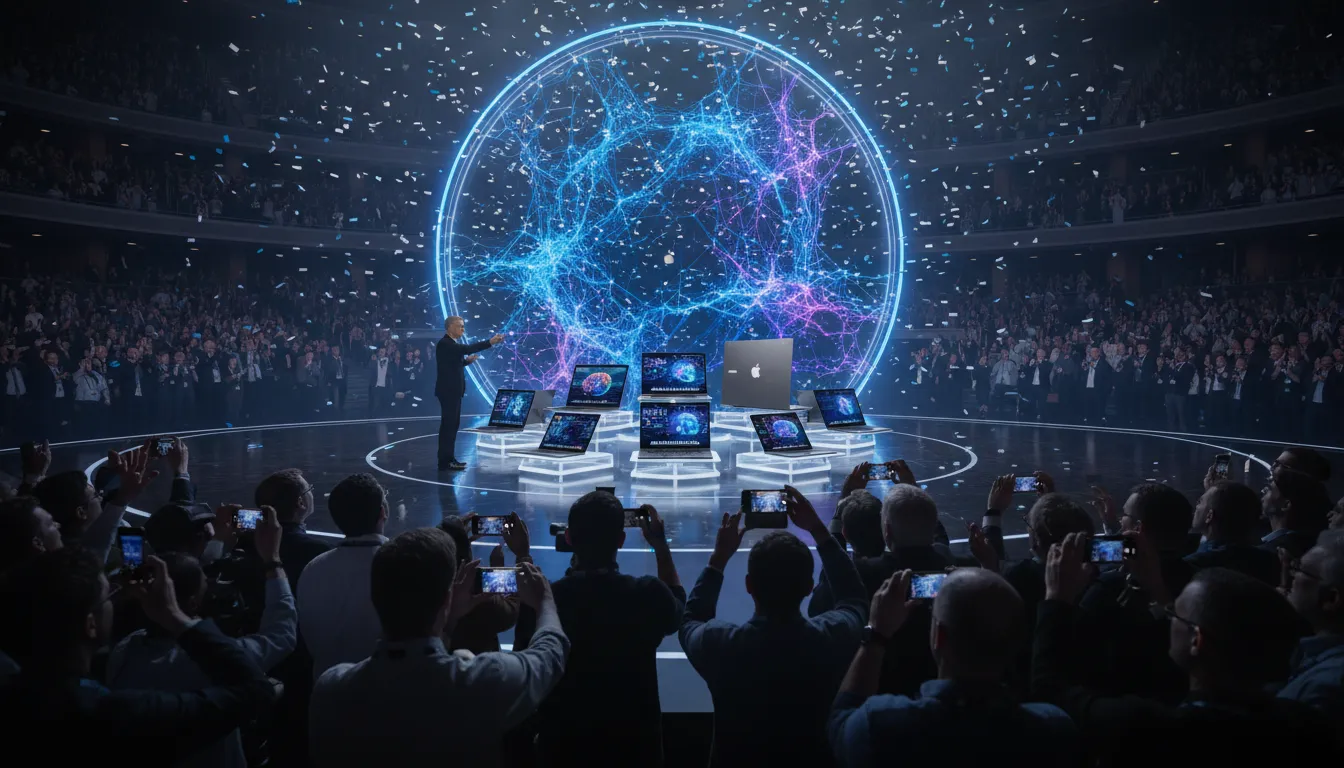
Apple wrapped up an extraordinary three-day product sprint on Wednesday, March 4, unveiling the MacBook Air with M5 and MacBook Pro with M5 Pro and M5 Max — the capstone of a blitz that also delivered the iPhone 17e, a refreshed iPad Air with M4, and new Apple Studio Displays. The compressed rollout, spanning just 72 hours, signals a deliberate shift: Apple is no longer waiting for annual keynotes to define its product year.
MacBook Air Gets a Serious AI Upgrade
The new MacBook Air — Apple's best-selling laptop line — arrives in 13- and 15-inch versions powered by the M5 chip, featuring a 10-core CPU and up to a 10-core GPU. The headline figure is AI performance: Apple claims the M5 delivers four times the AI throughput of the M4, thanks to a Neural Accelerator embedded in every GPU core. Base storage doubles to 512GB, and the new N1 wireless chip brings Wi-Fi 7 and Bluetooth 6 connectivity. Pricing starts at $1,099 — $100 more than the previous generation — with availability beginning March 11.
The laptop ships in four colors: sky blue, midnight, starlight, and silver. Storage is configurable up to 4TB, a ceiling that underscores Apple's expectation that even consumer users will increasingly store large AI models and datasets locally.
MacBook Pro: Fusion Architecture and the World's Fastest Core
The MacBook Pro refresh is the more technically ambitious announcement. Both the M5 Pro and M5 Max chips adopt what Apple calls Fusion Architecture — a design that connects two silicon dies via advanced interconnects into a single system-on-chip. The result is an 18-core CPU combining six "super cores" (Apple's fastest-ever CPU design) with 12 efficiency-optimized performance cores.
Apple claims up to 4x the AI performance of M4-generation predecessors, and up to 8x compared to M1-era machines. Storage starts at 1TB for M5 Pro configurations and 2TB for M5 Max, with SSD speeds roughly double those of the prior generation. Like the Air, the Pro gains Wi-Fi 7 and Bluetooth 6 through the N1 chip. Pricing begins at $2,199 for the 14-inch M5 Pro and reaches $3,899 for the 16-inch M5 Max. Pre-orders opened March 4, with shipping beginning March 11.
AI at the Core of Apple's 2026 Strategy
Taken together, this week's launches reveal a company fully committed to on-device AI. Every new device — from the budget iPhone 17e to the pro-tier MacBook — is built around Apple Intelligence features, including Visual Intelligence, which uses on-device machine learning to recognize objects, text, and scenes in real time. The Neural Accelerator is no longer a footnote; it is increasingly the product itself.
Analysts noted that the doubled base storage on MacBook Air, combined with enhanced neural compute, positions Apple's consumer laptops to handle AI workloads that previously required cloud round-trips — a move with meaningful privacy implications, as Apple continues to differentiate on local inference over server-side processing.
What Comes Next
Bloomberg has reported a touch-screen MacBook Pro is in development for late 2026, alongside a low-cost "MacBook Neo" that has already appeared in regulatory filings. If the March marathon is any indication, Apple intends to keep its hardware calendar dense and fast-moving throughout the year — a pace designed to keep competitors perpetually reacting.