Blood Moon on March 3, 2026: Last Total Lunar Eclipse Until 2028
In the early hours of March 3, 2026, the Moon will turn a deep red for 59 minutes during a total eclipse visible from the Americas, East Asia, and the Pacific. It will be the last event of its kind until New Year's Eve 2028.
A Spectacle Not to Be Repeated for Years
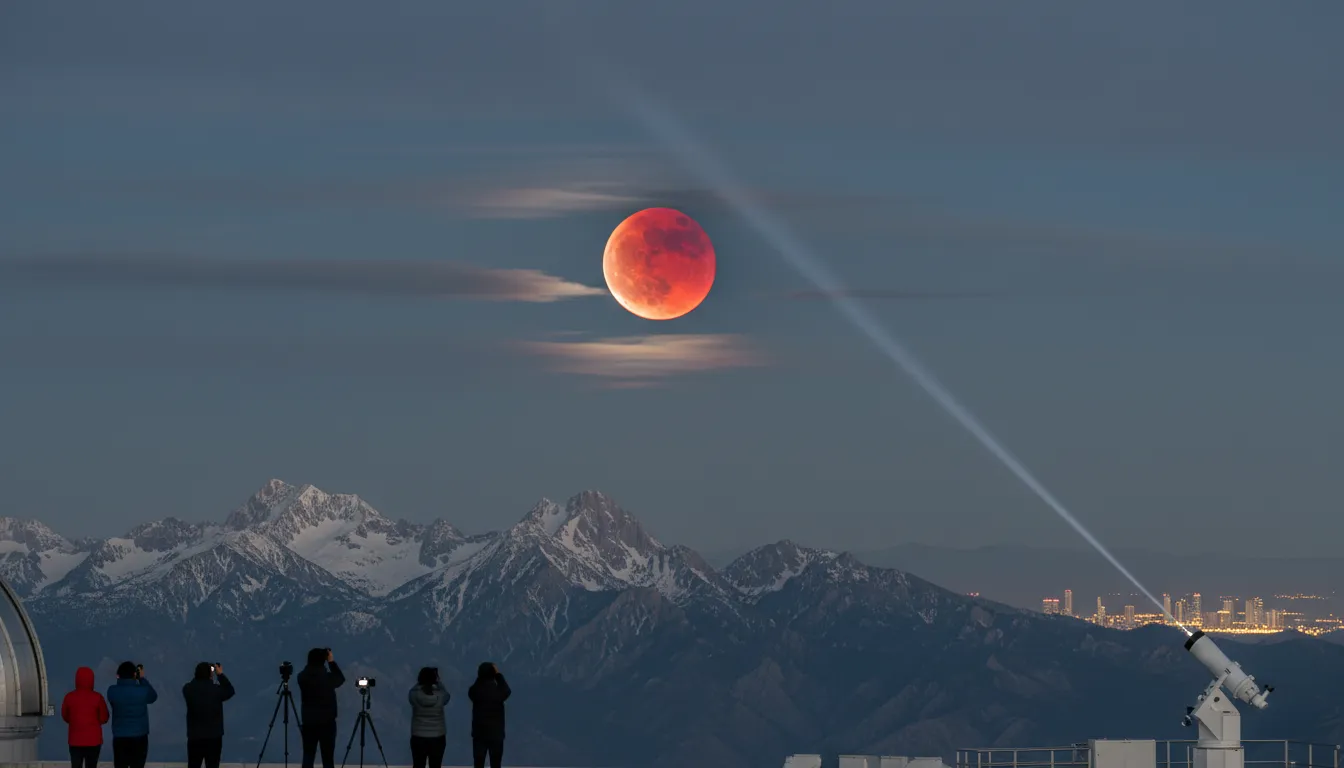
In the early hours of Tuesday, March 3, 2026, the Moon will be bathed in an intense reddish hue for almost an hour, transforming the night sky into an exceptional astronomical spectacle. The total lunar eclipse—popularly known as a "blood moon"—will be visible from much of the Americas, East Asia, Australia, and the Pacific, and will not be repeated until New Year's Eve 2028.
When and Where to See It
The totality phase—the moment when the Moon is completely immersed in the Earth's shadow—will extend from 11:04 UTC to 12:03 UTC, with its peak at 11:33 UTC. This phase lasts approximately 59 minutes, although the entire spectacle, including the penumbral and partial phases, lasts for about 5 hours and 39 minutes.
For North America, the phenomenon will occur in the early morning: on the west coast of the United States and Canada, totality will begin around 3:04 a.m. local time. In the eastern part of the continent, the Moon will set before the eclipse concludes, although a good portion of totality will still be visible in the sky.
In Latin America, visibility varies by region. Mexico, Central America, and western South America—Colombia, Ecuador, Peru, and northern Chile—will have privileged views during the early morning. In Argentina and the southern part of the continent, the eclipse will coincide with sunrise, with the Moon increasingly low on the western horizon. Europe and Africa will be completely outside the area of visibility: the Moon will remain below the horizon throughout the event.
Why the Moon Turns Red
The characteristic color of a "blood moon" is not a random optical effect, but the direct result of the physics of our atmosphere. During a total eclipse, the Earth passes between the Sun and the Moon, blocking direct sunlight. However, the atmosphere acts as a giant prism: it scatters blue and violet wavelengths, but allows red and infrared light to pass through, surrounding the planet and reaching the lunar surface.
The exact shade—which can range from a bright red to an almost dull dark brown—depends on the amount of dust or volcanic ash present in the atmosphere at that time. The more atmospheric turbidity, the darker and more dramatic the color will be.
No Telescopes or Glasses: Safe for Everyone
Unlike solar eclipses, lunar eclipses are completely harmless to the eyes. No filters or protective glasses are necessary: simply find a dark place, away from urban light pollution, and look up. Binoculars or a small telescope will enhance the color nuances, but are not essential.
Experts recommend starting the observation during the partial phase, approximately 90 minutes before the start of totality, to watch how the Earth's shadow progressively advances across the lunar disk. Patience is rewarded: the transition from silver light to copper red is one of the most impressive spectacles that astronomy offers to the naked eye.
A Unique Opportunity Until 2028
The next total lunar eclipse will not take place until New Year's Eve, December 31, 2028, when the blood moon will shine mainly over Asia, Australia, Europe, and Africa. The Americas will then have much more limited visibility at that event.
This makes the March 3, 2026 eclipse a unique opportunity for millions of people in the Americas for almost three years. Amateur and professional astronomers agree: provided the weather permits, it is worth setting the alarm and going out to see one of the most spectacular phenomena the solar system has to offer.