Czech Republic 8th in EU Prosperity Index: Post-Communist Leader, but Innovation Lags
The Czech Republic has secured eighth place in the new EU Prosperity Index, becoming the economic leader among post-communist countries. However, analysts warn that investments are directed towards machinery rather than research and intellectual property, which threatens to slow down innovation potential in the age of artificial intelligence.
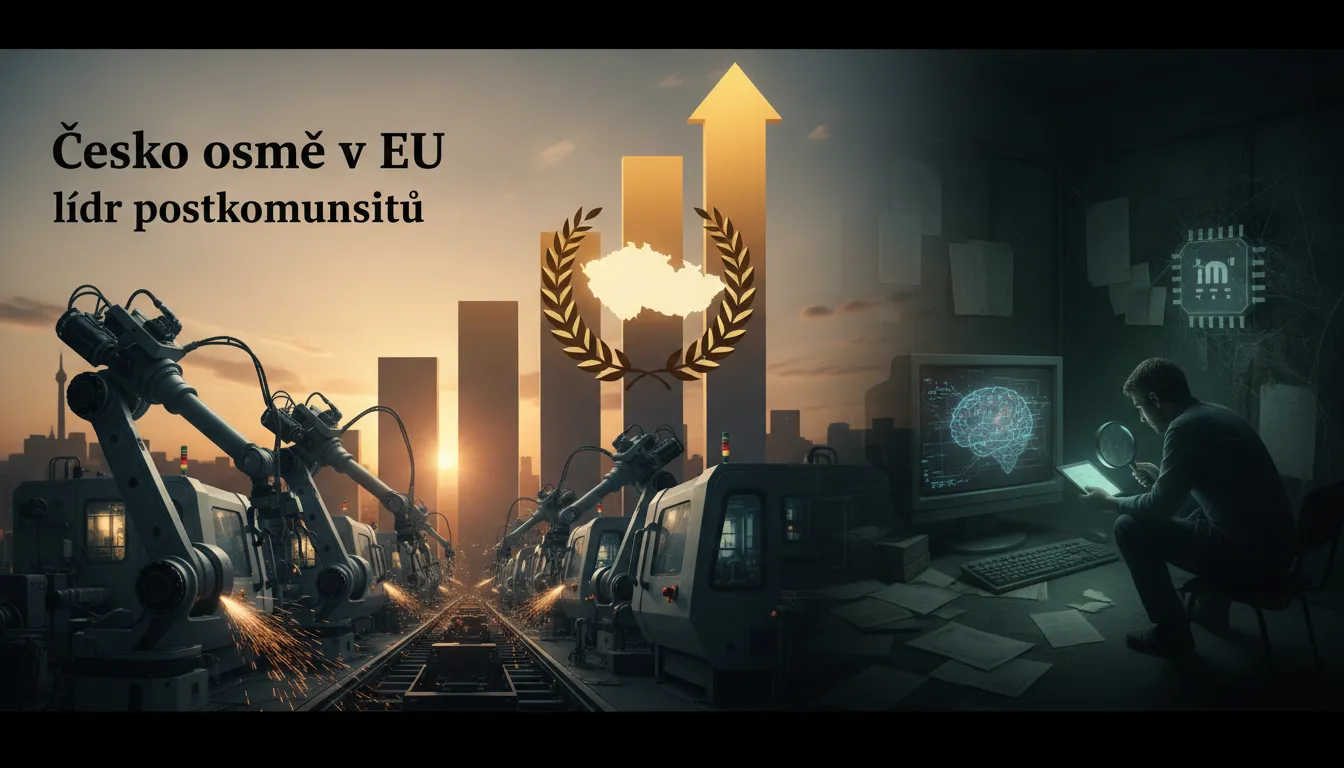
Eighth Place as a Historic Success
The Czech Republic has fought its way to eighth place in the fifth annual Prosperity and Financial Health Index, compiled by Česká spořitelna and the Europe in Data portal. This is the country's best result in this measurement to date and also confirms its position as the economic leader among post-communist EU countries — ahead of Slovenia, Poland, and Slovakia. Sweden, Germany, and Denmark remain at the top of the ranking.
The road to eighth place was not straightforward. After Russia's invasion of Ukraine and the subsequent wave of inflation, the Czech Republic fell to fourteenth place. Last year it returned to ninth, and this year it has strengthened by another position. "The Czech economy has demonstrated resilience that many analysts did not anticipate," the index authors state.
Growth Engine: Domestic Consumption and Real Wages
The Czech Republic's gross domestic product grew by approximately 2.5 percent in 2025, with domestic consumption remaining the main driver. Real wages rose by almost five percent, giving households purchasing power. The average savings rate exceeded eighteen percent — significantly higher than pre-pandemic values — so the potential for further consumption remains untapped.
The Czech Republic also excels in its high degree of robotization: 216 industrial robots per ten thousand employees in manufacturing, compared to just 81 in Poland. The investment share of GDP reaches 26.5 percent, among the highest in the EU, and public debt remains relatively low. These indicators have secured the Czech Republic a strong position in the State of the Economy pillar.
Weakness at the Heart of Success: Where Investments Go
Despite the impressive numbers, analysts point to a structural flaw. While the Czech Republic invests a lot, it invests in the wrong things. Approximately 36 percent of capital expenditures go to machinery and equipment — that is, to "faster conveyor belts." In contrast, more economically advanced countries such as Denmark or Sweden prioritize intangible assets: patents, software, and intellectual property.
Tereza Hrtúsová, an analyst at Česká spořitelna, warns openly: "Investments in the Czech Republic are not going in the right direction." Domestic value added in exports reaches only 58.2 percent, while Poland achieves 66.7 percent. The Czech economy thus remains largely in the role of a sophisticated subcontractor — foreign companies own the brands, patents, and profit margins.
The Challenge of Artificial Intelligence and Green Industry
The problem is becoming more urgent in the context of two global megatrends: the rise of artificial intelligence and the transformation of industry towards a green economy. Both waves reward those who own technologies and patents — not those who merely use them in production. According to experts, the Czech Republic, which so far benefits from cheap and skilled industrial labor, risks falling into the middle-income trap if it does not redirect capital to research and development.
The educational sphere also complicates the situation. As entrepreneur and analyst Martin Vohánka pointed out, the Czech Republic is in the lower ranks of the EU in terms of the proportion of university-educated workers, and the best Czech university ranks around three hundredth place in global rankings. Without domestic talent to create and own intellectual property, a structural shift is difficult to achieve.
Eighth Place as a Warning, Not Just a Celebration
The Prosperity Index confirms that the Czech economy is healthy and resilient. Eighth place in the EU is a result to be proud of. At the same time, however, it is a challenge: the current model — a high-quality assembly plant with high automation — has its limits. The transition to a knowledge-based economy with its own innovations is not just an academic wish, but a necessity for maintaining competitiveness in the coming decades.