Eurofighters Depart Malbork: NATO Mission Ends
Germany has concluded its NATO Enhanced Air Policing mission in Poland, withdrawing Eurofighter jets and approximately 150 personnel from the Malbork airbase. Poland is intensifying its own defense capabilities with a record-breaking military budget.
End of German Mission Over Poland
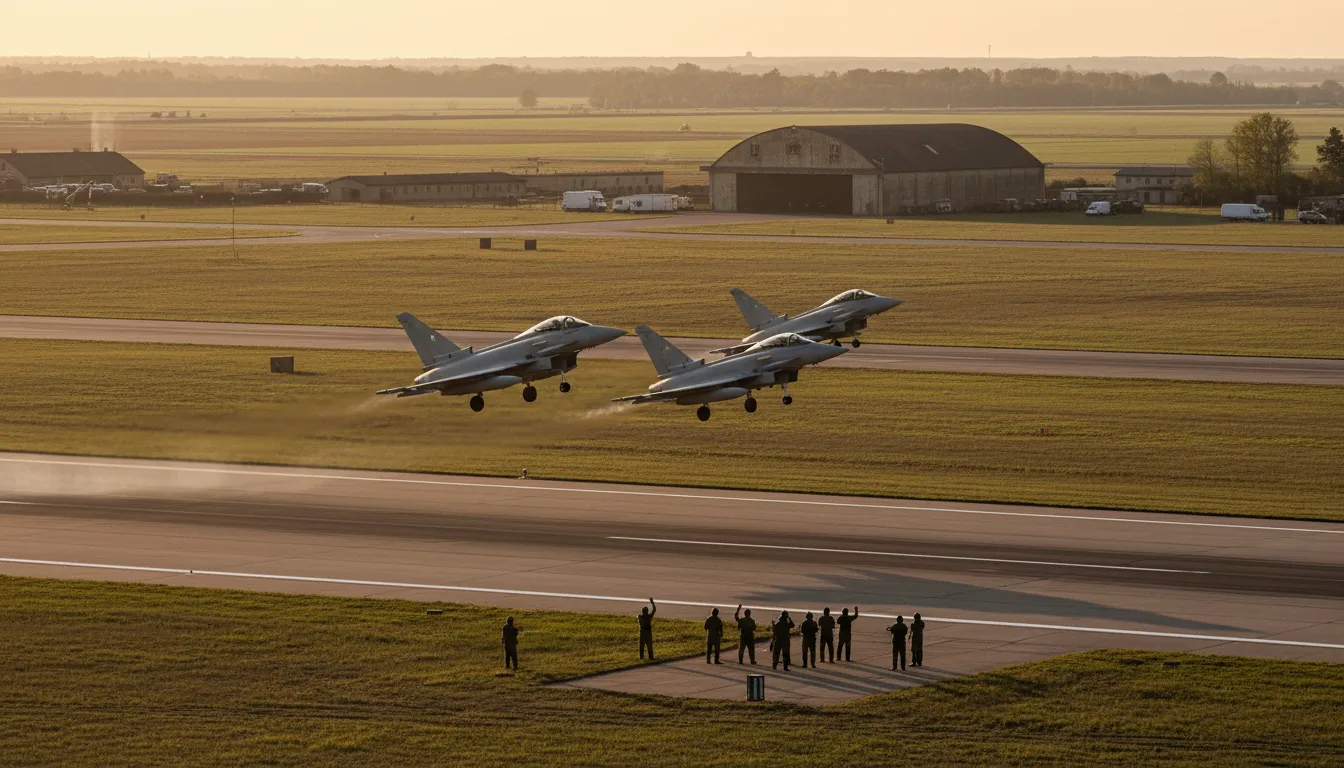
German Eurofighter EF-2000 fighter jets have concluded their mission in Poland and departed the 22nd Tactical Air Base in Malbork. Along with the aircraft, approximately 150 Bundeswehr soldiers – pilots, technicians, logistics specialists, security personnel, and military police – have returned to Germany.
The mission lasted from December 6, 2025, to March 24, 2026, and was conducted as part of the NATO Enhanced Air Policing program – strengthened protection of the airspace on the Alliance's eastern flank. German pilots were on Quick Reaction Alert duty, maintaining constant readiness to launch immediately upon detection of unidentified objects in Polish airspace.
Dual Role in Malbork
The German contingent carried out two parallel tasks in Poland. In addition to patrolling the airspace, Bundeswehr soldiers also participated in the NATO Security Assistance and Training for Ukraine (NSATU) program. Joint exercises were also conducted with the Polish Air Force, which – as emphasized – contributed to increased interoperability between the allies.
The General Command of the Armed Forces thanked the Bundeswehr for their cooperation, describing the German presence as "an extremely important gesture of cooperation within the framework of collective defense."
Who Will Replace the Germans?
The biggest question mark remains the issue of a successor. For now, it is not known which NATO country will take over the rotation in Malbork. The withdrawal comes at a critical moment – just a few days earlier, on March 18, a Russian Su-30 violated Estonian airspace and was intercepted by Italian fighter jets. Analysts point out that such incidents are a deliberate testing of NATO's reaction by Moscow, and their frequency in the Baltic Sea region is increasing.
In 2023, NATO recorded over 300 scramble launches in response to Russian air activity near the Alliance's borders. Any gap in the rotation of countries patrolling the eastern flank is therefore seen as a potential signal of weakness.
Poland Focuses on its Own Forces
The withdrawal of the German contingent fits into the broader context of Poland's defense strategy. Prime Minister Donald Tusk has declared 2026 as a time of "Polish acceleration" in the field of defense. Planned spending on the military reaches a record 200 billion zlotys, which is about 4.8% of GDP – one of the highest rates among NATO countries.
Tusk emphasized directly: "We will not defend the Polish border with a low deficit, but with a modern Polish army." The Polish Army currently numbers 218,000 soldiers, and the government is consistently striving to build one of the strongest armies in Europe.
Allied Solidarity on Trial
The mission of the German Eurofighters in Malbork was an example of allied solidarity within NATO – a rotational system in which member states alternately protect the airspace of allies who do not have sufficient capabilities of their own. Although Poland has its own F-16 fighter jets and is awaiting deliveries of F-35s, the presence of allied contingents strengthens deterrence and demonstrates unity.
The question of how quickly another rotation will appear in Malbork remains open – and in the current geopolitical situation, it sounds increasingly urgent.