German Federal Election: Union and AfD Neck and Neck
On the eve of the German federal election, the CDU/CSU and AfD are locked in a historically tight race in the polls — and the question of a coalition remains unresolved.
A Historic Neck-and-Neck Race
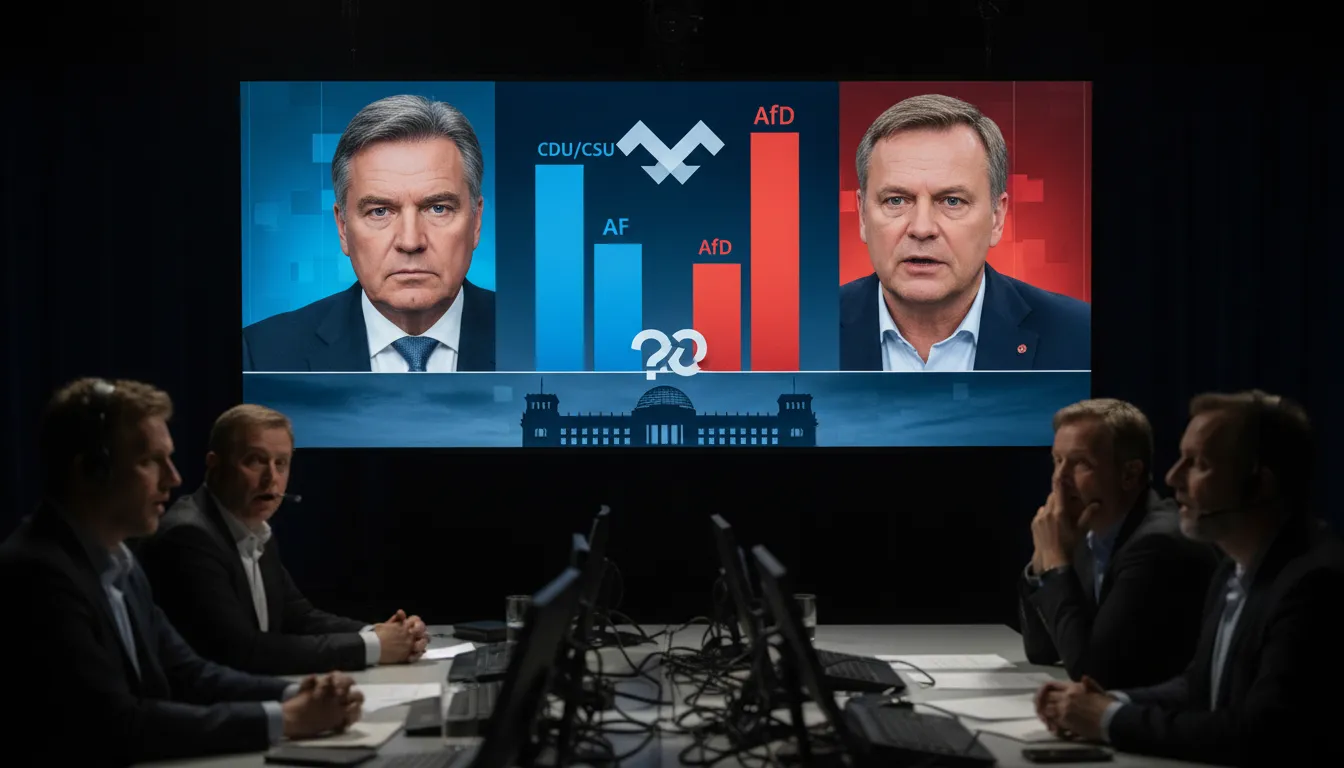
Rarely has a German federal election been as exciting and unpredictable as tomorrow, February 23rd. The latest polls from major institutes paint a picture Germany hasn't seen in decades: the CDU/CSU and AfD are separated by just one or two percentage points. Depending on the polling institute, the Union stands at 25 to 27 percent, the AfD at 24 to 27 percent — statistically speaking, a tie. The SPD follows in third place with 14 to 16 percent, the Greens come in at 11 to 13 percent. The FDP remains below the crucial five percent threshold, at 3 to 4 percent.
The Firewall — A Crack Before the Election
The dominant theme of the last weeks of the election campaign was the so-called firewall: CDU Chancellor candidate Friedrich Merz had a migration motion passed in the Bundestag with votes from the AfD — a taboo broken that caused outrage across the political landscape. Even former Chancellor Angela Merkel spoke out in rare public appearances, criticizing that Merz had "consciously enabled a majority with AfD votes for the first time." The incident fueled distrust among the SPD and Greens — potential coalition partners — and gave the AfD additional tailwind, which became visible in the polls.
"The firewall must stand" — this demand accompanied the entire election campaign, but its substance was seriously damaged by the events in the Bundestag.
The Coalition Question: A Mathematical Puzzle
Regardless of the outcome of the election, Friedrich Merz faces a difficult coalition poker game. All established parties — SPD, Greens, FDP, Left Party, and BSW — categorically rule out cooperation with the AfD. This means that even if the AfD were to become the strongest force tomorrow, it would remain unable to govern.
For Merz, there are two realistic scenarios from a purely mathematical perspective:
- Grand Coalition (CDU/CSU + SPD): With a combined total of around 40 percent, this alliance would be mathematically barely possible, but fragile. The SPD is fighting for its identity after the historic slump, and SPD representatives have publicly withdrawn their trust in Merz.
- Three-Way Alliance (CDU/CSU + SPD + Greens): A three-way coalition would have a comfortable majority, but is delicate in terms of content — CSU leader Markus Söder repeatedly ruled out a government with the Greens during the election campaign.
Small Parties as Kingmakers
The performance of the small parties could decisively shape the result. If the FDP does manage to jump over five percent, a bourgeois alliance of Union, SPD, and FDP opens up — without the Greens. If it fails again, the scope remains narrower. According to YouGov, around a third of voters have not yet made a final decision — which makes the forecasts even more uncertain.
Historical Dimension
What is certain tomorrow: The AfD will achieve its best federal election result of all time. According to polls, it could replace the SPD as the second strongest force — a seismic shift in the German party landscape. At the same time, around 74 to 76 percent of the population are sending a clear signal: they do not want a coalition with the AfD. Germany faces a long night of projections — and probably even longer weeks of coalition negotiations.