France Returns Djidji Ayôkwé Drum to Ivory Coast
On February 20, 2026, Paris officially returned the Djidji Ayôkwé talking drum to Ivory Coast, 110 years after its colonial confiscation — a historic gesture that is part of a broader movement to repatriate African heritage.
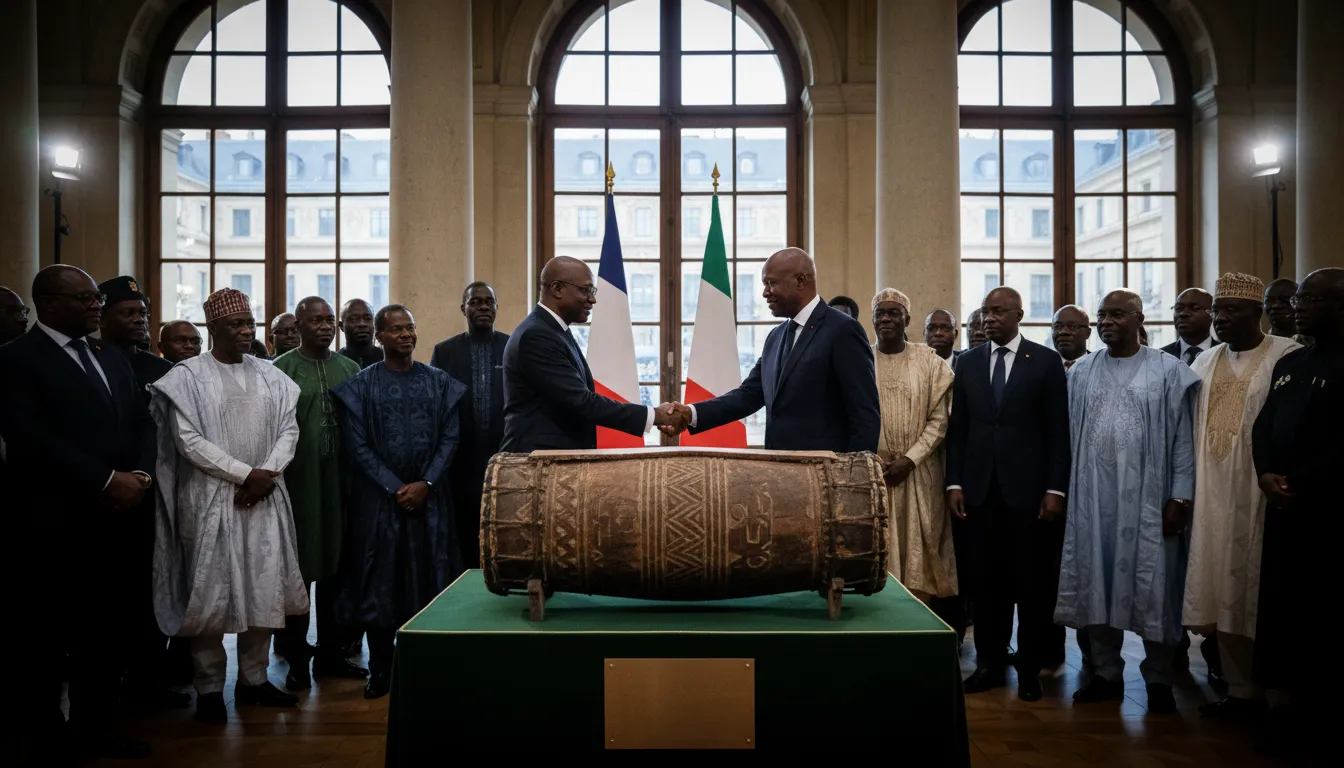
On February 20, 2026, at the heart of the Quai Branly – Jacques Chirac Museum in Paris, a 430-kilogram drum found its way back to its destiny. France officially returned the Djidji Ayôkwé, a talking drum of the Ébrié people, to Ivory Coast, 110 years after it was confiscated by the colonial administration. A historic gesture, as symbolic as it is political.
The Sacred Instrument of the Ébrié People
Over three meters long and weighing 430 kilograms, the Djidji Ayôkwé — literally "panther-lion" in the Ébrié language — was much more than a musical instrument. This talking drum transmitted coded messages between villages in the Abidjan region, announced ritual ceremonies, and alerted Atchan communities to danger — particularly during forced recruitment operations in the colonial era. Its rhythmic voice embodied the spiritual and political identity of an entire people.
One Hundred and Ten Years of Forced Exile
In 1916, the French colonial authorities seized the instrument. It left Ivory Coast for good in 1929, first exhibited at the Trocadéro Museum in Paris, then integrated into the collections of the Quai Branly – Jacques Chirac Museum. For decades, the principle of the inalienability of French public collections blocked any restitution: an item that had entered the national collections could not, in theory, leave them.
A Decisive Diplomatic Mobilization
On August 1, 2019, Ivorian President Alassane Ouattara made a formal request for restitution. Emmanuel Macron confirmed his support in October 2021. It was the adoption of Law No. 2025-644 on July 16, 2025, that made the return legally possible: this text created an exception to the principle of inalienability for cultural property "illicitly appropriated" between 1815 and 1972. The Senate took a further step in January 2026 by adopting a framework allowing for large-scale repatriations.
The Ceremony of February 20, 2026
It was in this context that the Ministers of Culture of the two countries — Rachida Dati for France and Françoise Remarck for Ivory Coast — signed the official transfer act at the Quai Branly.
"This return is not a settling of scores with history; it is the victory of dialogue over silence."Rachida Dati emphasized France's willingness to confront its colonial past "with lucidity and in a peaceful manner."
The drum must be physically transferred before July 17, 2026. It will be exhibited at the Museum of Civilizations in Abidjan, whose modernization is benefiting from French support of 4.3 million euros, including the digitization of collections and staff training in partnership with major French institutions. A national ceremony is planned in Abidjan before the summer of 2026.
First Step Towards 148 Restitutions
The Djidji Ayôkwé is the first of the 148 objects claimed by Abidjan from Paris. It is part of a broader movement initiated by the restitution, in 2021, of the royal treasures of Abomey to Benin. While some critics regret that the new law avoids any explicit reference to the word "colonization" or any form of reparation, this return marks a major symbolic break. By taking the lead over its European partners such as Belgium and the United Kingdom, France is sending a strong signal: intercultural dialogue and memorial justice are possible.