Giant Tortoises Return to Floreana After 150-Year Absence
On February 20, 2026, Galápagos National Park released 158 captive-bred giant tortoises onto Floreana Island — the first return of the species in over 150 years. The historic reintroduction opens the archipelago's most ambitious ecological restoration, aiming to bring back 12 locally extinct species by 2030.
A Long-Awaited Homecoming
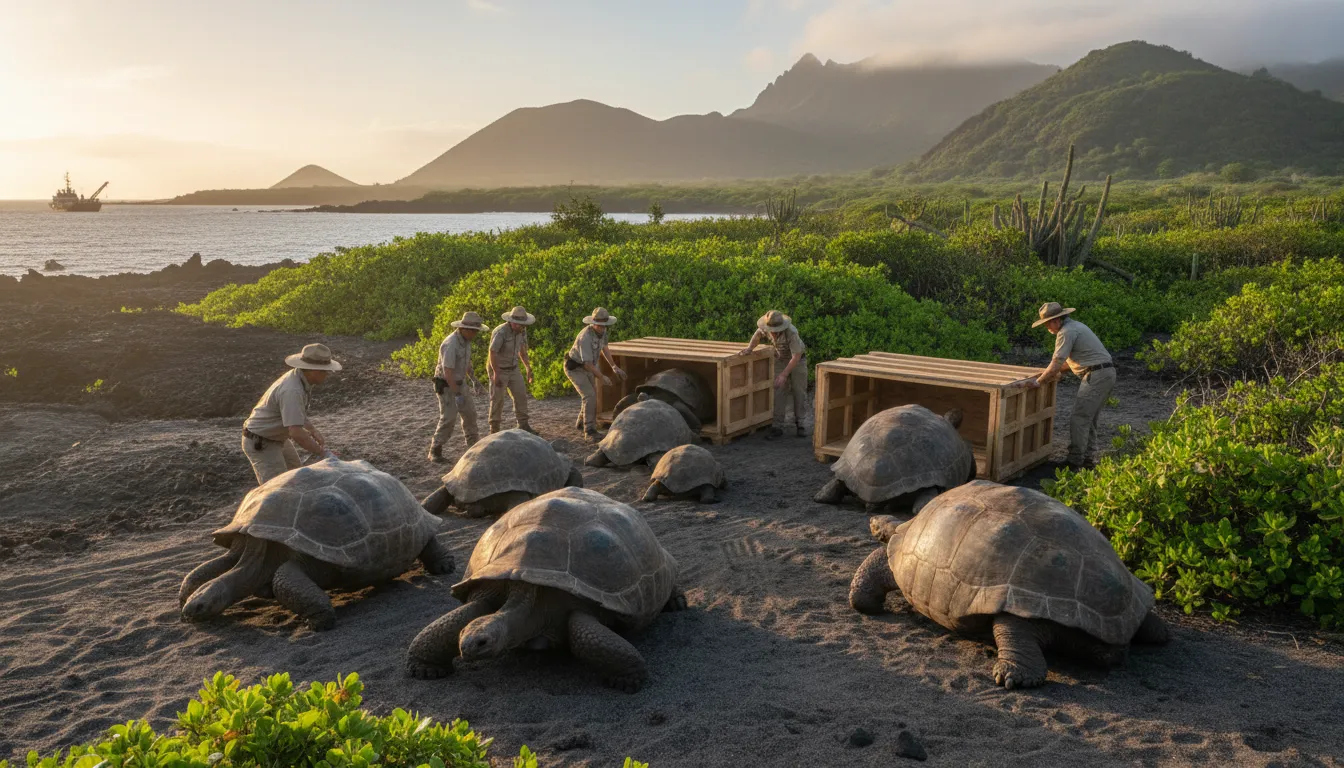
On February 20, 2026, a convoy of juvenile giant tortoises made landfall on Floreana Island in Ecuador's Galápagos archipelago — the first of their kind to set foot there in more than 150 years. The release of 158 captive-bred tortoises, aged between 8 and 13 years, marks a turning point in one of conservation's most ambitious rewilding projects and a moment scientists have spent decades working toward.
The Chelonoidis niger niger, Floreana's native giant tortoise, vanished from the island in the 1840s and 1850s. Whalers hunted them for food, and invasive species — particularly rats and feral cats — decimated their eggs and hatchlings. For well over a century, the island existed without its most iconic ecological engineer.
Genetic Detectives and the Wolf Volcano Discovery
The road back began with a remarkable genetic detective story. In the early 2000s, researchers analyzing tortoise populations on Wolf Volcano — a remote corner of Isabela Island — discovered something extraordinary: some tortoises there carried significant Floreana ancestry. Scientists believe that 19th-century sailors, offloading tortoises to clear cargo space, had inadvertently deposited Floreana animals on Isabela. Those castaways bred with local populations and, crucially, passed on their genes.
Through selective breeding at the Galápagos National Park's captive breeding center on Santa Cruz Island, conservationists produced offspring carrying between 40% and 80% of the original Chelonoidis niger genetic makeup — verified through DNA analysis of fossilized bones. "Reintroducing a species with a significant genetic component of the original species is vital," said biologist Washington Tapia of the Galápagos Conservancy. More than 600 animals have been raised in captivity so far, with a total of 700 planned for eventual release on Floreana.
Clearing the Path: Eradicating Invasive Species
Before the tortoises could return safely, the island had to be transformed. A major eradication campaign in 2023 targeted rats and feral cats — the same invasive predators that had originally driven native species into collapse. The results were swift and dramatic. Native bird populations rebounded; the Galápagos rail, believed locally extinct for 190 years, was rediscovered. Lizards, geckos, native snails, doves, and petrels all showed measurable recovery. Local farmers reported improved harvests as the ecological balance shifted in their favor.
The February 20 release ceremony brought together Ecuador's Ministry of Environment, the Galápagos National Park Directorate, and an array of international conservation NGOs — Island Conservation, the Charles Darwin Foundation, Fundación Jocotoco, the Galápagos Conservancy, and the Galápagos Conservation Trust, which has been engaged in the project for over 20 years. For Floreana resident Verónica Mora, the moment carried deep personal meaning. "It's a dream come true," she said.
Ecosystem Engineers at Work
Giant tortoises are far more than symbols — they are keystone species that actively reshape landscapes. By grazing dense vegetation, digging muddy wallows, and dispersing seeds, they create habitat conditions that benefit dozens of other species. Their return to Floreana is expected to accelerate native plant recovery and improve nesting conditions for seabirds, reinforcing the ecological links between land and sea through nutrient cycling. Breeding center director Fredy Villalba noted that the selected animals, aged 8 to 13, are large enough to defend themselves against any remaining predators.
A Blueprint for Global Conservation
The tortoise reintroduction is only the opening act. Eleven additional endemic species are slated to follow, including the Floreana Mockingbird — absent from the main island since the 1880s — along with the racer snake, Vegetarian Finch, and Little Vermilion Flycatcher. The full multi-species program is scheduled to run through at least 2030 and is considered the largest ecological restoration effort ever undertaken in the Galápagos archipelago.
Scientists and officials describe the project as a potential global model: proof that even profoundly damaged island ecosystems can be rebuilt when genetic science, community cooperation, invasive species removal, and sustained international funding converge. The tortoises now walking Floreana's highlands are not merely a conservation milestone — they are the beginning of an island reborn.