How Consumer Humanoid Robots Work—and Why Now
From Tesla's Optimus to China's Unitree G1, humanoid robots are moving from factories to living rooms. Here is how they walk, balance, sense the world, and why the technology is finally ready for homes.
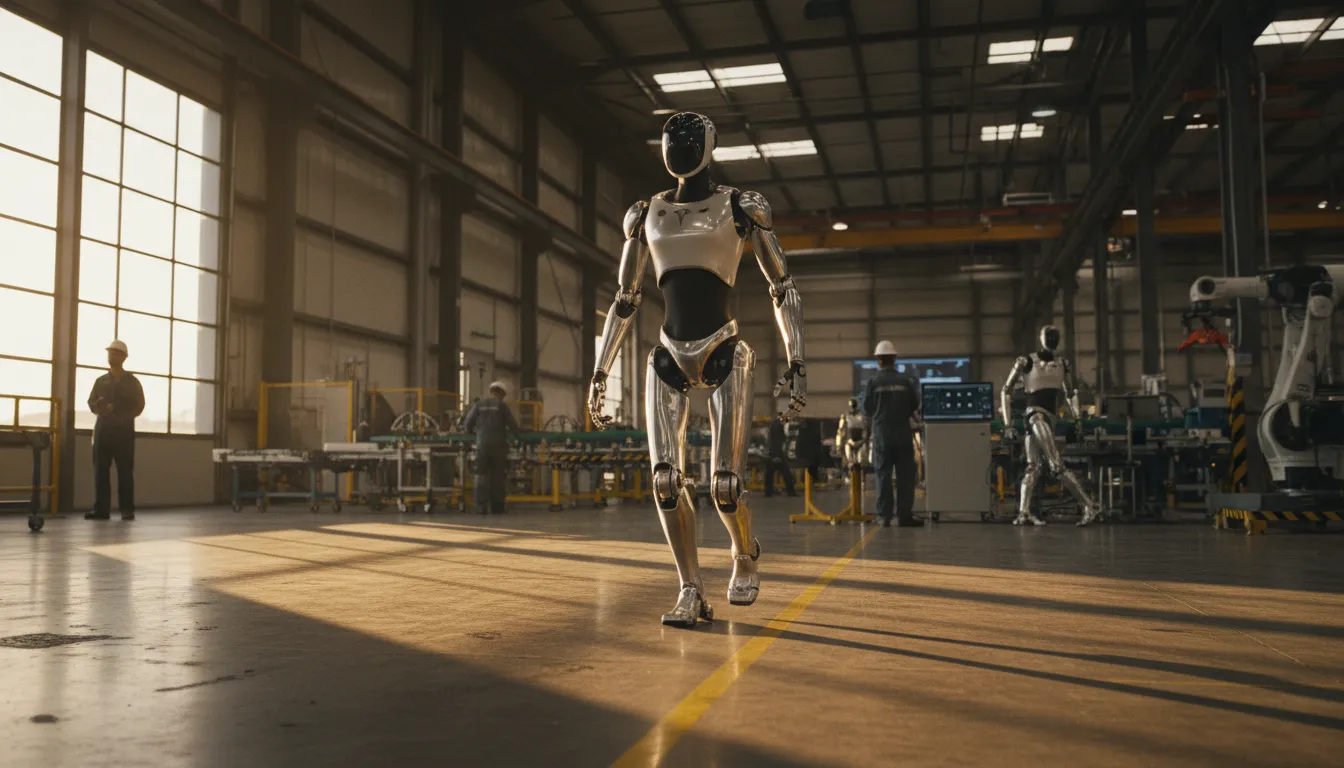
The Machine That Walks Like You
For decades, humanoid robots belonged to science fiction and research labs. That era is ending. Companies from Tesla to China's Unitree are now shipping bipedal, human-shaped machines designed not for factory floors alone but for ordinary households. Amazon's March 2026 acquisition of Fauna Robotics—maker of the three-and-a-half-foot-tall Sprout robot—signals that Big Tech sees a mass market forming. But how does a machine stand on two legs, navigate a cluttered kitchen, and respond to spoken commands? The answer involves a surprisingly complex stack of hardware and software working in concert.
Standing Up: The Hardest Easy Thing
Walking on two legs is something toddlers master in months, yet it remains one of the toughest unsolved problems in engineering. A bipedal robot is essentially an inverted pendulum—inherently unstable and constantly on the verge of tipping over. To stay upright, the machine must keep its center of mass within a tiny support polygon defined by its feet.
Engineers solve this with a concept called the Zero Moment Point (ZMP). Sensors measure where ground-reaction forces act on each foot, and a real-time control loop adjusts joint torques dozens of times per second to keep the ZMP inside the safe zone. Modern designs go further: instead of merely reacting to wobbles, they use predictive whole-body motion control, anticipating the next step much the way a human shifts weight before walking.
Muscles, Nerves, and Eyes
A typical humanoid has more than 20 degrees of freedom—independent axes of rotation at hips, knees, ankles, shoulders, elbows, and wrists. Each joint is driven by an electric actuator paired with a precision gear system, such as a harmonic drive, that converts high-speed motor spin into the slow, powerful torque needed to lift a limb or absorb a landing.
Balance control relies on a layered sensing stack. Inertial measurement units (IMUs) report angular rate and acceleration. Joint encoders track position. Force-torque sensors in the feet detect ground contact. Cameras—often stereo or depth-sensing—provide vision, while microphones capture speech. All this data feeds into an onboard computer that must coordinate locomotion, obstacle avoidance, and task planning with latencies measured in milliseconds.
Why the Market Is Moving Now
Three converging trends explain the sudden commercial momentum:
- Cheaper actuators. Advances in brushless motors and compact gear trains have driven component costs down sharply, enabling price points like Unitree's G1 at roughly $13,500.
- AI-powered control. Reinforcement learning now lets robots teach themselves to walk across uneven terrain in simulation, then transfer those skills to physical hardware—a technique called sim-to-real transfer.
- Large language models. Integrating LLMs gives robots the ability to interpret natural-language commands and plan multi-step tasks, bridging the gap between a capable body and a useful assistant.
The result is a new generation of machines that are smaller, safer, and smarter than their laboratory ancestors. Tesla aims to price its Optimus robot between $20,000 and $30,000. Figure AI's Figure 03, named one of TIME's Best Inventions of 2025, targets general-purpose home use. Nearly 90 percent of humanoid robots sold globally in 2025 came from Chinese manufacturers, led by Unitree with 5,500 units shipped.
What Still Holds Them Back
Despite rapid progress, significant hurdles remain. Battery life is arguably the biggest bottleneck: most humanoids run for only 90 minutes to two hours per charge, far short of the eight-plus hours a household assistant would need. Joint elasticity, vibration damping, and ankle precision still limit smooth movement on stairs and soft carpets. And safety certification for a 50-pound walking machine sharing space with children and pets is uncharted regulatory territory.
The global humanoid robot market is projected to reach $6 billion in 2026 and could surpass $38 billion by 2035, according to industry analysts. Whether that growth materializes depends less on whether the robots can walk and more on whether they can do so reliably, safely, and affordably enough to earn a place beside the dishwasher and the vacuum cleaner.