How Galápagos Tortoise Conservation Works
Giant tortoises once numbered 250,000 across the Galápagos—centuries of exploitation nearly wiped them out. Here is how scientists are bringing them back using genetics, captive breeding, and ecosystem restoration.
The World's Most Ambitious Tortoise Rescue
Few conservation stories rival the scale and ingenuity of what is happening in the Galápagos Islands. Giant tortoises—some living more than 150 years and weighing over 200 kilograms—once roamed the archipelago in numbers estimated at 250,000. By the 1970s, fewer than 15,000 remained. Three species had been driven to extinction. The story of how scientists are reversing this decline is a masterclass in modern conservation biology, combining genetics, captive breeding, habitat restoration, and ecological engineering.
How Tortoises Were Nearly Wiped Out
The decline began almost as soon as European sailors discovered the Galápagos in the sixteenth century. Tortoises were the perfect provisions: they could survive in ship holds for months without food or water, supplying fresh meat on long ocean voyages. Historians estimate that whalers and pirates took more than 100,000 tortoises between 1774 and 1860. The Floreana tortoise was the first casualty, disappearing in the 1850s.
Invasive species compounded the slaughter. Rats, pigs, goats, and cats introduced by settlers ravaged tortoise nests and hatchlings. In the wild, fewer than 10 percent of tortoise eggs hatch under natural conditions—invasive predators can cut that fraction to near zero.
The Science of Captive Breeding
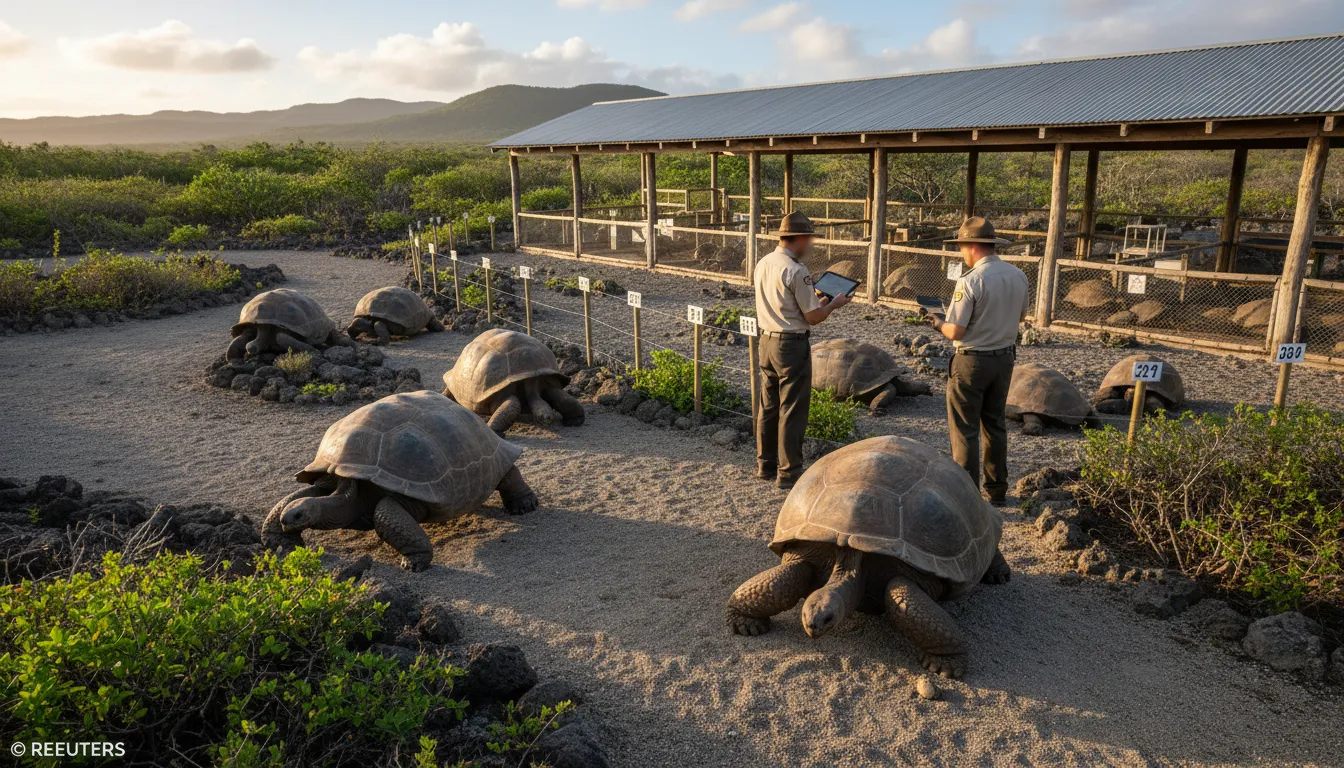
The cornerstone of Galápagos tortoise recovery is captive rearing, a program in place since 1965. Eggs or hatchlings are collected from wild nests and raised in protected breeding centers until the tortoises reach about five years of age and 1.5 kilograms—large enough to evade most predators—before being released into the wild. This approach bypasses the years of highest juvenile mortality.
Modern breeding centers use precision incubation technology with microprocessor-controlled temperature regulation, achieving hatching success rates of around 90 percent, compared with less than 10 percent in the wild. Scientists have also learned that incubation temperature determines hatchling sex in tortoises. By fine-tuning temperatures, conservationists can skew production toward females, accelerating population recovery.
The results speak for themselves. On Española Island, a population reduced to just 15 survivors—three males and twelve females—has grown to more than 3,000 naturally reproducing tortoises through five decades of captive breeding and reintroduction, according to the Galápagos Conservancy.
Resurrect the Extinct: The Power of Genetics
Perhaps the most remarkable chapter involves the Floreana tortoise—extinct since the 1850s. In 2008, researchers on Wolf Volcano on Isabela Island discovered living tortoises carrying Floreana DNA. Over generations, Floreana tortoises had interbred with other species before their island population collapsed, and their genetic legacy survived diluted in hybrid descendants.
Scientists from the Yale Center for Genetic Analyses of Biodiversity screened more than 1,600 individuals to identify those carrying the most Floreana ancestry. Selective breeding between these hybrids began in 2017, with the explicit goal of concentrating Floreana genes across successive generations. By 2025, more than 600 hatchlings with predominantly Floreana ancestry had been produced—enough to begin restoring the population. Over 158 individuals were then released onto Floreana Island, ending nearly two centuries of absence, as reported by the Charles Darwin Foundation.
This back-breeding technique—rebuilding a functionally extinct species from hybrid survivors—has opened a new frontier in conservation science.
Tortoises as Ecosystem Engineers
Restoring tortoises is not merely sentimental. Giant tortoises are what ecologists call ecosystem engineers—species whose behavior physically transforms the environment in ways that benefit entire communities of plants and animals.
Tortoises disperse seeds across vast distances in their gut, maintain open habitats by trampling dense vegetation, and create wallows that sustain freshwater wetlands. Research published in peer-reviewed journals has shown that the loss of giant tortoises in the Galápagos highlands caused freshwater wetlands to convert to Sphagnum bogs, driving the decline of multiple plant species. Restoring tortoises reverses these cascades.
On Floreana, early signs are already promising: native birds, reptiles, and invertebrates have started rebounding following concurrent programs to eradicate invasive rats and cats, according to the Galapagos Conservation Trust.
What This Means for Conservation Worldwide
The Galápagos programs have proven several principles that now guide conservation globally. Captive breeding buys time for wild populations to stabilize. Genetic screening enables targeted breeding that maximizes diversity and recovers lost lineages. Habitat restoration—removing invasive species before reintroducing native ones—is essential for long-term success.
Perhaps most importantly, the Floreana project demonstrates that extinction is not always final. As long as the genetic information survives somewhere—even in hybrids—the species can potentially be rebuilt. It is a rare cause for optimism in a century defined by biodiversity loss.