How Plasma Works—the Fourth State of Matter
Plasma makes up more than 99% of the visible universe, yet most people have never heard of it. Here's how this superheated, electrically charged state of matter works—and why it powers everything from stars to smartphone chips.

Beyond Solid, Liquid, and Gas
Most people learn about three states of matter in school: solid, liquid, and gas. But there is a fourth state that dwarfs them all. Plasma—a superheated, electrically charged gas—makes up an estimated 99.9% of all visible matter in the universe. Every star, including our Sun, is a churning ball of it. Lightning bolts, the aurora borealis, and the glow inside a neon sign are all plasma. Yet on Earth's surface, natural plasma is surprisingly rare.
What Makes Plasma Different
At its core, plasma is a gas that has been energized to the point where electrons break free from their atoms. The result is a soup of positively charged ions and free-roaming electrons. Unlike an ordinary gas, this mixture conducts electricity and responds powerfully to electric and magnetic fields.
The transition from gas to plasma happens when enough energy—whether from extreme heat, an electrical discharge, or intense light—strips electrons away from neutral atoms, a process called ionization. The temperature required varies, but the surface of the Sun, at roughly 5,500°C, is hot enough to keep hydrogen in a plasma state permanently.
A key property of plasma is quasineutrality: the overall mix contains roughly equal numbers of positive and negative charges, so it appears electrically neutral on large scales. But on smaller scales, those free charges create complex collective behaviors—waves, instabilities, and self-organized structures—that make plasma far more dynamic than any ordinary gas.
Where Plasma Exists
In space, plasma is the default state of matter. It fills the space between stars as the interstellar medium, forms the tails of comets, and makes up the magnetospheres surrounding planets. Saturn's rings contain dusty plasma—tiny charged particles suspended in ionized gas—that scientists study to understand how matter behaves under extreme conditions.
On Earth, plasma appears naturally in lightning strikes and in the upper atmosphere, where solar radiation ionizes thin air to create the ionosphere. Artificially, humans generate plasma inside fluorescent bulbs, plasma televisions, welding arcs, and—most ambitiously—inside experimental fusion reactors.
Plasma in Technology and Industry
Plasma science quietly underpins several trillion-dollar industries. In semiconductor manufacturing, plasma etching carves the nanoscale circuits on every microchip. Without it, modern smartphones, computers, and data centers would not exist. According to the U.S. Department of Energy, plasma-based processes are essential to producing advanced integrated circuits.
In medicine, low-temperature atmospheric plasma jets are being tested for wound sterilization, cancer treatment, and tissue regeneration. These "cold plasmas" can kill bacteria on contact while leaving healthy tissue unharmed.
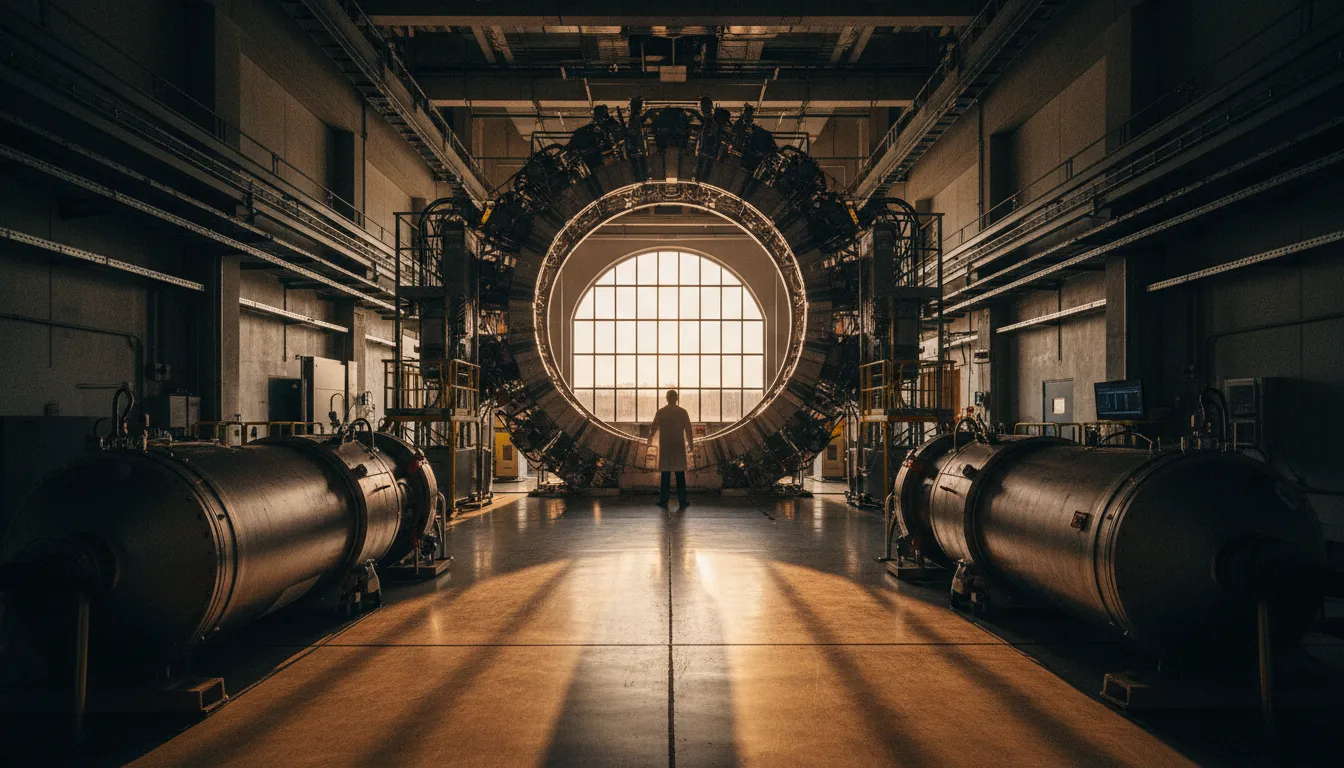
The biggest prize, however, is nuclear fusion. Inside reactors like ITER, hydrogen plasma is heated to over 150 million degrees Celsius—ten times hotter than the Sun's core—so that atomic nuclei fuse together and release enormous energy. If engineers can sustain and contain this plasma long enough, fusion could provide virtually limitless clean energy.
Dusty Plasma and New Frontiers
A growing subfield called dusty or complex plasma studies what happens when micrometer-sized particles become trapped inside a plasma. These particles pick up electric charges and interact in ways that mimic the behavior of atoms in crystals and liquids, giving physicists a visible, slow-motion model of condensed matter. Research published in PNAS by Emory University scientists used neural networks to track 3D particle motion in dusty plasma, revealing hidden force laws that classical theories had missed.
Dusty plasma research also has practical stakes. In fusion reactors, stray dust particles can contaminate the plasma and damage reactor walls. Understanding how dust behaves inside plasma is critical to making fusion viable.
Why Plasma Matters
From lighting a room to powering a star, plasma operates at scales both intimate and cosmic. It etches the chips in every phone, sterilizes surgical instruments, and may one day fuel civilization through fusion. As researchers develop better tools—including AI-driven models—to decode plasma's complex physics, this ancient state of matter keeps revealing new secrets.