How Uranium Enrichment Works—From Ore to Bomb
Uranium enrichment is the process of increasing the concentration of uranium-235 in natural uranium, enabling both nuclear power and nuclear weapons. Understanding how centrifuges separate isotopes reveals why enrichment sits at the heart of every nonproliferation debate.

Why Natural Uranium Isn't Enough
Uranium is surprisingly common—about as abundant as tin in the Earth's crust. Yet the element straight out of the ground is nearly useless for generating nuclear energy or building weapons. The reason lies in its isotopes. Natural uranium is 99.3% uranium-238, a stable isotope that resists the chain reactions needed to release energy. Only 0.7% is uranium-235, the fissile isotope capable of sustaining those reactions. Enrichment is the industrial process of boosting that tiny fraction to useful levels.
Turning Rock Into Gas
Before enrichment can begin, mined uranium ore is milled into a concentrate called yellowcake, then chemically converted into uranium hexafluoride (UF₆)—a compound that becomes a gas when gently heated. The gaseous form is essential because the two main enrichment technologies rely on the slight mass difference between UF₆ molecules carrying U-235 and those carrying U-238.
The Gas Centrifuge—Today's Workhorse
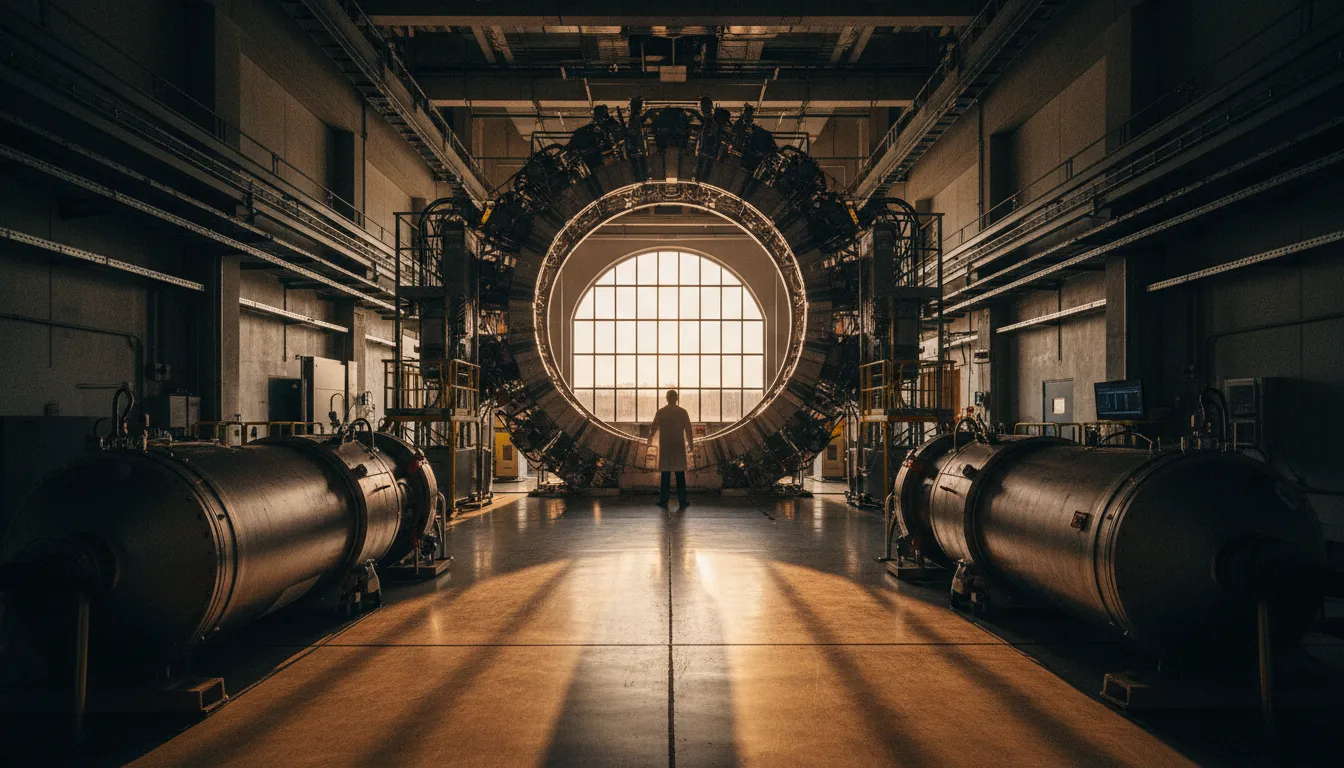
Nearly all modern enrichment uses gas centrifuges. A cylindrical rotor spins UF₆ gas at speeds approaching 100,000 revolutions per minute. The centrifugal force pushes heavier U-238 molecules toward the cylinder wall, while slightly lighter U-235 molecules concentrate closer to the center. A scoop draws off the enriched stream from the middle and the depleted stream from the edge.
A single centrifuge produces only a tiny increase in U-235 concentration. To reach useful levels, thousands of machines are linked end-to-end in cascades—the enriched output of one centrifuge feeds into the next. According to the U.S. Department of Energy, large commercial plants operate tens of thousands of centrifuges simultaneously.
Gas centrifuges replaced the older gaseous diffusion method, which pumped UF₆ through porous membranes. Diffusion plants consumed roughly 2,500 kilowatt-hours per separative work unit (SWU), while centrifuges need only about 50 kWh—a 98% reduction in energy, according to the World Nuclear Association. That efficiency gain also made centrifuge technology far easier to conceal, a persistent concern for nonproliferation experts.
The Enrichment Ladder
Different applications demand different U-235 concentrations, and the international community watches the numbers closely:
- 3–5% (low-enriched uranium, LEU) — standard fuel for the light-water reactors that generate roughly 90% of the world's nuclear electricity.
- Up to 20% (high-assay LEU) — used in research reactors and some advanced reactor designs. The 20% mark is a key legal and technical threshold.
- Above 20% (highly enriched uranium, HEU) — classified as weapons-usable. Naval reactors and some research reactors operate in this range.
- 90%+ (weapons-grade) — the concentration states typically seek for nuclear warheads, minimizing the size and weight of a weapon.
Critically, as the Center for Arms Control and Non-Proliferation notes, enriching uranium to 20% represents roughly 90% of the total effort needed to reach weapons grade. Once that threshold is crossed, the remaining steps are comparatively fast—which is why international inspectors treat 20% enrichment as a red line.
How the World Watches
The International Atomic Energy Agency (IAEA) is charged with verifying that enrichment facilities serve only peaceful purposes. Inspectors use cameras, seals, and environmental sampling to monitor centrifuge cascades. Since 2016, the IAEA has deployed online enrichment monitors that continuously measure the U-235 concentration of UF₆ flowing through plant piping—first installed at Iran's Natanz facility and gradually expanding to other sites.
Despite these tools, verification remains imperfect. Centrifuge plants are compact enough to hide in ordinary industrial buildings, and a country with the know-how can reconfigure cascades relatively quickly to produce higher-enriched material.
Why It Matters
Uranium enrichment is a dual-use technology at its core: the same centrifuge that makes reactor fuel can, with enough cascades and time, produce bomb material. That duality places enrichment at the center of every major nonproliferation negotiation—from the 2015 Iran nuclear deal to ongoing debates over fuel supply guarantees for emerging nuclear-energy states. Understanding the physics and the thresholds helps explain why a few percentage points of U-235 can shift the geopolitical balance.