How Quantum Computers Work: Qubits Explained
Quantum computers harness the strange rules of quantum physics to solve problems that would take classical machines millions of years. Here is how they actually work — and why the technology is approaching a pivotal turning point.
Beyond the Binary
Every smartphone, laptop, and server farm on the planet runs on the same fundamental principle: information stored as bits — tiny switches that are either off (0) or on (1). This binary logic has powered the computing revolution for seven decades. Quantum computers throw that rulebook out entirely.
Instead of bits, quantum computers use qubits (quantum bits). Thanks to the laws of quantum mechanics, a qubit does not have to be a 0 or a 1 — it can be both at the same time. That single difference, strange as it sounds, unlocks a form of parallel computation that classical machines simply cannot replicate.
Three Key Principles
Superposition
A qubit placed in superposition holds every possible value simultaneously until it is measured. Two qubits in superposition represent four states at once; three qubits represent eight; fifty qubits represent over a quadrillion states. A quantum computer with just 300 qubits can, in theory, represent more simultaneous states than there are atoms in the observable universe, according to IBM's quantum computing research group.
Entanglement
When qubits are entangled, they become correlated regardless of physical distance. Measuring one qubit instantly reveals information about its entangled partner. Quantum processors exploit this link to coordinate calculations across many qubits simultaneously, producing an exponential growth in computing power as more qubits are added — something that has no equivalent in classical hardware.
Interference
Like waves of light, quantum states can interfere with each other. Quantum algorithms are cleverly designed so that wrong answers cancel themselves out (destructive interference) while correct answers reinforce one another (constructive interference). When the system is finally measured, only the useful solution survives. This is why quantum computing is not just about raw speed — it is about solving problems in a fundamentally different way.
The Transistor Moment
Scientists publishing in the journal Science in early 2026 declared that quantum technology has reached what they call its "transistor moment" — the stage where the technology transitions from laboratory curiosity to early practical systems. The analogy is deliberate: the transistor, invented in 1947, seemed unremarkable at first but went on to enable every modern computer and smartphone.
As the U.S. National Institute of Standards and Technology (NIST) explains, functional quantum systems now exist across computing, sensing, and communications — but scaling them into powerful, reliable machines still demands major engineering advances. The current challenge has shifted from building qubits to keeping them error-free long enough to be useful.
Why Qubits Are So Hard to Build
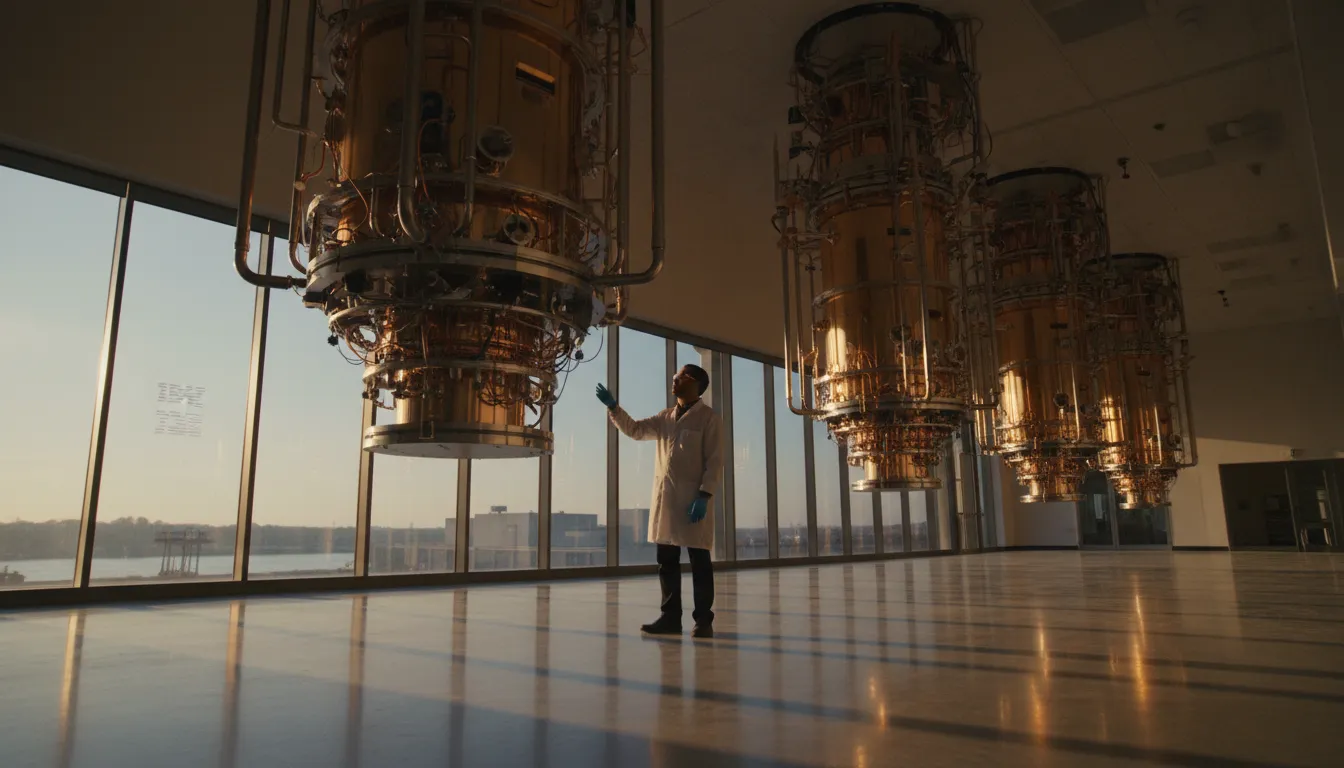
Qubits are extraordinarily fragile. Any interaction with the outside world — heat, vibration, electromagnetic noise — causes decoherence, collapsing the quantum state and ruining the calculation. To prevent this, most leading systems (from IBM, Google, and others) operate qubits at temperatures close to absolute zero, colder than outer space. Others use trapped ions, photons, or topological structures to achieve stability through different physical means.
Error correction is the frontier that will define the next decade. In 2026, the industry's focus has moved from raw qubit counts to logical qubits — groups of physical qubits that collectively correct each other's errors. The first commercially available error-corrected quantum systems are beginning to reach select customers, though they remain specialized tools rather than general-purpose machines.
What Problems Can They Solve?
Quantum computers are not replacements for ordinary PCs — they excel at a specific class of exponentially complex problems where classical approaches reach their limits:
- Drug discovery: Simulating molecular interactions at the quantum level to design new medicines. Google demonstrated with pharmaceutical firm Boehringer Ingelheim that quantum systems can model Cytochrome P450 — a critical enzyme — more accurately than any classical computer.
- Finance: Portfolio optimization and risk modeling. JPMorgan Chase has partnered with IBM to explore quantum algorithms for option pricing that could outperform classical Monte Carlo simulations.
- Materials science: Designing new superconductors, batteries, and catalysts by modeling atomic behavior precisely.
- Cryptography: Quantum computers threaten current encryption standards, driving urgent development of quantum-resistant security protocols — an area where governments are already investing heavily.
How Far Away Is the Quantum Age?
Estimates from MIT Technology Review and industry analysts place meaningful commercial quantum advantage — the point where quantum machines reliably outperform classical ones on real-world problems — somewhere between five and fifteen years away for most applications. The timeline is shortening as investment from governments and corporations accelerates. The United States, China, the European Union, and others have each committed billions to quantum research programs.
For now, quantum computing sits at the same threshold as computing did in the early 1950s: the principles are proven, the machines exist, but the era of practical, widespread impact is still being built — one qubit at a time.