How Scientists Plan to Grow Food on the Moon
As humanity prepares to return to the Moon for extended stays, scientists are racing to solve one of the hardest problems in space exploration: how to grow food in lunar soil.
Why Lunar Agriculture Matters
Feeding astronauts on a six-month Mars transit or a permanent lunar base entirely from Earth is neither practical nor affordable. Every kilogram launched from Earth costs thousands of dollars, and the logistical challenge of supplying a distant outpost with fresh food would be staggering. The solution, researchers believe, lies in the Moon itself — specifically in the layer of broken rock and dust that blankets its surface, known as lunar regolith.
The goal is not romantic. Growing food in moon dirt is a hard engineering and biology problem, one that scientists have been chipping away at for years. Recent breakthroughs suggest it may finally be within reach.
What Is Lunar Regolith?
Lunar regolith is the loose, fragmented material covering the Moon's surface, created over billions of years by meteorite bombardment and cosmic radiation. Unlike Earth's soil, it contains no organic matter, no nitrogen compounds in usable form, and no microbial ecosystem. It is also extremely abrasive — tiny, glassy shards that can damage equipment and lungs alike.
What lunar regolith does contain is a range of minerals — silica, iron oxides, calcium, magnesium, and sulfur — that are essential for plant growth. The challenge is making those nutrients accessible to living plants.
The First Landmark: Plants in Real Moon Soil
In 2022, scientists at the University of Florida achieved a historic first: they grew plants in actual lunar soil collected by Apollo 11, 12, and 17 astronauts. Working with just 12 grams of precious moon dirt — roughly a few teaspoons — the team planted seeds of Arabidopsis thaliana, a small flowering plant commonly used in laboratory research.
The results were striking. Nearly all the seeds germinated, proving that lunar soil does not block the basic hormonal signals plants need to sprout. But the plants showed clear signs of stress: they grew more slowly, were smaller, and expressed genes associated with coping with heavy metals and salt toxicity. Real lunar soil, it turned out, is a hostile growing medium — but not an impossible one.
NASA described the experiment as a critical first step toward bioregenerative life support — systems that use living organisms to recycle air, water, and food on long-duration missions.
The Chickpea Breakthrough of 2026
A major advance came in early 2026, when a team working with Texas A&M University published results in Scientific Reports showing that chickpeas — a high-protein food crop — could be grown and harvested from simulated lunar soil. This was the first time a food crop had actually seeded in a lunar regolith simulant.
The key ingredient was not a new fertilizer but a fungus. The researchers coated chickpea seeds with arbuscular mycorrhizal fungi (AMF) before planting. These fungi form a symbiotic relationship with plant roots, dramatically expanding their ability to absorb nutrients while also blocking the uptake of toxic heavy metals. The team also added vermicompost — nutrient-rich worm castings — to the growing medium.
Plants in mixtures of up to 75% lunar simulant successfully produced seeds. In 100% simulant, none of the plants survived long enough to flower — a reminder that the remaining challenges are significant.
The Main Obstacles
Researchers have identified several persistent barriers to lunar farming:
- Nitrogen deficiency: Lunar regolith contains virtually no biologically available nitrogen, which plants need to build proteins and DNA. Future farms may need to rely on nitrogen delivered from Earth, recycled from astronaut waste, or fixed by specialized microbes.
- Radiation: The Moon has no magnetic field and no atmosphere to shield against solar radiation, which can damage plant DNA. Greenhouses would likely need to be built underground or heavily shielded.
- Gravity: At one-sixth of Earth's gravity, water and nutrients move differently through soil, complicating irrigation and root growth.
- Temperature extremes: Lunar surface temperatures swing from around 127°C in sunlight to -173°C in shadow — making enclosed, climate-controlled environments essential.
Alternative Approaches: Hydroponics and Waste Recycling
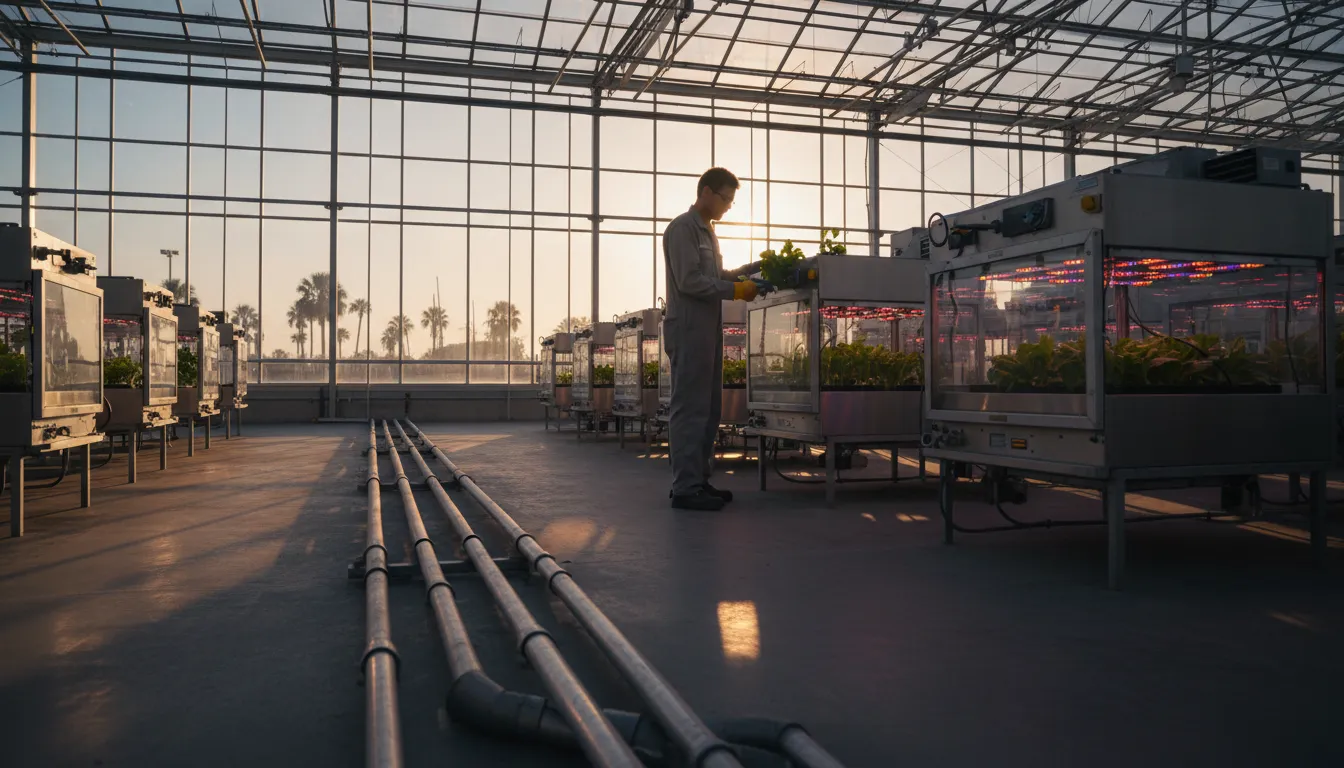
Many researchers argue that trying to farm directly in regolith may be the hardest path. The European Space Agency has been investigating a hybrid approach: extracting minerals from regolith and dissolving them into water to feed hydroponic systems, where plants grow in nutrient-rich liquid rather than soil. A team at NASA's Kennedy Space Center is testing how processed wastewater — recycled from astronaut sewage — interacts with lunar and Martian simulants to produce plant-ready nutrient solutions.
These bioregenerative life support systems (BLiSS) would form a closed loop: astronauts eat food, produce waste, which is recycled into nutrients, which feed more food. The Moon, in this vision, becomes a testing ground for the sustainable systems that Mars missions will depend on.
The Road Ahead
With NASA's Artemis program targeting a sustained human presence near the lunar south pole in the late 2020s, and several space agencies pursuing their own lunar ambitions, the pressure to solve lunar agriculture is intensifying. Growing even a fraction of an astronaut's diet on-site would dramatically reduce resupply costs and improve mission resilience.
Scientists are cautious but optimistic. The Moon is inhospitable — but so, once, was every farm on Earth.