How Wildlife Thrives in the Chernobyl Exclusion Zone
The Chernobyl Exclusion Zone has become one of Europe's largest de facto nature reserves, where wolves, bears, bison, and rare horses flourish in the absence of humans — raising profound questions about ecology, radiation, and rewilding.
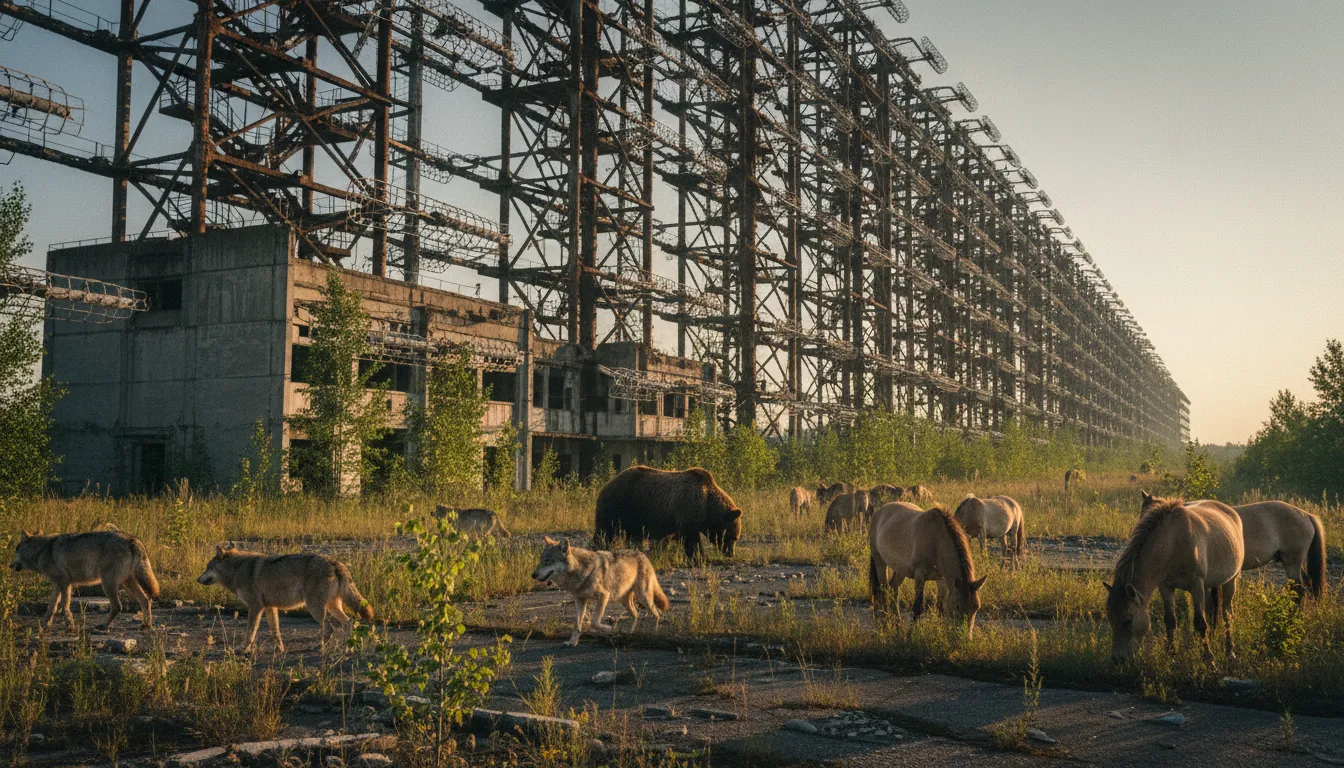
An Accidental Wildlife Sanctuary
When more than 350,000 people evacuated the area surrounding Ukraine's Chernobyl nuclear power plant in 1986, they left behind a contaminated landscape that most assumed would remain a dead zone for centuries. Instead, the roughly 2,600-square-kilometre Chernobyl Exclusion Zone has become one of the largest nature reserves in mainland Europe — and one of the most extraordinary rewilding experiments ever conducted, entirely by accident.
Wolves, brown bears, European bison, lynx, moose, wild boar, and dozens of other species now roam forests and abandoned villages where tens of thousands of people once lived. The zone offers a stark natural lesson: for many species, the absence of humans matters more than the presence of radiation.
What Lives There Now
Camera traps and long-term monitoring by Ukrainian and Belarusian scientists have documented a remarkable ecological recovery. Grey wolves prowl the zone in packs, thriving at densities comparable to pristine wilderness areas. Brown bears, absent from the region for over a century, have returned. European bison graze on former farmland, while Eurasian lynx hunt through dense forests that have reclaimed roads and rooftops.
Perhaps the most surprising residents are Przewalski's horses — a critically endangered Mongolian species introduced to the zone in 1998 as a conservation experiment. The population has grown to over 150 animals that roam freely, sometimes sheltering in crumbling barns and abandoned homes. "The fact that Ukraine now has a free-ranging population is something of a small miracle," says Denys Vyshnevskyi, the zone's lead nature scientist.
Beavers have recolonised rivers and cooling ponds, reshaping waterways. Bird populations have rebounded. Even the zone's most radioactive "Red Forest" — so named because pine trees turned rust-coloured and died after absorbing lethal doses — has regrown with birch and other species.
Why Animals Flourish Despite Radiation
The key to understanding Chernobyl's wildlife recovery lies in a simple equation: the harm caused by chronic low-level radiation is, for most large mammals, outweighed by the benefit of having no humans around. When people left, hunting stopped, agriculture ceased, roads crumbled, and industrial activity vanished. The ecosystem responded rapidly.
According to research published in journals including PNAS and Current Biology, populations of large mammals within the exclusion zone match or exceed those in uncontaminated nature reserves across Europe. A landmark study found no evidence that radiation suppressed mammal populations at the landscape scale — the dominant factor was simply the removal of human pressure.
The Scientific Debate
Not all researchers agree that the zone is a paradise. Some studies, particularly by biologists Timothy Mousseau and Anders Pape Møller, have documented elevated rates of genetic mutations, partial albinism in birds, cataracts in rodents, and reduced insect diversity in the most contaminated hotspots. Reproductive failures and developmental abnormalities have been recorded in several species.
The debate centres on scale: while individual animals may suffer radiation-related health effects, population-level recovery has been dramatic. Scientists describe this as the "Chernobyl paradox" — radiation damages organisms, yet wildlife communities as a whole have bounced back because the ecological benefits of a human-free landscape overwhelm the biological costs of contamination.
Lessons for Conservation
The Chernobyl Exclusion Zone has become a powerful, if unintentional, case study in rewilding — the practice of restoring ecosystems by removing human interference. It demonstrates how quickly nature can reclaim landscapes when given the opportunity, even under extreme conditions.
The zone's ecological value, however, faces new threats. Russia's 2022 invasion of Ukraine saw troops advance through the exclusion zone toward Kyiv, digging trenches in contaminated soil and sparking forest fires. Military activity disrupted decades of ecological monitoring and raised concerns about long-term damage to the recovery.
Despite these challenges, the zone remains a living laboratory. Researchers continue to study how species adapt to chronic radiation, how ecosystems recover without human management, and what the zone's transformation reveals about the resilience of nature. Four decades after one of history's worst industrial disasters, Chernobyl's forests teem with life — a reminder that, given enough time, the wild tends to find a way.