Iran War Sends Global Aviation Into Chaos
The US-Israeli military campaign against Iran has shuttered airspace across the Middle East, rerouting or cancelling tens of thousands of flights, spiking jet fuel prices by 60%, and pushing airfares to post-pandemic highs on key Asia-Europe corridors.
The Hole in the Sky
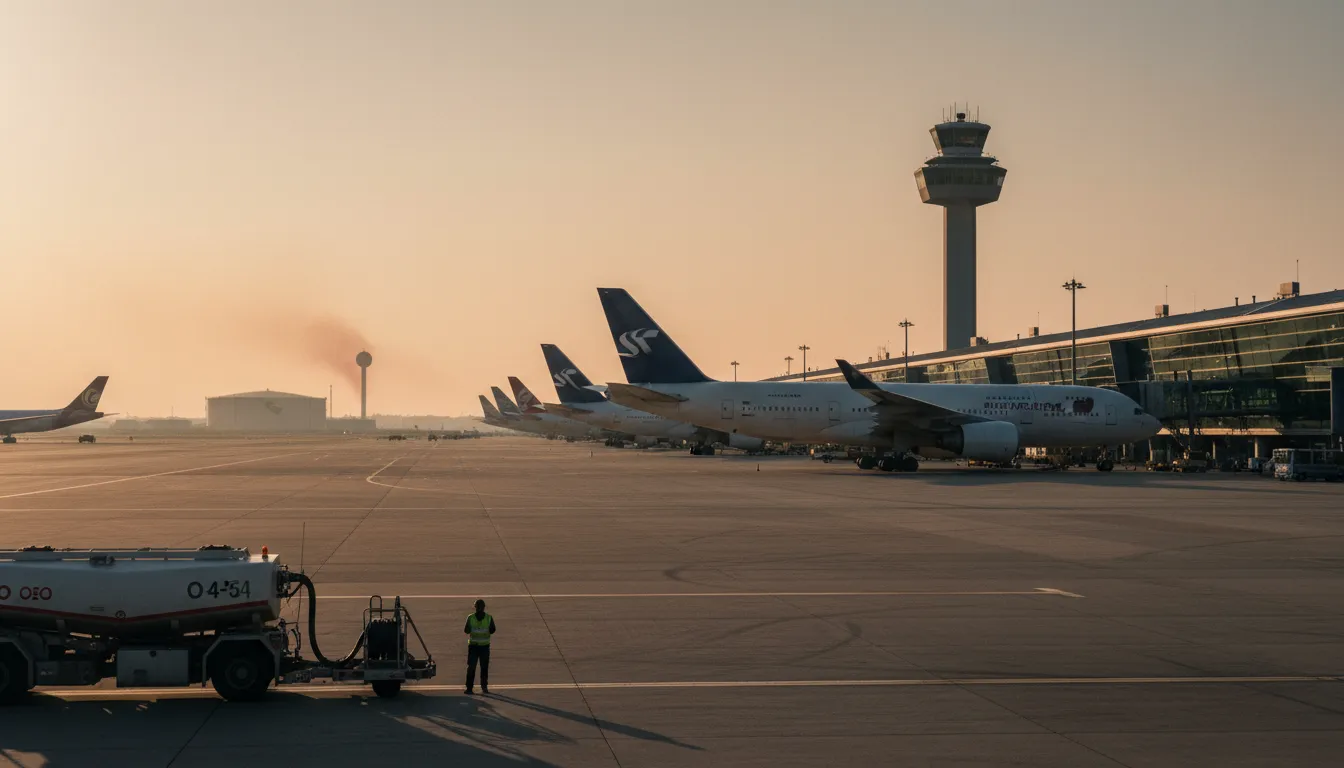
Where one of the world's busiest aviation crossroads once hummed with hundreds of daily flights linking Europe, Asia, and Africa, there is now a yawning gap. Since the United States and Israel launched coordinated strikes on Iran on February 28, 2026 — dubbed Operation Epic Fury — at least eight countries have closed their airspace: Iran, Israel, Iraq, Jordan, Qatar, Bahrain, Kuwait, and the United Arab Emirates. Experts are calling it "pretty well the biggest shutdown we've seen since the COVID pandemic."
Scale of the Disruption
The numbers are staggering. More than 46,000 flights in and out of the Middle East were cancelled or diverted between February 28 and March 11 alone, according to tracking data. On a single day in mid-March, airports across Bahrain, the UAE, Qatar, Saudi Arabia, Kuwait, and Oman collectively cancelled 777 flights and delayed 340 more, stranding thousands of passengers worldwide.
The closure of Iranian and Iraqi airspace is particularly damaging for Asia-Europe routes. That corridor — used daily by dozens of carriers flying between East Asia, South Asia, and European capitals — has been forced onto two costly detours: north through the Caucasus and Central Asia, or south via Egypt, Saudi Arabia, and Oman. Either option adds two to four hours to flight times and burns significantly more fuel.
Fares and Fuel Surge
The financial pain is landing squarely on passengers. Jet fuel prices rose more than 60 percent in under two weeks — from $2.11 per gallon at the start of the year to $3.40 by March 10 — after tanker traffic through the Strait of Hormuz nearly ground to a halt. Airlines including Qantas, SAS, and Air New Zealand have already announced fare hikes, citing the fuel spike.
The impact on individual ticket prices has been dramatic. A direct Seoul-to-London flight on Korean Air leapt from $564 to $4,359 almost overnight, illustrating how rapidly market forces can punish travelers when a critical airspace corridor closes. CNBC reports the disruption threatens a global travel industry valued at $11.7 trillion.
European Carriers Under Pressure
Major European airlines have suspended or scaled back regional routes. The Lufthansa Group — covering Lufthansa, SWISS, Austrian Airlines, Brussels Airlines, and Eurowings — halted flights to multiple Middle Eastern destinations. Air France suspended services to Dubai and Riyadh, while KLM extended its Dubai suspension. British Airways also pulled back from several regional routes, citing crew and aircraft positioning problems caused by sudden airspace closures.
Ryanair Compounds the Crisis
Separately, Europe's largest budget carrier Ryanair has announced sweeping route cuts across Germany and Spain — driven not by the conflict but by escalating airport fees. The airline is eliminating 24 routes to and from Germany and cutting approximately 1.2 million seats from its Spanish summer schedule, closing its Santiago de Compostela base entirely. Ryanair is redirecting capacity toward lower-cost airports in Morocco, Croatia, Italy, and Albania — further squeezing connectivity for travellers across Western Europe at an already turbulent moment.
No Quick Resolution in Sight
Aviation analysts at Aviation Week warn that the long-term effects on airline networks remain deeply uncertain. As long as Iranian and Iraqi airspace stays closed, carriers face a permanent structural cost increase on Asia-Europe routes. NPR advises travellers to avoid booking non-refundable fares until the situation stabilises, noting that pricing volatility is likely to persist for weeks or months. For now, the skies between Asia and Europe are quieter, longer, and far more expensive — with no clear end in sight.