Macron Extends Nuclear Umbrella to European Allies
French President Emmanuel Macron delivered a landmark speech at France's Île Longue submarine base on March 2, offering European partners new forms of nuclear cooperation as doubts over American security guarantees under Trump deepen and Russian threats grow.
A Historic Speech from the Heart of France's Arsenal
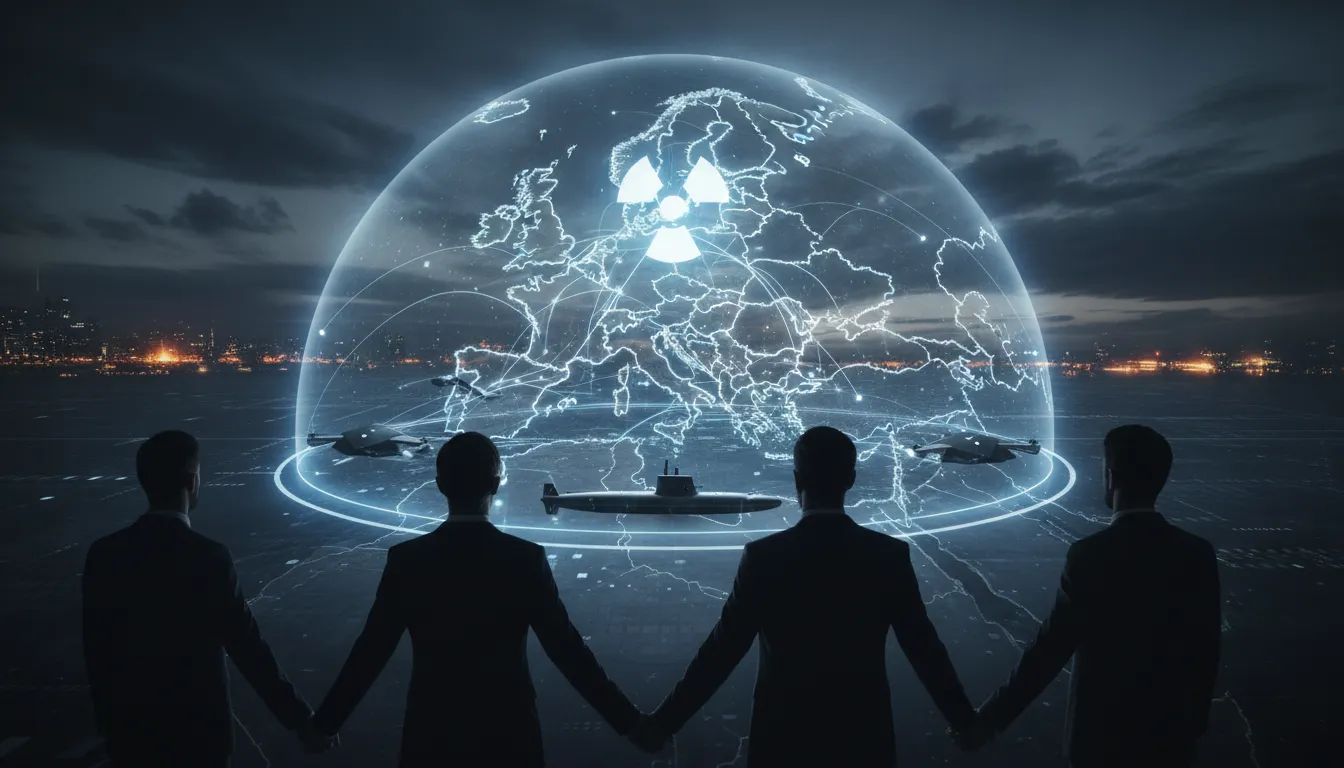
Standing at the Île Longue submarine base near Brest — the fortified nerve center of France's nuclear deterrent — President Emmanuel Macron delivered one of the most consequential security addresses of his presidency on Monday. The landmark speech outlined how France's nuclear arsenal could extend its protective reach across Europe as doubts grow about American security guarantees under President Donald Trump.
The Twin Pressures of Trump and Russia
The address came at a moment of acute anxiety for European defense planners. Russia's ongoing war in Ukraine has sharpened fears of broader aggression, and Moscow's 2024 revision lowering its nuclear retaliation threshold deepened alarm in allied capitals. Meanwhile, the Trump administration's erratic approach to NATO — including pauses in military aid to Ukraine and questions about intelligence sharing — has prompted allies to reassess their security architecture.
Danish Parliament Defense Committee chair Rasmus Jarlov captured the growing unease: "If things got really serious, I very much doubt that Trump would risk American cities to protect European cities." Macron himself was blunt: "Russia has become a threat for France and Europe. To watch and do nothing would be madness."
What Paris Is Offering
France holds fewer than 300 nuclear warheads under a "strict sufficiency" doctrine — the EU's only independent nuclear arsenal. Its four nuclear-armed submarines at Île Longue each carry 16 M51 intercontinental ballistic missiles, giving France the capacity to inflict what its doctrine describes as "absolutely unacceptable damage" on any aggressor.
Macron proposed a layered cooperation framework centered on three elements: bilateral cooperation agreements with key European partners, joint military exercises — including potential inclusion of allied forces in France's secretive "Poker" nuclear strike simulations — and formally articulated shared security interests. The possibility of deploying nuclear-armed Rafale fighter jets to partner countries has also been raised as one scenario under discussion.
Germany and Poland are seen as the primary targets of this evolving framework. German Chancellor Friedrich Merz had already held "confidential" talks with Macron on the subject and publicly floated the idea of German Air Force aircraft carrying French nuclear weapons — a significant conceptual leap in European nuclear burden-sharing.
One Firm Red Line
Despite the expansive vision, Macron was unequivocal on one point: launch authority stays exclusively with the French president. There will be no joint command structure, no shared control mechanism, and no expectation that allies financially contribute to France's nuclear program. This reflects both France's deep tradition of strategic autonomy and the practical impossibility of delegating nuclear authority to any multinational body.
Macron also emphasized that the initiative complements rather than competes with NATO. "This is in no way in competition with NATO," his office said, seeking to reassure Washington and other allies wary of any European decoupling from the U.S. umbrella.
Building on a Long-Ignored 2020 Proposal
Monday's speech builds directly on a largely overlooked 2020 address in which Macron first proposed a "strategic dialogue" with European partners on the role of French deterrence in continental security. That offer drew polite but limited interest at the time. Six years on, with Russia fighting in Ukraine and Trump back in the White House, European appetite for the conversation has been transformed entirely.
Ukrainian President Volodymyr Zelenskyy welcomed Macron's stance: "I am grateful for his clear vision and our joint efforts to achieve peace." Nuclear deterrence expert Héloïse Fayet noted that "there are high expectations from allies, partners — and perhaps also adversaries — about how French nuclear doctrine could evolve."
Whether the proposals will translate into binding operational arrangements remains uncertain. But by choosing Île Longue — aboard the very submarines that carry France's deterrent — as his stage, Macron sent an unmistakable signal: France is prepared to anchor European security in ways it has never done before.