Nepal's Gen Z Election: RSP Sweeps, Ending Decades of Elite Rule
Balendra Shah's Rastriya Swatantra Party is headed for a historic parliamentary landslide in Nepal's first election since the 2025 Gen Z uprising that toppled the government of four-time Prime Minister KP Sharma Oli.
A Seismic Shift in the Himalayas
Nepal's political establishment is in ruins. Results from the country's March 5, 2026 parliamentary election show the Rastriya Swatantra Party (RSP) — a centrist anti-corruption party led by 35-year-old former rapper and Kathmandu mayor Balendra Shah — on course for one of the most decisive election victories in South Asian history. With RSP having secured over 103 of 165 directly elected seats and leading in proportional representation tallies with roughly 51 percent of the vote, analysts estimate the party could surpass the 184 seats needed for a two-thirds parliamentary majority.
The results, described by observers as a referendum on corruption and generational change, arrive just six months after violent street protests upended the country's political order.
From Kathmandu's Streets to Parliament
Balendra Shah's rise is improbable by any standard. Trained as a structural engineer, he became one of Nepal's most celebrated rappers — his music, targeting graft and inequality, later served as anthems for protesters in 2025. In 2022 he was elected Kathmandu's mayor as an independent candidate, the first non-party figure to hold the post. He formally joined the RSP in late December 2025 and resigned the mayoralty in January 2026 to lead the party into the general election as its prime ministerial candidate.
His personal performance was equally stunning. Shah defeated four-time Prime Minister KP Sharma Oli in the Jhapa-5 constituency by approximately 50,000 votes — securing 68,348 ballots against Oli's 18,734. The image of a former head of government losing so decisively to a one-time hip-hop artist encapsulates the scale of the political earthquake Nepal has just experienced.
The 2025 Uprising That Rewrote the Rules
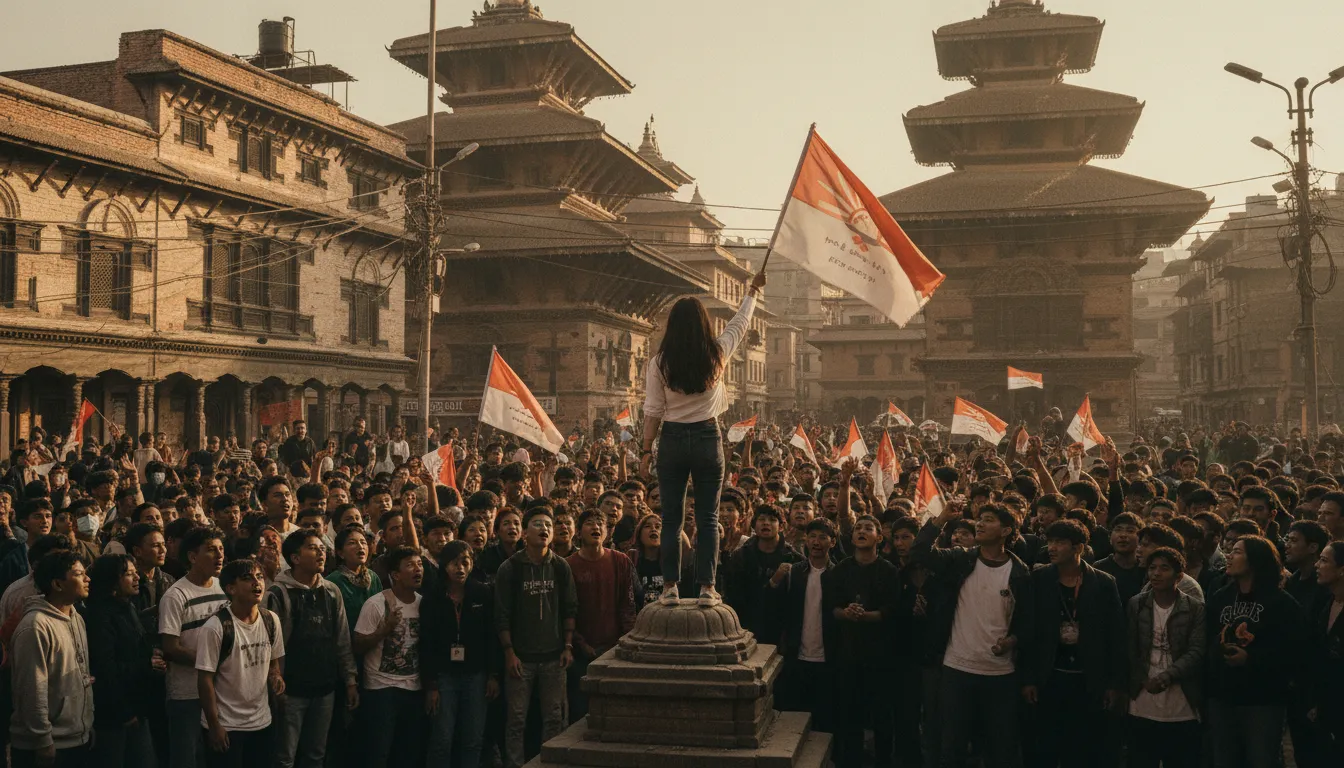
To understand March 2026, one must look back to September 2025. What began as outrage over the Oli government's sweeping social media ban — granting authorities powers to monitor online activity and detain citizens for "spreading misinformation" — rapidly evolved into a nationwide anti-corruption uprising driven by young Nepalis.
On September 8, 2025, police killed 19 protesters, including a 12-year-old child. The crackdown backfired catastrophically: the movement spread, ultimately leaving more than 70 people dead and thousands injured before Oli resigned on September 9 and fled Kathmandu. According to Human Rights Watch, security forces used unlawful force throughout the unrest. The Election Commission confirmed a snap parliamentary election for March 2026 with over a third of newly registered parties founded in the aftermath of the protests.
A Rout of the Old Guard
Voter turnout reached approximately 60 percent — a significant figure in a country weary of political instability. The message voters sent was unambiguous. The Nepali Congress, one of the country's two historically dominant parties, captured just five first-past-the-post seats and garnered 17 percent of proportional votes. The Communist Party of Nepal (UML), Oli's own party, won a single directly elected seat. RSP swept all 15 constituencies across three districts in the Kathmandu Valley alone.
"The party's first agenda is to develop the nation," Shah told reporters as results mounted, pledging a focus on health, education, and the fight against corruption — the same themes that animated both his music and the protests that propelled his party to power.
What Comes Next
A two-thirds majority would give RSP the power to amend Nepal's constitution — a prospect that carries enormous consequence for a country that has rewritten its founding document multiple times since becoming a federal democratic republic in 2008. International observers, including Indian Prime Minister Narendra Modi who offered congratulations, are watching closely to see whether Shah's movement can translate street-level energy into durable institutional reform.
Nepal has cycled through more than a dozen governments since 2008, making political stability one of the country's most elusive commodities. Whether Balendra Shah — engineer, rapper, mayor, and now almost certainly prime minister — can break that cycle is the defining question for a nation that has just handed power, emphatically, to a new generation.