Paris Fashion Week AW26: Archives, Green Push, Trade Tensions
Paris Fashion Week autumn/winter 2026 confirmed two defining forces in luxury fashion: a return to archival heritage and mounting sustainability pressure — all against a backdrop of trade war turbulence that is quietly reshaping the industry.
The City of Light Under Pressure
Paris Fashion Week for the autumn/winter 2026 season, which ran from March 2 to 10, unfolded against a markedly tense backdrop. The official calendar shrank — 67 runway shows compared with 74 the previous year, and 31 presentations instead of 37 — as brands from emerging independents to established mid-tier houses weighed the mounting costs of staging spectacle against a volatile global trade environment. Yet the grand maisons delivered, and Paris reaffirmed its role as the world's pre-eminent cultural barometer.
Heritage at the Centre of the Stage
The season's most celebrated moment belonged to Jonathan Anderson at Dior. Staged in the Jardin des Tuileries across a runway skimming a lily-pad-strewn pond — a nod to the Musée de l'Orangerie and Monet's Water Lilies nearby — the show placed Dior's iconic 1947 Bar jacket at its heart. Anderson reinterpreted the silhouette across pastel knits with fluted peplums, elongated Donegal tweed coats, and abbreviated versions layered over embroidered mini-crinis. Critics described the collection as a designer finding confident stride, built in under a month and greatly bolstered by the overwhelmingly positive reception to Anderson's couture debut in January.
At Chanel, Matthieu Blazy presented his sophomore ready-to-wear season, widely anticipated to deliver a more settled, personal vision drawing on the house's 1930s archival elegance. Louis Vuitton closed fashion month on Tuesday, March 10, alongside Miu Miu. The season's broader tendency was unmistakable: major houses returning to their own histories as a form of both creative grounding and commercial reassurance in uncertain times.
Sustainability: From Trend to Requirement
If archive-diving defined the grand narrative, sustainability was its urgent subtext. Loewe and Schiaparelli debuted garments using lab-grown bio-textiles, and a dedicated exhibition space showcased next-generation materials — biodegradable synthetics, regenerative natural fibres, and zero-waste production techniques. Smaller and second-generation designers went further, foregrounding recycled materials and transparent supply chains as genuine brand propositions rather than marketing footnotes.
As covered by Wallpaper* and Marie Claire, sustainability is no longer a niche concern on the Paris calendar — it is becoming a baseline expectation, driven by younger consumers and incoming EU disclosure regulations requiring brands to account for environmental footprints in detail.
Trade War Clouds Over the Runway
The most consequential story of the week may have unfolded largely off the catwalk. As reported by Business of Fashion, the weighted average of US tariffs on apparel and footwear spiked from 13 percent to as high as 54 percent in 2025 before settling around 36 percent — still far above historical norms. Some 76 percent of fashion executives surveyed said trade disruptions would shape the industry in 2026, and 55 percent expected further price increases.
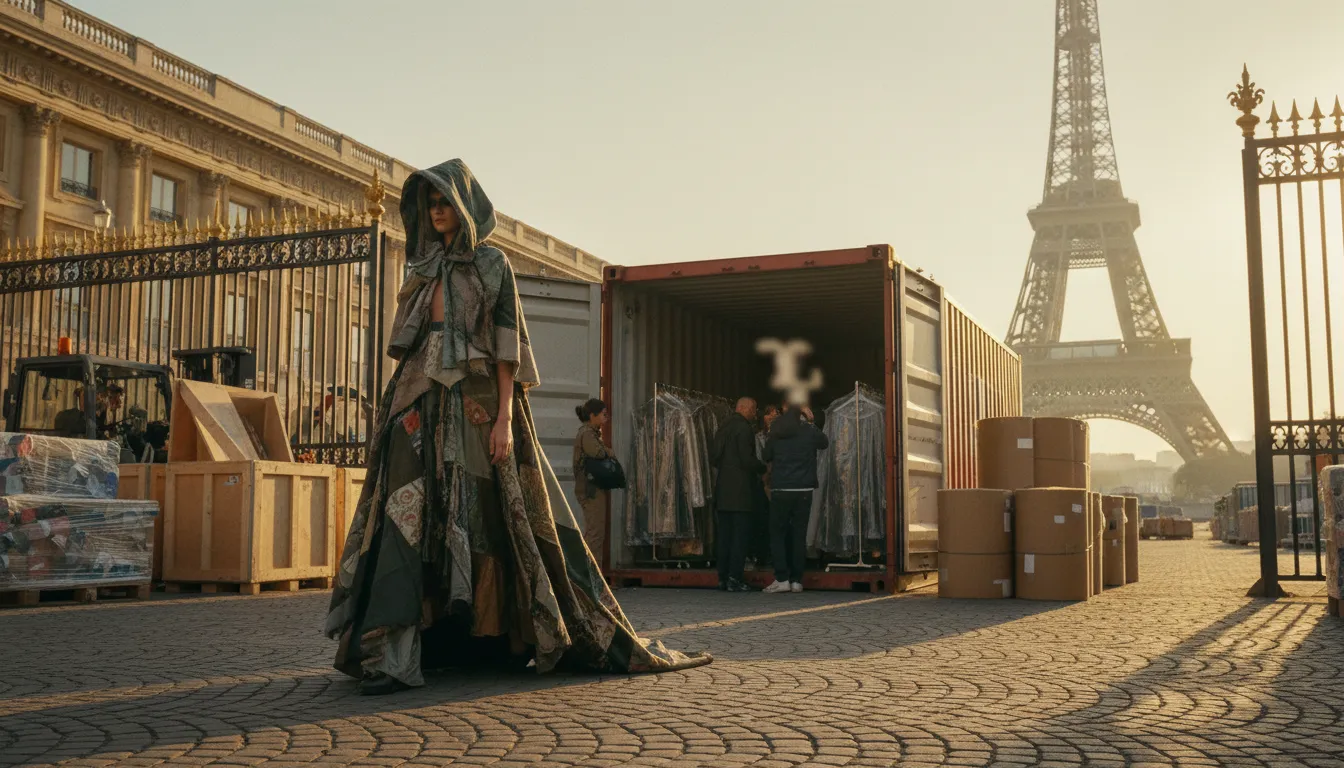
The impact was visible in the PFW calendar itself. Independent labels — for whom even a modest runway show can cost upwards of €100,000 — increasingly opted out. Coperni, Sacai, and others chose lookbooks or off-calendar formats. "Fashion shows are incredibly expensive," one industry figure told WWD. "It's really hard to get a return on that investment." Luxury houses, with deeper reserves, were better insulated, but several are quietly re-evaluating manufacturing bases and logistics chains to reduce exposure to cross-border tariffs.
Paris Holds
Despite the pressures, Paris delivered what it always does. Peplum silhouettes emerged as a dominant trend — from Anderson's Dior to Pieter Mulier's Alaïa. Tartan and gingham ran through Chloé. Structured elegance held sway at Saint Laurent. The city's fashion week remains the global industry's most reliable mirror: reflecting not just what people will wear next winter, but what an anxious, archive-haunted, sustainability-pressured luxury world is striving to become.