Smart Home Market Eyes $95B as Matter Protocol Reshapes IoT
The global smart home market is projected to reach $95.83 billion in 2026, driven by AI integration, 5G connectivity, and the Matter protocol — a cross-brand interoperability standard backed by Apple, Google, Amazon, and Samsung that aims to eliminate ecosystem lock-in.
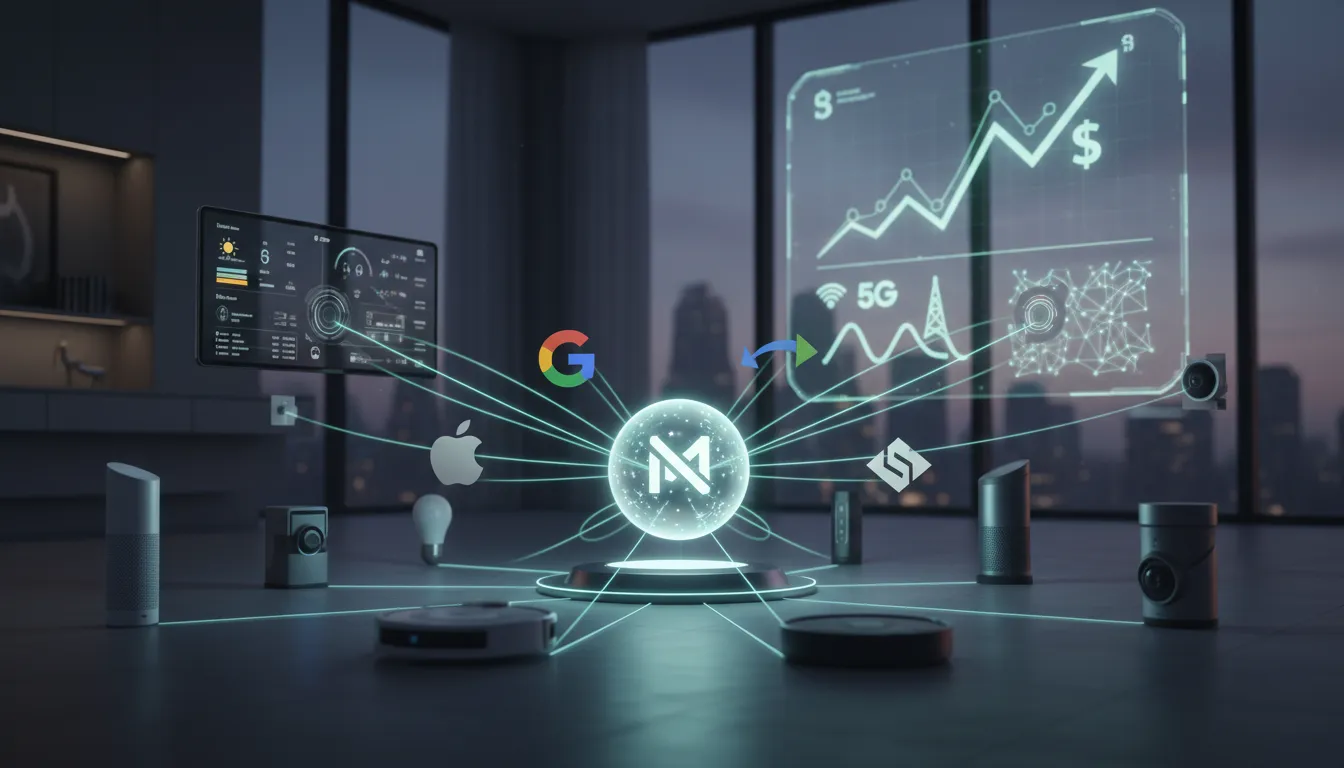
A Market on the Move
The global smart home industry is entering a defining chapter. According to MarketsandMarkets, the sector is projected to reach $95.83 billion in 2026, continuing a steady climb toward $139.24 billion by 2032 at a compound annual growth rate of roughly 6.4%. The numbers reflect a technology wave that has moved well beyond novelty — smart thermostats, connected lighting, AI-powered security cameras, and automated energy systems are rapidly becoming standard household infrastructure.
Matter: The Protocol That Could Change Everything
For years, the smart home market's biggest obstacle wasn't technology — it was fragmentation. Shoppers faced an impossible puzzle: devices from one brand often refused to speak to hardware from another. That wall is now being dismantled by Matter, an open interoperability standard developed under the Connectivity Standards Alliance (CSA) with backing from Apple, Google, Amazon, and Samsung.
Matter uses Internet Protocol (IP) to link devices, ecosystems, and apps regardless of brand. Its most powerful feature is multi-admin support, which allows a single device — say, a smart lock — to function simultaneously within Apple Home, Google Home, and Amazon Alexa without additional configuration. In November 2025, the protocol reached version 1.5, adding support for cameras, soil moisture sensors, and expanded energy management features, signaling a maturing standard with growing ambitions.
More than 280 companies now back Matter, and the standard is gradually shifting consumer expectations. "Matter creates more connections between more objects, simplifies development for manufacturers, and increases compatibility for consumers," notes the CSA.
AI, IoT, and 5G: The Engines of Growth
Beyond interoperability, three converging forces are reshaping what a connected home can do. Artificial intelligence has moved from voice commands to behavioral learning — systems now observe occupancy patterns to autonomously schedule heating, lighting, and security responses before residents even think to ask. According to TechTimes, local AI hubs that reduce cloud dependence are a key focus for 2026, improving both responsiveness and privacy.
5G networks are providing the backbone for real-time device communication at scale. Greater bandwidth allows homes to support far more sensors, appliances, and wearables simultaneously — a prerequisite for the fully automated household that industry analysts have long promised. Meanwhile, energy management has emerged as a killer application: smart systems integrating solar panels, battery storage, and EV charging are turning homes into micro-grids capable of optimizing consumption in real time.
The Friction Factor
Despite the momentum, honest assessment requires acknowledging Matter's stumbles. Tom's Guide reported that two years after launch, the protocol still faces "missing features, setup problems, and flaky connections," with some smart home communities largely bypassing it. Manufacturers with entrenched proprietary ecosystems remain reluctant to cede differentiation, while business model concerns — interoperability reduces lock-in revenue — create structural resistance. The standard also covers a limited device range, with complex appliances still awaiting full integration.
These are teething problems common to any ambitious open standard, but they underscore that the smart home revolution will unfold unevenly across demographics and geographies.
The Road Ahead
The trajectory is clear even if the timeline remains contested. A market approaching $100 billion, backed by the combined weight of the world's largest tech companies and an open protocol designed to serve consumers rather than corporate silos, has the structural conditions for sustained expansion. Whether Matter fulfills its interoperability promise in 2026 or takes several more years, the direction of travel — toward AI-driven, energy-aware, universally connected living spaces — now looks irreversible.