What Are Alvarezsaurs and Why They Puzzle Scientists
Alvarezsaurs were a bizarre group of tiny, bird-like dinosaurs with stubby arms and a single giant claw. A near-complete fossil from Patagonia is finally revealing how these miniature predators evolved—and upending decades of assumptions.
The Strangest Dinosaurs You Have Never Heard Of
Among the hundreds of dinosaur groups that walked the Earth during the Mesozoic Era, few are as perplexing as alvarezsaurs. These small, bird-like creatures had tiny teeth, extremely short forelimbs, and—most bizarrely—a single, oversized thumb claw where other theropods had multi-fingered hands. For decades, their evolutionary story remained shrouded in mystery because most well-preserved fossils came from Asia, leaving scientists guessing about how this group originated and spread across the world.
That picture is now becoming clearer. A nearly complete skeleton unearthed in Patagonia, Argentina, is providing researchers with what one scientist called a "paleontological Rosetta Stone"—a reference specimen that finally allows fragmentary finds from around the globe to be properly interpreted.
Anatomy of a Bizarre Dinosaur
Alvarezsaurs belong to the broader group of theropod dinosaurs—the same lineage that includes Tyrannosaurus rex and Velociraptor, and which ultimately gave rise to modern birds. But alvarezsaurs took a radically different evolutionary path. Key features that define them include:
- Highly reduced forelimbs with a single functional digit ending in a large, robust claw
- Tiny, peg-like teeth suited to picking up small prey rather than tearing flesh
- A compact, lightly built body that in many species weighed less than a kilogram
- Long, slender hindlimbs suggesting they were fast runners
Scientists have long hypothesized that the oversized thumb claw was used to break open insect nests—much like a modern anteater—giving alvarezsaurs access to ants, termites, and grubs. This makes them one of the few non-avian dinosaurs thought to have specialized in insect predation.
The Patagonia Find: A Missing Chapter Uncovered
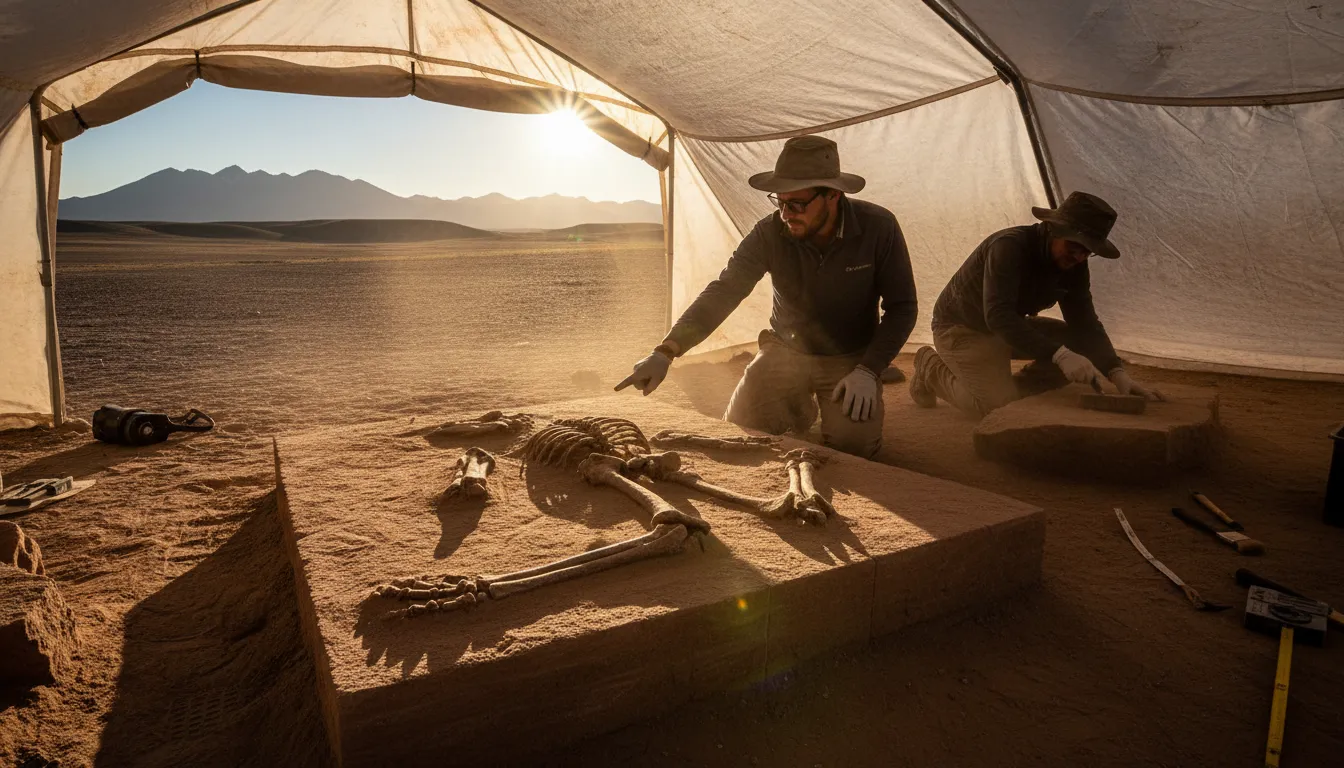
The specimen at the center of recent research is Alnashetri cerropoliciensis, discovered in 2014 at La Buitrera, a world-renowned fossil site in northern Patagonia. Rapid burial beneath a sand dune preserved the skeleton in exceptional condition. Because the individual bones are extremely small, researchers spent nearly a decade carefully cleaning and preparing them before analysis could begin.
The result was worth the wait. Bone analysis confirmed the animal was a fully grown adult—at least four years old—yet weighed under two pounds (roughly 900 grams), making it one of the smallest non-avian dinosaurs ever discovered in South America. The study, led by University of Minnesota paleontologist Peter Makovicky and Argentine paleontologist Sebastián Apesteguía, was published in the journal Nature.
Small Before Specialized: A Surprising Evolutionary Sequence
Perhaps the most significant finding from Alnashetri is what it reveals about the order in which alvarezsaurs acquired their distinctive traits. Earlier assumptions held that the group first evolved its strange forelimb anatomy and then shrank in body size. The Patagonian fossil tells a different story.
Unlike later alvarezsaurs with their stubby, single-clawed arms, Alnashetri still had comparatively longer arms and larger teeth. Yet it was already extremely small. This indicates that miniaturization came first—alvarezsaurs became tiny before their bodies reorganized around insect-eating. Extreme size reduction appears to have been a precondition for the anatomical specializations that followed, not a consequence of them.
This kind of evolutionary sequencing matters because it changes how scientists model the selection pressures that shaped the group. Body size reduction may have opened new ecological niches—small insects, tight burrows, dense undergrowth—that then drove further anatomical change.
A Global Puzzle Solved by Continental Drift
Another longstanding mystery was how alvarezsaurs ended up on multiple continents. With well-preserved fossils concentrated in Asia, some researchers wondered whether the group originated there and somehow crossed vast oceanic barriers. The South American Alnashetri fossil, dated to 90 million years ago, suggests a simpler explanation: alvarezsaurs originated when the supercontinent Pangaea still connected the world's landmasses, allowing their ancestors to spread overland before the continents drifted apart.
This places the group's origins considerably earlier than previously estimated and frames their global distribution as a product of plate tectonics rather than improbable ocean crossings.
Why Alvarezsaurs Matter Beyond Paleontology
Understanding how alvarezsaurs evolved illuminates broader questions about how extreme specialization arises in nature. Their story—rapid size reduction followed by radical anatomical remodeling—parallels patterns seen in other lineages, from the evolution of whales from land mammals to the reduction of wings in flightless birds. Each case suggests that body size is often the first variable to change when a lineage enters a new ecological niche, with structural specializations following later.
Alvarezsaurs also sit close to the dinosaur-bird boundary, making them relevant to understanding the early evolution of birds themselves. Studying these strange, tiny insect-hunters helps scientists piece together one of the most dramatic evolutionary transitions in the history of life on Earth.