What Is Permafrost and Why Its Thaw Threatens Earth
Permafrost stores twice as much carbon as the atmosphere. As the Arctic warms, this frozen ground is thawing—unleashing greenhouse gases, destabilizing infrastructure, and accelerating climate change in a dangerous feedback loop.
A Frozen Carbon Vault
Beneath the surface of the Arctic and subarctic regions lies a hidden giant: permafrost, ground that has remained frozen for at least two consecutive years and, in many places, for hundreds of thousands of years. It covers roughly a quarter of the Northern Hemisphere's land surface, spanning vast stretches of Alaska, Canada, Siberia, and the Tibetan Plateau.
What makes permafrost so consequential is not the ice itself but what it holds. Over millennia, dead plants, animals, and other organic matter accumulated in these frozen soils without fully decomposing. According to NOAA and the National Snow and Ice Data Center, the northern permafrost region stores an estimated 1,500 to 1,700 gigatons of organic carbon—roughly twice what is currently in the atmosphere. It is the largest terrestrial carbon reservoir on Earth.
How the Thaw Releases Carbon
As global temperatures rise, the Arctic is warming two to four times faster than the rest of the planet. This heat penetrates the ground, deepening the "active layer"—the topsoil that thaws each summer—and reaching carbon that has been locked away for millennia.
Once exposed to warmer temperatures, soil microbes wake up and begin digesting the ancient organic matter. In oxygen-rich conditions, they produce carbon dioxide. In waterlogged, oxygen-poor environments—such as thawing bogs—they produce methane, a greenhouse gas roughly 80 times more potent than CO₂ over a 20-year period.
This creates what scientists call a positive feedback loop: thawing permafrost releases greenhouse gases, which warm the atmosphere further, which thaws more permafrost. Unlike fossil fuel emissions, this process cannot be turned off once it starts. According to a 2026 study in Nature Communications Earth & Environment, including permafrost and wildfire emissions in climate models reduces the remaining carbon budget for staying below 1.5°C by approximately 25%.
Beyond Carbon: Reshaping the Landscape
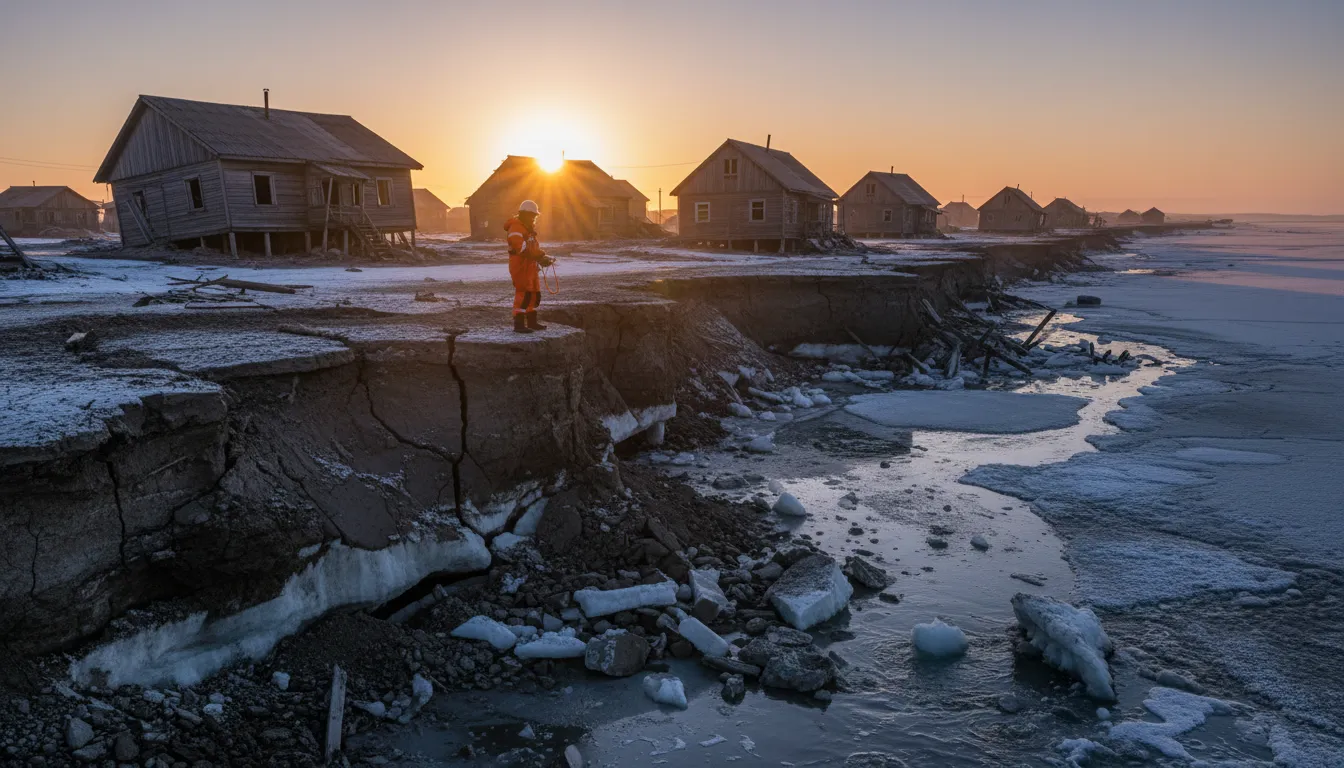
The consequences extend beyond atmospheric chemistry. As permafrost thaws, the ground physically collapses in a process called thermokarst, creating sinkholes, landslides, and waterlogged depressions. Rivers carry increasing loads of dissolved ancient carbon toward the ocean, where some converts to CO₂.
A recent study analyzing decades of data across northern Alaska found that runoff is increasing, rivers are transporting more dissolved carbon, and the thawing season is extending further into autumn—signs that the permafrost carbon cycle is accelerating.
Research from the University of Leeds has also shown that thawing increases permafrost permeability by a factor of 25 to 100, allowing trapped greenhouse gases to escape far faster than earlier models predicted.
Infrastructure at Risk
Permafrost thaw also threatens the four million people living in Arctic regions. Buildings crack and tilt as their foundations shift. Roads buckle. Pipelines warp. According to a study published in Nature Communications, one-third of pan-Arctic infrastructure and 45% of Russian hydrocarbon extraction fields sit in areas where thaw-related ground instability could cause severe damage. By 2050, more than 36,000 buildings, 13,000 kilometres of roads, and 100 airports face high hazard conditions. Repair and maintenance costs across the Arctic could reach 30 billion euros by 2060.
Why It Matters
Permafrost thaw is often called a "sleeping giant" of climate change because it operates on a slow timescale but with enormous cumulative impact. Unlike power plants or cars, it cannot be regulated or switched off. The MIT Climate Portal notes that Earth's permafrost will likely shift from being a net carbon sink to a net carbon source before 2100, fundamentally altering the global carbon budget.
Understanding permafrost is essential for anyone following climate policy. Current international emissions targets—including those under the Paris Agreement—do not fully account for permafrost emissions, meaning the world's carbon budgets may be significantly more constrained than official projections suggest.