How Farm Robots Work—and Why Agriculture Needs Them
Agricultural robots use computer vision, AI, and GPS to plant, weed, and harvest crops autonomously. As farm labor shrinks and demand grows, these machines are transforming how food is produced.
A Labor Crisis on the Farm
The average American farmer is 58 years old. Producers aged 65 and over outnumber those under 35 by a factor of four. Between 2017 and 2022, the United States lost nearly 142,000 farms—a 7 percent decline in just five years. In Canada, 40 percent of farm operators are expected to retire by 2033. Around the world, agriculture faces the same squeeze: rising demand for food, a shrinking workforce willing to do the back-breaking labor that puts it on the table.
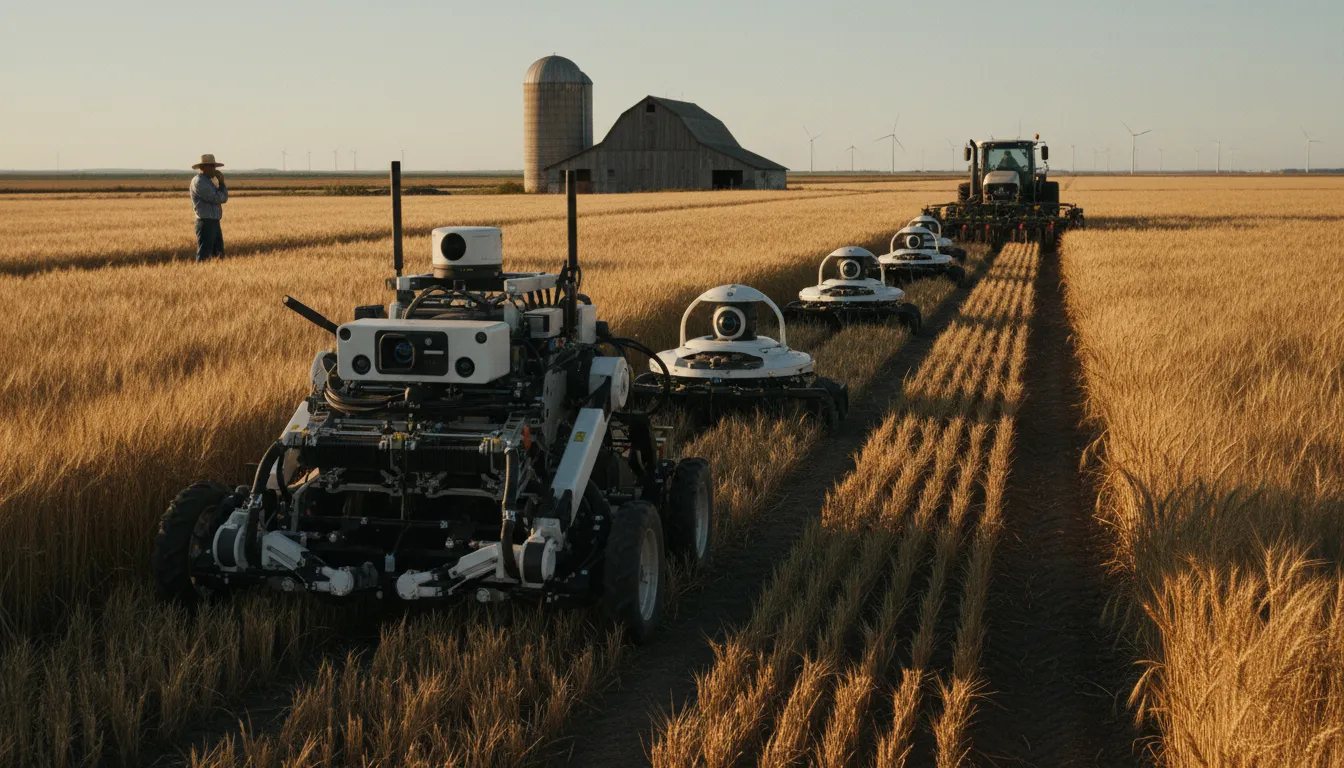
Enter the farm robot. Once a curiosity confined to university labs, autonomous agricultural machines are now a commercial reality. They seed, weed, spray, and harvest—often around the clock—using a combination of computer vision, artificial intelligence, and precision GPS. Understanding how they work explains why adoption is accelerating so quickly.
Eyes, Brains, and Hands
Every agricultural robot relies on three core systems: perception, decision-making, and actuation.
Perception comes from cameras, LiDAR, and RTK-GPS receivers. Cameras capture high-resolution images of the field; RTK-GPS pinpoints the robot's position to within two centimeters. Some machines also use multispectral sensors that detect plant health invisible to the naked eye.
Decision-making is handled by onboard AI models trained on millions of images of crops and weeds. These deep-learning systems classify plants in real time, distinguishing a sugar beet seedling from a thistle with accuracy rates above 96 percent in leading systems. The AI also plans navigation paths, adjusting speed and heading row by row.
Actuation is the physical work—and it varies widely by task. A weeding robot might deploy mechanical blades, micro-doses of herbicide, or even high-powered lasers. A harvesting robot uses soft grippers or suction cups calibrated to pick strawberries without bruising them. Seeding robots drop individual seeds at precise GPS coordinates, eliminating overlap and waste.
Lasers, Blades, and Targeted Sprays
Weed management showcases the technology's range. Carbon Robotics makes the LaserWeeder, a machine that fires thermal energy at identified weeds while leaving crops untouched. The company claims the system cuts weed-control costs by 80 percent and is already used by over 100 growers across North America, Europe, and Australia.
John Deere takes a different approach with its See & Spray system, developed by Blue River Technology. Instead of lasers, it uses AI-guided nozzles to apply herbicide only where weeds are detected—reducing chemical use by up to two-thirds compared with blanket spraying.
Danish company FarmDroid offers a solar-powered robot that both seeds and weeds. Because it remembers exactly where it planted each seed, it can return later and mechanically remove anything growing between those points—no cameras needed for weed identification at that stage.
Autonomous Tractors
Alongside specialized robots, the conventional tractor is going driverless. Companies like John Deere, Kubota, and CNH Industrial now sell autonomous tractors equipped with LiDAR, stereo cameras, and AI that can plow, sow, and haul without a human in the cab. Carbon Robotics offers an AutoTractor retrofit kit for existing John Deere 6R and 8R models, converting standard machines into fully autonomous platforms.
These systems continuously monitor their surroundings and stop automatically if an obstacle—a person, an animal, a stalled vehicle—enters their path.
Who Can Afford Them?
Adoption is uneven. According to the most recent U.S. Specialty Crop Automation Report, the average grower spent $500,000 on automation in 2022, and 70 percent plan to increase that investment. Among large-scale crop farms, 68 percent already use some form of precision agriculture technology. But across all U.S. farms, only 27 percent have adopted these tools.
The barrier is cost. Small and mid-size operations—the ones hit hardest by labor shortages—often cannot justify six-figure capital outlays. Robotics-as-a-service models, where farmers pay per acre rather than buying hardware outright, are emerging to bridge the gap. The global agricultural robotics market, valued at $13.4 billion in 2023, is projected to reach $86.5 billion by 2033.
Why It Matters
Farm robots are not replacing farmers—they are replacing the labor that farmers can no longer find. By operating day and night, reducing chemical inputs, and placing seeds and treatments with centimeter-level precision, these machines offer a path to producing more food with fewer resources. As the workforce ages and global food demand climbs toward feeding nearly 10 billion people by 2050, autonomous agriculture is shifting from novelty to necessity.