Why Dogs and Humans Share the Same Behavior Genes
A landmark study of 1,300 golden retrievers found that the same genes driving canine anxiety, trainability, and aggression also shape human depression, intelligence, and emotional sensitivity — revealing deep biological roots shared across species.
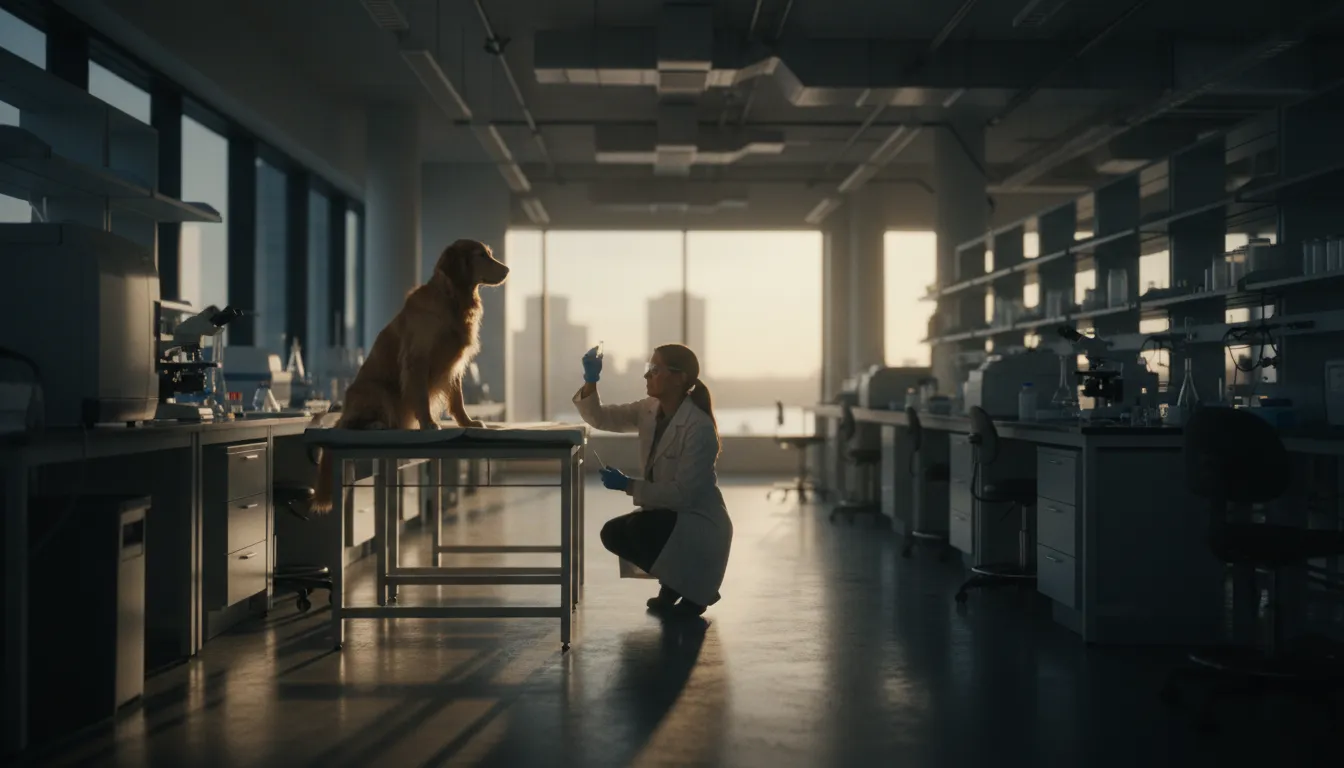
Man's Best Friend, Genetically Speaking
When a golden retriever trembles at a thunderstorm or becomes impossible to train, most people chalk it up to personality quirks. But new science suggests something far more profound is at work: the genes driving those behaviors are strikingly similar to the genes that make some people prone to anxiety, depression, or exceptional intelligence. Dogs, it turns out, are not just our oldest animal companions — they may be one of our most revealing biological mirrors.
The Study: 1,300 Dogs, Millions of Genetic Markers
A team of researchers at the University of Cambridge conducted a large-scale genome-wide association study (GWAS) using data from 1,300 golden retrievers aged three to seven, sourced from the Golden Retriever Lifetime Study run by the Morris Animal Foundation. The team examined millions of genetic variants across each dog's genome and cross-referenced them with 14 behavioral trait categories — everything from trainability and energy levels to fear of strangers and aggression toward other dogs.
The results, published in the Proceedings of the National Academy of Sciences, were striking: twelve of the genes associated with canine behavior are also implicated in human personality, mental health, and cognition.
Which Genes — and What Do They Do?
Two genes in particular stood out from the research.
PTPN1 was linked to aggression toward other dogs in golden retrievers. In humans, the same gene has been associated with both intelligence and depression — a pairing that illustrates how a single gene can influence complex, seemingly unrelated traits across different contexts and species.
ROMO1 appeared in dogs with high trainability scores. In the human genome, ROMO1 has been connected to intelligence and emotional sensitivity. The parallel suggests that the biological machinery underlying learning and adaptability is ancient and conserved — shared by mammals separated by tens of millions of years of evolution.
The researchers were also careful to note that these genes do not determine behavior directly. Rather, they appear to regulate broader emotional states — setting a kind of internal thermostat for how animals (and people) respond to stress, novelty, and social challenge. A dog genetically predisposed to "non-social fear" — anxiety triggered by vacuum cleaners, buses, or loud noises — carries a gene variant that, in humans, correlates with irritability and a tendency to seek medical help for nervousness.
Why Dogs and Humans Share These Genes
The overlap is not a coincidence. Humans and dogs share approximately 84% of their DNA, and the two species have lived in close proximity for at least 15,000 years — long enough for parallel evolutionary pressures to act on shared genetic pathways.
Research published in Nature Communications has shown that genes related to diet, digestion, neurological function, and social behavior have been evolving in tandem in both species since domestication began. Dogs that were calmer, more trainable, and better at reading human social cues were more likely to thrive alongside people — effectively selecting, generation by generation, for the same emotional regulation systems that humans themselves were under pressure to develop.
This co-evolution makes dogs uniquely valuable as a research model. Unlike lab mice, which are bred in artificial conditions, dogs live in human households, experience human-like stressors, and develop conditions that closely mirror human psychiatric disorders — including anxiety, compulsive behavior, and attention difficulties that parallel ADHD.
What This Means for Mental Health Research
The implications extend well beyond veterinary care. Scientists have long searched for reliable animal models of human mental health conditions, and dogs increasingly fit that role. Because golden retrievers are genetically more uniform than mixed-breed dogs, they offer a cleaner genetic signal — making it easier to isolate which variants matter.
Understanding that canine anxiety and human anxiety share genetic roots could accelerate the development of treatments for both. A drug or behavioral intervention that reduces fear responses in dogs may work through the same molecular pathway in humans. Conversely, insights from human psychiatric genetics can guide how veterinarians approach anxious or aggressive dogs.
As one of the Cambridge researchers put it, genetics govern behavior — making some dogs, and by extension some people, predisposed to finding the world stressful. Recognizing that predisposition as biological rather than a character flaw opens the door to more compassionate and effective approaches in both species.
A Shared Biology, a Shared Future
The bond between humans and dogs runs deeper than affection or habit. It is written into our genomes. Every golden retriever who struggles with fear or excels at learning reflects, in miniature, the same ancient biological systems that shape human emotion and cognition. Studying dogs is not a detour from understanding ourselves — it is one of the most direct routes we have.