Autonomous Robots Hit Tipping Point in 2026
MIT researchers, the World Economic Forum, and Morgan Stanley all point to 2026 as the year autonomous robotics shifts from lab experiments to mass industrial deployment, reshaping logistics, manufacturing, and the global labor market.
From Labs to Factory Floors
The foundational era of robotics is over. In a striking convergence of signals from academia, industry, and finance, 2026 is emerging as the year autonomous robots leap from controlled experiments into the chaotic reality of warehouses and production lines — and the implications for millions of workers worldwide are profound.
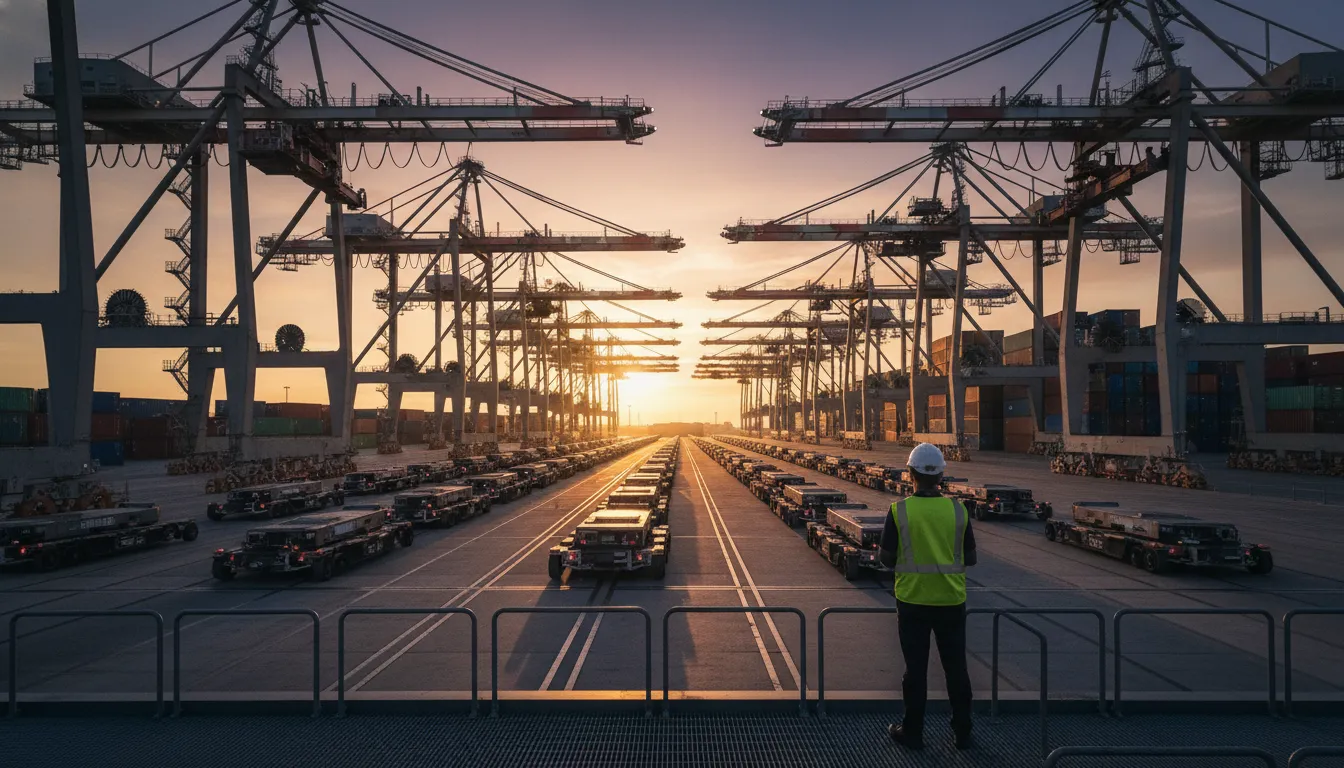
Researchers at MIT, partnering with warehouse automation firm Symbotic, published findings this week on a hybrid AI system that boosted robot fleet throughput by approximately 25 percent in simulated e-commerce warehouses. Meanwhile, the World Economic Forum declared that robotics has entered its "deployment era," and Morgan Stanley warned that most of the world is not prepared for the disruption ahead.
MIT's Hybrid Breakthrough
The MIT-Symbotic system, led by graduate researcher Han Zheng and senior author Professor Cathy Wu, combines deep reinforcement learning with classical optimization algorithms. A neural network trained through millions of simulated scenarios learns which robots should receive priority at any given moment, while a fast planning algorithm translates those decisions into real-time navigation instructions.
The key innovation is prediction: the system anticipates congestion and reroutes robots before bottlenecks form. "The planning system needs to be adaptive to these changes," Zheng told MIT News. Unlike previous systems that required engineers to manually program responses to every scenario, this approach learns and adapts autonomously. The team plans to scale the technology to warehouses with thousands of robots.
The Deployment Era
At the World Economic Forum, experts declared that the challenge is "no longer about making a robot move, but making it think — and act — responsibly alongside us." Mech-Mind Robotics CEO Shao Tianlan described scaling task-specific industrial robots into thousands of deployments, asserting that "the hardest advances in robotics are behind us."
Hyundai Motor Group and chip startup DEEPX unveiled an ultra-low-power AI chip consuming under 5 watts that serves as an "edge brain" for robots, enabling real-time autonomous decisions without cloud connectivity. Their partnership targets factories, logistics centers, and buildings — precisely the environments where autonomous robotics is now gaining traction.
A $5 Trillion Market — and a Workforce Reckoning
Morgan Stanley projects the humanoid robot market alone could reach $5 trillion by 2050, with warehouse robots reaching "critical mass" in 2026. The bank identified this year as a definitive AI breakthrough moment, noting that logistics automation spending is climbing more than 20 percent annually, driven by e-commerce growth, labor shortages, and the rising cost of inefficiency.
Facilities deploying automated systems already report 25 to 30 percent productivity gains. But Morgan Stanley's analysts delivered a blunt warning: companies that fail to integrate AI robotics now risk permanent competitive disadvantage. The bank highlighted a widening gap between nations investing in "physical AI" and those falling behind, with China designating "embodied intelligence" as a strategic priority in its 15th Five-Year Plan.
What Comes Next
The convergence is unmistakable. Academic breakthroughs like MIT's hybrid planning system are being commercialized in real time. Hardware costs are plummeting thanks to innovations like Hyundai's edge chips. And the economic incentives — labor shortages, efficiency demands, competitive pressure — are accelerating adoption faster than most policymakers anticipated.
The question is no longer whether autonomous robots will transform industry. It is whether workers, companies, and governments will adapt quickly enough to manage the transition.