'Hell Heron' Spinosaurus Rewrites Prehistoric Sahara
Scientists have named Spinosaurus mirabilis — the first new Spinosaurus species in over a century — a blade-crested, fish-hunting 'hell heron' found 95 million years ago deep in Niger's central Sahara.
A Century in the Making
In November 2019, a small scouting team led by Paul Sereno of the University of Chicago spotted unusual bone fragments weathering from the desert surface at Jenguebi, deep in Niger's central Sahara. Returning with a full 20-member international expedition in 2022 and unearthing multiple matching crest pieces, they confirmed something extraordinary: a species of Spinosaurus entirely new to science. Published in Science on February 23, 2026, the paper formally names Spinosaurus mirabilis — "the astonishing spine lizard" — the first new Spinosaurus species described in more than a century, since S. aegyptiacus was identified from Egypt in 1915.
A Blade-Crested Colossus
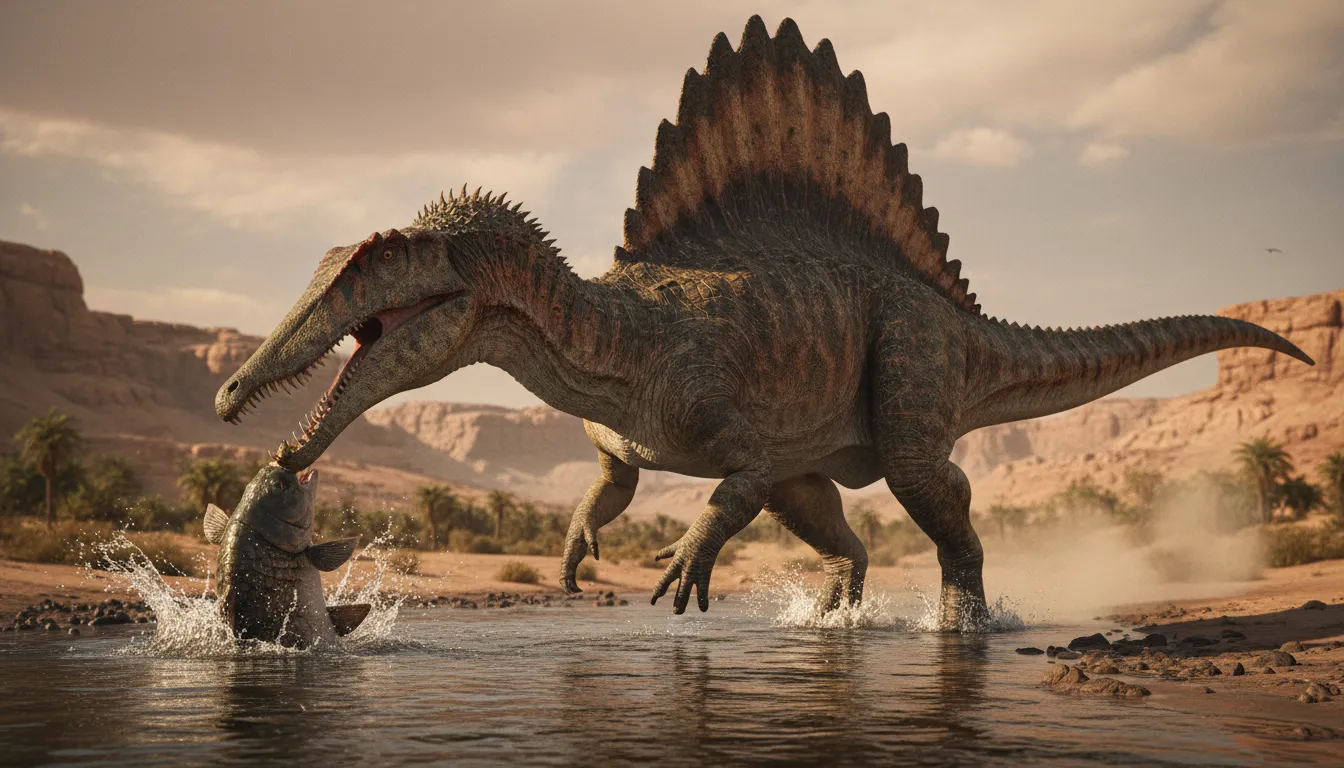
The most striking feature of S. mirabilis is its towering head crest, shaped like a scimitar and standing roughly 50 centimetres (20 inches) tall. Covered in keratin — similar to the casque of a cassowary — the crest was likely brightly coloured and served for mate attraction or territorial display. A prominent sail formed by elongated spines along the backbone added to the creature's dramatic silhouette. The specimens recovered at Jenguebi appear to be juveniles, meaning adults may have exceeded the estimated 12-metre (40-foot), 5-to-7-tonne body size the team reconstructed — already ranking S. mirabilis alongside Tyrannosaurus and Carcharodontosaurus as one of the largest meat-eating dinosaurs ever documented.
The Hell Heron of the Cretaceous
Rather than an ocean-going predator, S. mirabilis appears to have been a wader of inland rivers and floodplains. Its interlocking teeth — engineered to trap slippery fish — and retracted nostrils suited for partial submersion point to a hunting style Sereno memorably described as that of a "hell heron." "I suspect that this animal was fishing largely in about three feet of water," Sereno told NPR, conjuring the image of a multi-tonne predator stalking marshy shallows the way a modern heron hunts a stream. Those shallows teemed with prey: ancient fish in the region could exceed 2.7 metres (9 feet) in length. Sereno added that the elaborate crest was "about love and life — attracting a mate, defending your hot feeding shallows."
Rewriting Spinosaurid Ecology
The discovery's most profound implication may be geographic. The Jenguebi site lies 500 to 1,000 kilometres from the nearest ancient coastline — far into the continental interior. This directly challenges the long-held hypothesis that framed spinosaurids as uniquely coastal or fully aquatic animals. Prior debate had centred on whether S. aegyptiacus was a powerful swimmer analogous to a crocodile; S. mirabilis suggests the group thrived as shallow-water hunters across a far wider range of inland environments, sharing vast river systems with other giant theropods in what was then a lush, marshy landscape.
Natural History Museum palaeontologist David Hone welcomed the find but cautioned that fragmentary remains mean "we need to discover better preserved specimens to fully understand how spinosaurids evolved." Yet the hell heron's emergence from the Sahara sand underscores how much the fossil record has yet to reveal — and how dramatically a single expedition can rewrite the map of prehistoric life.