How Beaver Dams Store Carbon and Reshape Rivers
Beavers are nature's most prolific engineers, building dams that create wetlands, store massive amounts of carbon, reduce flooding, and boost biodiversity — making them a surprisingly powerful tool in fighting climate change.
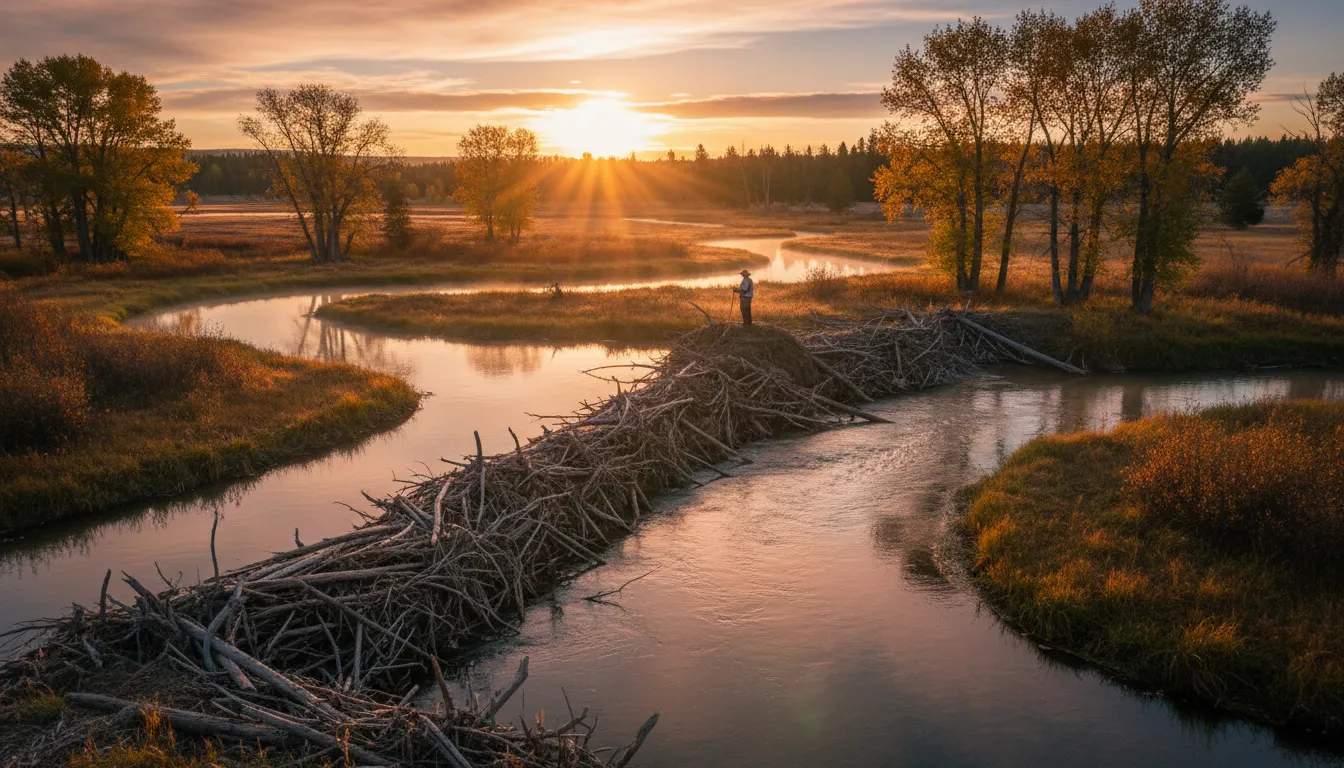
Nature's Original Engineers
Few animals reshape their environment as dramatically as the beaver. By felling trees and packing mud, sticks, and stones across streams, beavers build dams that can stretch dozens of metres wide and persist for decades. The structures impound water, flood surrounding land, and create entirely new wetland ecosystems — earning beavers the title of ecosystem engineers.
Scientists have long known that beaver activity transforms landscapes. But recent research is revealing just how significant those transformations are — not only for biodiversity, but for the global carbon cycle and climate resilience.
How a Beaver Dam Works
A beaver dam is deceptively simple. The animals harvest branches and small trees with their powerful incisors, then weave them together with mud, gravel, and vegetation to block a stream's flow. Water backs up behind the dam, forming a pond. Over time, sediment accumulates, the water table rises, and what was once a narrow stream corridor becomes a complex mosaic of open water, marshland, and wet meadow.
This transformation alters hydrology in profound ways. The dam slows peak river flows — studies show reductions of roughly 26% compared to undammed watersheds — which helps buffer downstream communities against flooding. At the same time, the raised water table recharges groundwater and sustains stream flows during dry periods.
Turning Streams Into Carbon Sinks
A landmark 2026 study published in Communications Earth & Environment, led by the University of Birmingham and Wageningen University, put hard numbers on beavers' climate impact for the first time. Researchers examined a beaver-engineered wetland in northern Switzerland that had been active for over 13 years.
The results were striking. The wetland accumulated an estimated 1,194 tonnes of carbon — roughly 10.1 tonnes per hectare per year, up to ten times more than comparable areas without beaver activity. Sediments in the beaver ponds contained up to eight times more organic carbon than nearby forest soils.
Crucially, methane emissions from the wetland were negligible, making up less than 0.1% of the total carbon budget. That matters because methane is a potent greenhouse gas, and scientists had worried beaver ponds might release enough of it to cancel out carbon storage benefits.
When researchers scaled their findings to all suitable floodplain areas in Switzerland, they estimated beaver wetlands could offset 1.2–1.8% of the country's annual carbon emissions — with no human intervention or cost required.
Biodiversity Bonanza
Carbon storage is only part of the story. Beaver wetlands are biodiversity hotspots. Research shows that after 12 years of beaver presence, plant species richness increases by 46% on average, while the cumulative number of species recorded rises by 148%. Habitat heterogeneity — the variety of microenvironments available to different organisms — climbs by 71%.
The ponds, channels, and flooded meadows beavers create provide habitat for fish, amphibians, birds, insects, and mammals. In Britain, beaver-modified sites have shown measurable increases in bat activity, as the diverse wetland structure supports richer insect populations.
The Return of the Beaver
Hunted to near-extinction across Europe by the 19th century for fur and castoreum, beavers have staged a remarkable comeback. Sweden launched the first recovery project in the 1920s, and more than 200 formal reintroduction programmes have followed across 26 European countries.
In Britain, where beavers had been extinct for over 400 years, formal reintroduction began in Scotland's Knapdale in 2009. Wild populations now exist in Cornwall, Devon, Dorset, Kent, and Tayside. Around 100 beavers were set for release in the UK in early 2026, with more planned.
The reintroductions are not without tension. Beaver dams can flood agricultural fields, block fish passage, and fell commercially valuable trees. In Tayside, Scotland, conflicts between farmers and expanding beaver populations have required active management. Most conservation programmes now include mitigation measures such as dam removal or flow devices that let water pass through without destroying the structure.
Why Beavers Matter for Climate Strategy
One U.S. estimate values beaver ecosystem services at roughly $133 million annually in habitat and biodiversity protection, plus $75 million in greenhouse gas sequestration. In an era when governments spend billions on engineered carbon capture, beavers offer a free, self-sustaining alternative — provided they have suitable habitat.
The catch: when beavers abandon a site, stored carbon can gradually leak back into the atmosphere. Long-term benefits depend on maintaining healthy, stable populations. For policymakers weighing nature-based climate solutions, the message from the latest science is clear — the humble beaver punches far above its weight.