Why Greenland Is a Strategic Arctic Prize
Greenland sits at the crossroads of Arctic defense, rare earth minerals, and emerging shipping routes, making the world's largest island a focal point of great-power competition.
A Frozen Island With Outsized Importance
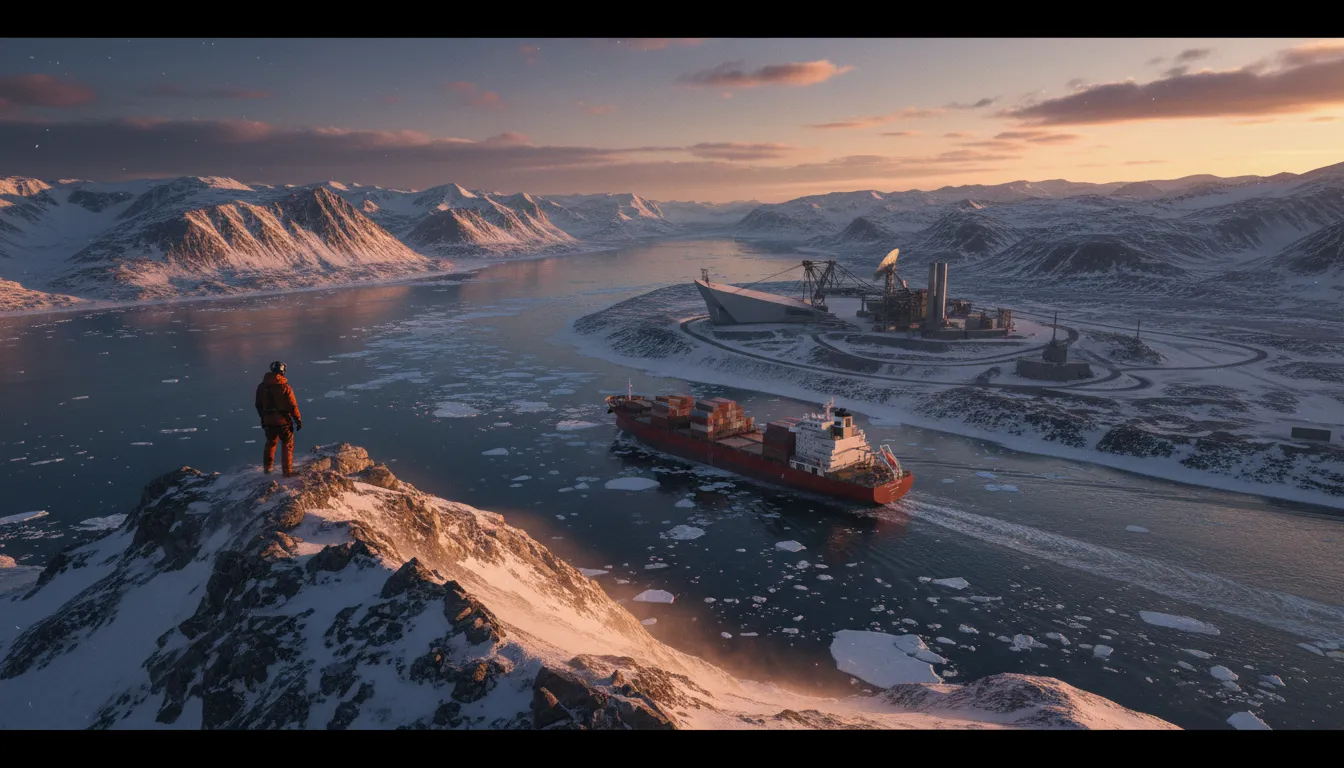
Greenland, the world's largest island, is home to roughly 56,000 people spread across a territory bigger than Western Europe. Most of it lies beneath an ice sheet up to three kilometers thick. Yet beneath the ice and surrounding ocean lies a combination of military geography, mineral wealth, and shipping potential that makes Greenland one of the most strategically contested places on Earth.
The GIUK Gap: NATO's Arctic Chokepoint
Greenland forms the western anchor of the GIUK Gap — the maritime corridor between Greenland, Iceland, and the United Kingdom. This passage is the primary bottleneck between the Arctic Ocean and the North Atlantic, and any submarine or warship moving from Russia's Northern Fleet toward Europe or North America must transit through it.
During the Cold War, NATO invested heavily in sonar arrays, patrol aircraft, and naval bases along the gap to track Soviet submarines. After the Soviet Union collapsed, attention drifted. It has returned with force: Russia has modernized its Northern Fleet, deployed advanced submarines, and expanded its Arctic military bases. NATO now considers the GIUK Gap a frontline in renewed great-power competition.
Missile Defense and Early Warning
Greenland hosts Pituffik Space Base (formerly Thule Air Base), one of the U.S. military's northernmost installations. Built in 1951, the base operates radar systems designed to detect ballistic missile launches aimed at North America. The shortest trajectory for a Russian intercontinental ballistic missile to reach the continental United States passes directly over the North Pole — and Greenland.
According to analysis from the Small Wars Journal, Greenland's position along transatlantic missile flight paths makes it irreplaceable for early-warning and space-tracking infrastructure tied to U.S. and NATO defense systems.
Rare Earth Minerals and Critical Resources
Greenland holds an estimated 36 million tonnes of rare earth elements, potentially the second-largest reserves in the world after China. These minerals — including neodymium, dysprosium, and graphite — are essential for manufacturing electric vehicle batteries, wind turbines, smartphones, and advanced military equipment.
China currently dominates rare earth production and processing, controlling well over half of global output. Western nations see Greenland as a potential hedge against that dependency. In 2025, the European Union designated Greenland's Amitsoq graphite deposit as a Strategic Project under its Critical Raw Materials Act, signaling the island's importance to supply-chain resilience.
However, development faces steep obstacles. Greenland's extreme climate, isolated terrain, limited infrastructure, and relatively low ore concentrations mean that meaningful production likely remains a decade or more away.
Emerging Arctic Shipping Routes
Climate change is reshaping the Arctic. As sea ice recedes, new shipping routes are opening that could dramatically shorten travel times between Asia and Europe compared with the Suez Canal. Greenland sits alongside these emerging corridors, and whoever controls the surrounding waters and ports will influence global trade flows.
Both Russia and China have invested in Arctic shipping infrastructure. China has declared itself a "near-Arctic state" and pursued scientific, economic, and military footholds in the region — further raising the strategic stakes around Greenland.
An Island Caught Between Powers
Greenland is a semi-autonomous territory of Denmark with its own parliament and growing aspirations for full independence. But its tiny population and limited economy make true self-sufficiency difficult. Denmark has historically spent little on Greenland's defense, a gap that has drawn criticism from Washington.
The tension between Greenland's self-determination, Denmark's sovereignty, and great-power interest ensures that the island will remain at the center of Arctic geopolitics for years to come. In a world where missile trajectories, mineral supply chains, and melting ice all converge on the same frozen landmass, Greenland's strategic value is only growing.