How Cluster Munitions Work—and Why 112 Nations Ban Them
Cluster munitions scatter hundreds of explosive submunitions across wide areas. Their high failure rates turn battlefields into minefields for decades, prompting most countries to outlaw them—though major military powers refuse to sign.
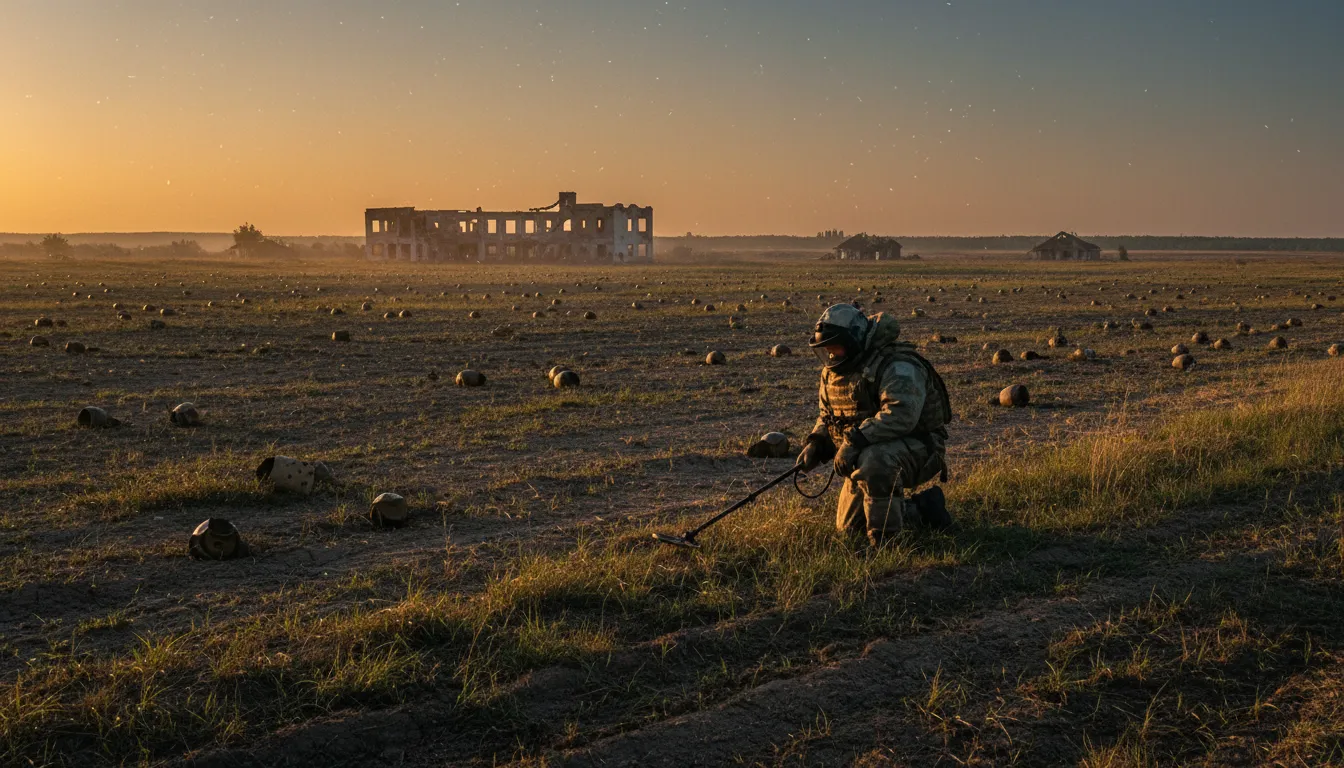
A Weapon That Keeps Killing
Cluster munitions are among the most controversial weapons in modern warfare. Dropped from aircraft or fired from artillery, a single canister breaks open mid-air and scatters dozens to hundreds of smaller explosive charges—called submunitions or bomblets—across an area the size of several football fields. The design makes them devastatingly effective against dispersed military targets. It also makes them uniquely dangerous to civilians, both during and long after a conflict ends.
How They Work
A cluster munition consists of two parts: a dispenser (the bomb, rocket, or shell) and the submunitions it carries inside. When launched, the dispenser travels toward the target area and opens at a preset altitude—typically between 100 and 1,000 metres above the ground. The submunitions spill out, spread by wind and rotation, and are designed to detonate on impact.
The standard U.S. submunition, known as the dual-purpose improved conventional munition (DPICM), combines a shaped charge that can penetrate armoured vehicles with a fragmentation shell that scatters shrapnel against infantry. A single 155mm artillery shell carries 76 to 88 of these bomblets. Other designs include incendiary submunitions, anti-runway penetrators, and sensor-fused weapons that detect and strike vehicles autonomously.
Military analysis dating to the Vietnam War found cluster munitions roughly eight times more effective at producing casualties than conventional projectiles of equivalent size, because they saturate a wide area rather than striking a single point.
The Dud Problem
The core controversy lies in what happens when submunitions fail to explode. Every bomblet that malfunctions becomes, in effect, a landmine—armed, unstable, and waiting to be disturbed by a farmer's plough, a child's hand, or a returning refugee's footstep.
Failure rates vary enormously. The United States claims its newer DPICM rounds have dud rates below 2.35 percent, but independent testing and battlefield conditions often produce far worse results. Russian submunitions have documented failure rates of up to 40 percent. During the 2006 Israel–Lebanon conflict, Israel fired an estimated 4.6 million submunitions into southern Lebanon; roughly one million failed to detonate, according to the International Committee of the Red Cross. More than 500 civilian casualties have been recorded in Lebanon from those duds alone.
Even a "low" dud rate is dangerous at scale. A single artillery shell with a 2 percent failure rate still leaves approximately two unexploded bomblets on the ground—each one requiring manual clearance by demining teams.
The Human Cost
Global casualty tracking confirms at least 23,000 documented cluster munition victims, though the Arms Control Association estimates the true toll ranges between 56,500 and 100,000. The overwhelming majority—over 90 percent—are civilians. Children account for nearly half of all post-conflict casualties, partly because some bomblets are small, brightly coloured, and easily mistaken for toys.
Survivors face devastating injuries. Medical studies from Lebanon document rates of upper-limb amputation in 62 percent of tracked cases, lower-limb amputation in 83 percent, and post-traumatic stress disorder in 43 percent. Wound infections, traumatic brain injury, and lifelong disability are common outcomes.
The International Ban—and Who Refuses
The scale of civilian harm led to the Convention on Cluster Munitions (CCM), adopted in Dublin in May 2008 and entering force in August 2010. The treaty prohibits the use, production, stockpiling, and transfer of cluster munitions. It requires signatories to destroy existing stockpiles within eight years and clear contaminated land within ten.
As of 2026, 112 nations have ratified the convention. Yet the world's largest military powers—the United States, Russia, China, India, and Israel—have all refused to sign. These five countries are also among the biggest producers and users of cluster munitions. Their absence from the treaty means cluster bombs continue to appear in active conflicts, from Ukraine to Yemen to the Middle East.
Lithuania withdrew from the convention in March 2025, citing security concerns on NATO's eastern flank—a signal that geopolitical pressures can erode even established arms-control norms.
A Weapon With a Long Memory
Cluster munitions contaminate land for decades. Laos, bombed heavily during the Vietnam War era, still records casualties from American submunitions more than 50 years later. Clearance is slow, expensive, and dangerous work. Until every dud is found—or every affected country is cleared—cluster munitions remain weapons whose damage far outlasts the wars that deployed them.


