How Light Pollution Works—and Why It's Erasing Stars
Artificial light at night creates skyglow, disrupts wildlife, suppresses melatonin, and has brightened Earth's nights by 16% since 2014. Here's how it works and what can be done.
What Is Light Pollution?
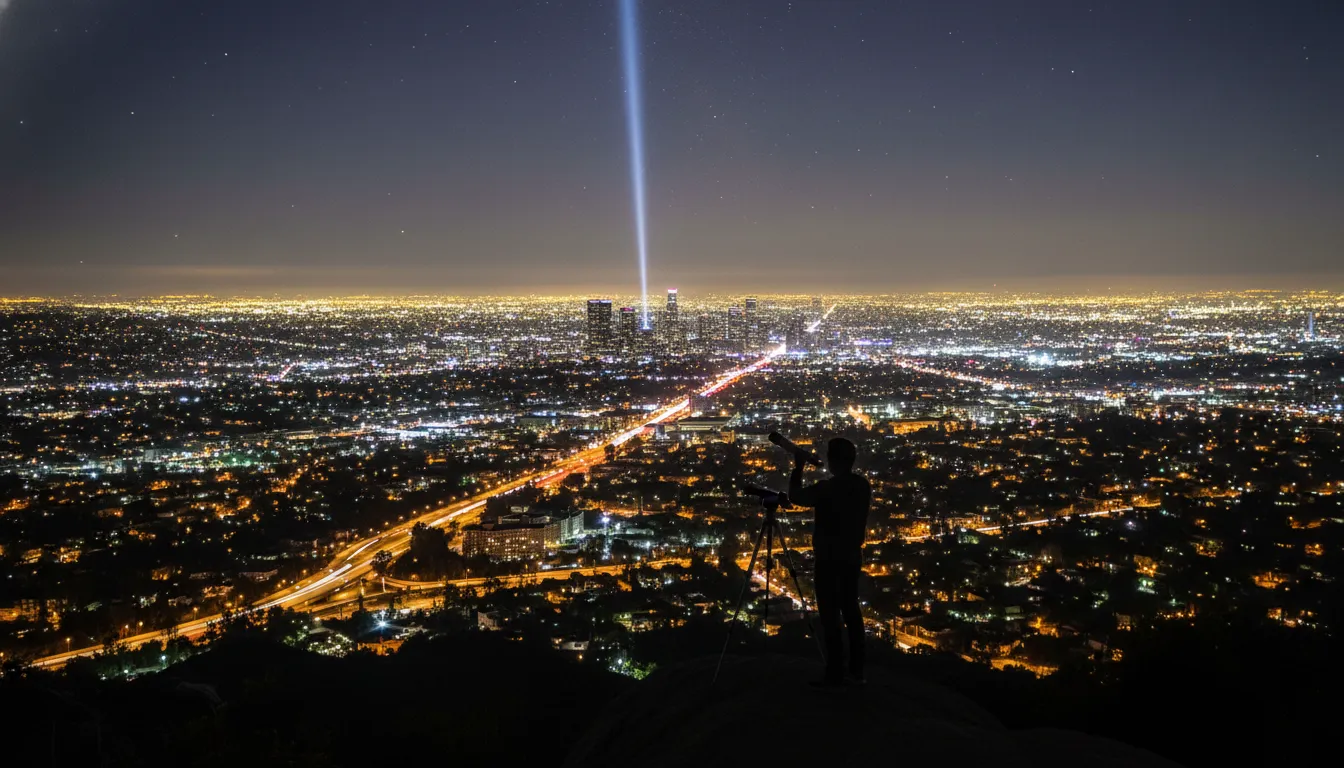
On any clear night, a person standing in a city can see perhaps two dozen stars. Move to a dark rural location and that number jumps to several thousand. The difference is light pollution—the excessive or misdirected artificial light that washes out the night sky and disrupts ecosystems worldwide.
Unlike chemical pollutants, light pollution is not a substance. It is wasted energy: photons from streetlamps, billboards, parking lots, and building facades that scatter off particles in the atmosphere and create a luminous dome called skyglow. According to satellite data analyzed in a study published in Nature, Earth's artificially lit surface brightened by roughly 16% between 2014 and 2022.
How It Happens: Three Mechanisms
Light pollution manifests in three distinct ways, each caused by poorly designed or aimed lighting:
- Skyglow — Upward-directed light scatters off atmospheric aerosols and moisture, creating the orange or white haze visible above cities. It is the most widespread form, detectable hundreds of kilometres from its source.
- Glare — Excessively bright, unshielded light that shines directly into observers' eyes, reducing visibility rather than improving it.
- Light trespass — Artificial light spilling beyond its intended area, such as a security floodlight illuminating a neighbour's bedroom window.
The common thread is bad fixture design. When a lamp emits light sideways or upward instead of focusing it downward where it is needed, much of its energy is wasted—contributing to skyglow while failing to improve safety or visibility on the ground.
Why It Matters: Health and Wildlife
Artificial light at night (ALAN) does far more than obscure the Milky Way. It disrupts the circadian rhythm—the internal 24-hour clock that governs sleep, hormone release, and metabolism in nearly every living organism.
In humans, exposure to light after dark suppresses the production of melatonin, the hormone that signals the body to sleep. Chronic melatonin disruption has been linked to sleep disorders, obesity, depression, and an elevated risk of certain cancers, according to research published in the journal Environmental Health Perspectives.
Wildlife faces equally severe consequences. A 2025 review in BMC Environmental Science catalogued impacts across species: sea turtle hatchlings, which navigate by moonlight reflected off the ocean, crawl inland toward artificial lights and die of dehydration. Nocturnal insects swarm around lamps until they perish from exhaustion, depleting a critical food source for birds and bats. Amphibians such as the common toad delay mating under artificial light, reducing reproductive success.
The LED Paradox
The global transition to LED streetlights was expected to reduce light pollution because LEDs are more energy-efficient. Instead, the opposite has happened. Because LEDs are cheaper to operate, municipalities and businesses have installed more of them and left them on longer—a textbook example of the rebound effect.
Colour temperature adds another problem. Many early LED streetlights emit light at 4000–5000 Kelvin, which contains a high proportion of blue wavelengths. Blue-rich light scatters more effectively in the atmosphere than warmer tones, amplifying skyglow far beyond the light source. It also suppresses melatonin more aggressively than the amber glow of older sodium-vapour lamps.
What Can Be Done
The good news is that light pollution is one of the most reversible forms of environmental damage. Turn off a light and the pollution vanishes instantly. DarkSky International recommends several practical steps:
- Shield fixtures so that no light escapes above the horizontal plane.
- Use warm-coloured LEDs (2200–3000 Kelvin) that emit minimal blue light.
- Install timers and dimmers to reduce output when streets are empty.
- Light only what is needed—many outdoor areas are dramatically over-illuminated.
Some regions are already acting. Satellite data shows that Europe reduced its nighttime light emissions by roughly four percent over the study period, driven by energy-conservation policies and growing awareness of ecological harm. Over 200 sites worldwide have earned International Dark Sky Place certification, demonstrating that communities can protect darkness without sacrificing safety.
A Problem Hiding in Plain Sight
Light pollution rarely triggers the same alarm as air or water contamination, partly because many people have never experienced a truly dark sky. Yet its effects ripple through human health, ecosystems, energy budgets, and scientific research. Understanding how artificial light escapes into the night is the first step toward reclaiming the stars.