How Meatpacking Plants Work—and Why They're So Dangerous
Modern meatpacking plants process hundreds of animals per hour using high-speed disassembly lines—but the relentless pace comes at a steep cost to workers, who are injured at more than twice the rate of other industries.
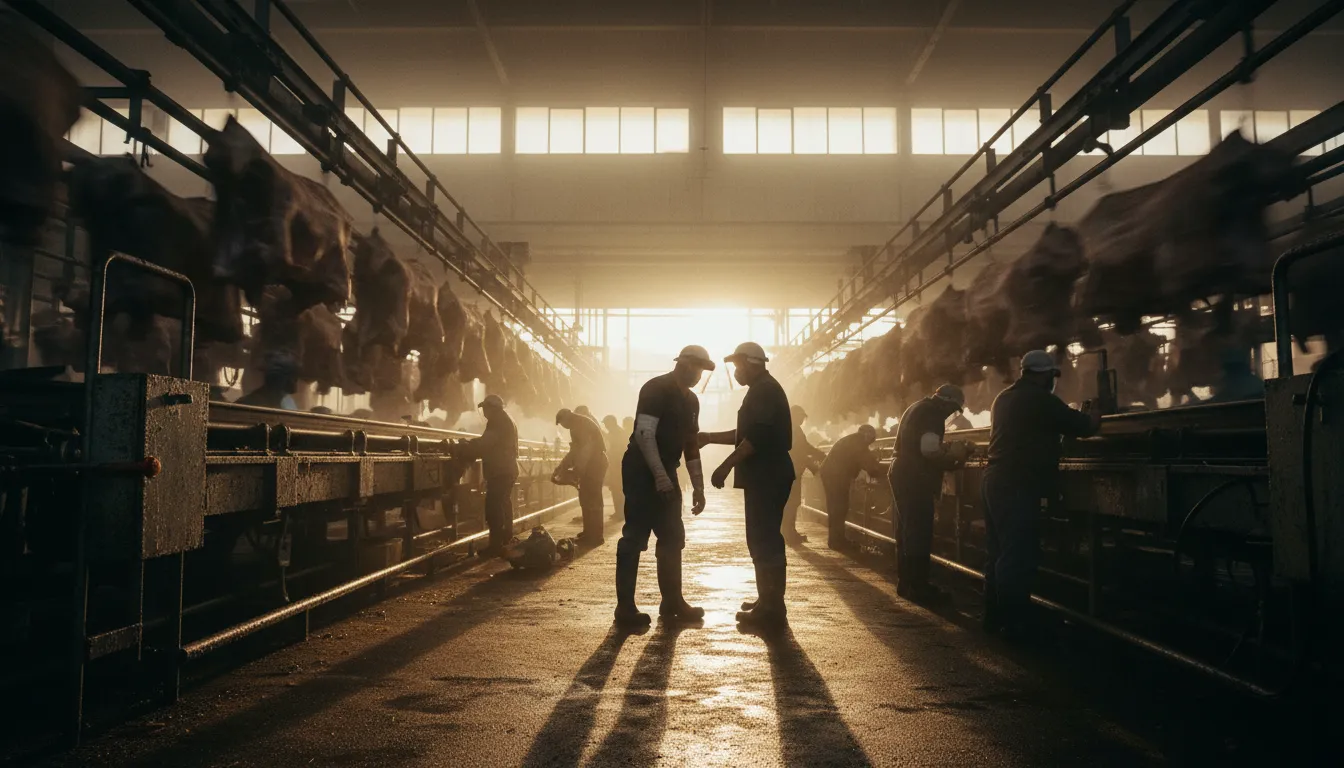
From Livestock to Supermarket Shelf
Every steak, pork chop, or chicken breast that reaches a supermarket shelf passes through one of the most physically demanding industrial environments in the world. Meatpacking—the process of slaughtering animals, breaking down carcasses, and preparing meat for distribution—is a massive global industry. In the United States alone, more than 500,000 workers process roughly 9 billion chickens, 120 million hogs, and 32 million cattle each year.
The work happens on what industry insiders call a disassembly line: a continuous moving conveyor or overhead rail system along which stationary workers each perform a single, highly repetitive task—a cut here, a trim there—thousands of times per shift. The concept actually predates Henry Ford's famous assembly line; Chicago's meatpacking plants in the 1870s pioneered the idea of moving the product past the worker, not the other way around.
The Disassembly Line Step by Step
When animals arrive at a processing facility, the sequence is broadly the same regardless of species:
- Stunning and slaughter: Animals are rendered unconscious—via captive bolt, electric shock, or gas—before being bled out.
- Cleaning and hide removal: Carcasses are scalded, dehaired (pigs), or skinned (cattle), then eviscerated.
- Inspection: Federal inspectors from the USDA's Food Safety and Inspection Service examine each carcass for disease or contamination.
- Fabrication: Large carcasses are broken into primal cuts—loins, ribs, shoulders—before being trimmed into consumer portions.
- Packaging and chilling: Finished cuts are vacuum-sealed and rapidly chilled to prevent bacterial growth before shipping.
Line speeds dictate how fast each of these steps must happen. A typical beef plant today processes up to 400 cattle per hour—eight times the rate of early Chicago plants in the 1870s, which managed around 50 per hour. Poultry plants move even faster, with some running at 140 birds per minute.
Why the Work Is So Hazardous
Speed is the root of most danger. A meat cutter on a beef fabrication line may perform the same knife stroke every two to three seconds—roughly 10,000 repetitions in a single eight-hour shift. The combination of cold temperatures (needed to keep meat safe), wet floors, sharp tools, heavy carcasses, and relentless pace creates a uniquely hostile environment.
According to the Occupational Safety and Health Administration (OSHA), the main hazards include:
- Musculoskeletal disorders from repetitive motion—strains, sprains, and carpal tunnel syndrome
- Lacerations and amputations from knives, band saws, and moving machine parts
- Slips and falls on blood- and fat-slicked floors
- Biological exposures to pathogens from blood, feces, and animal tissue
The numbers are striking. Meatpacking workers are injured at 2.4 times the rate of workers in other industries, and illnesses occur at 17 times the rate, according to data compiled by the Economic Policy Institute. On average, 27 US line workers per day suffer an amputation, loss of an eye, or injury serious enough to require hospitalization.
A USDA study found that at current line speeds, 81% of chicken processing workers face significantly elevated risk of developing carpal tunnel syndrome and other debilitating upper-extremity disorders. For hog slaughter workers, the figure is 46%.
A Problem That Has Persisted for Over a Century
The dangers of the meatpacking industry are not new. In 1906, journalist Upton Sinclair published The Jungle, an exposé of Chicago's Union Stock Yards that shocked the public with its descriptions of filthy conditions and worker exploitation. The outcry forced President Theodore Roosevelt to push through the Meat Inspection Act and Pure Food and Drug Act that same year—landmark food safety legislation that still underpins modern regulations.
Yet the labor conditions Sinclair described—low wages, dangerous speeds, a workforce of vulnerable immigrants—have proved remarkably persistent. The industry today is dominated by a handful of global giants, with the top four beef processors controlling roughly 80% of US beef slaughter capacity. Critics argue this consolidation reduces competitive pressure to improve worker conditions.
The Line Speed Debate
The central policy battle in meatpacking safety is over line speed limits. The USDA has historically capped how fast plants can run, but has repeatedly granted waivers allowing faster speeds, arguing that modern technology can compensate. Worker advocates counter that faster lines mean more injuries—a position backed by the agency's own research.
When workers demand safer conditions, the stakes are high not just for them but for the entire food supply chain. A single large beef processing plant can handle up to 5% of national daily beef production, meaning a strike or shutdown ripples quickly to grocery store shelves and consumer prices.
Who Works in These Plants
The meatpacking workforce is disproportionately made up of immigrant and refugee workers, many of whom face language barriers that complicate safety training and limit their ability to report violations. Union representation—primarily through the United Food and Commercial Workers (UFCW)—has been a key mechanism for improving conditions, though coverage is uneven across the industry.
The combination of physically brutal work, relatively low pay, and a workforce with limited labor-market alternatives has made meatpacking a perennial flashpoint for labor rights debates—and a window into the true cost of cheap meat.