How Oyster Reefs Work—and Why They Guard Coastlines
Oyster reefs are among the most valuable yet imperiled marine ecosystems on Earth. This explainer covers how oysters build living reefs, why these structures protect shorelines and filter water, and how scientists are racing to restore them.
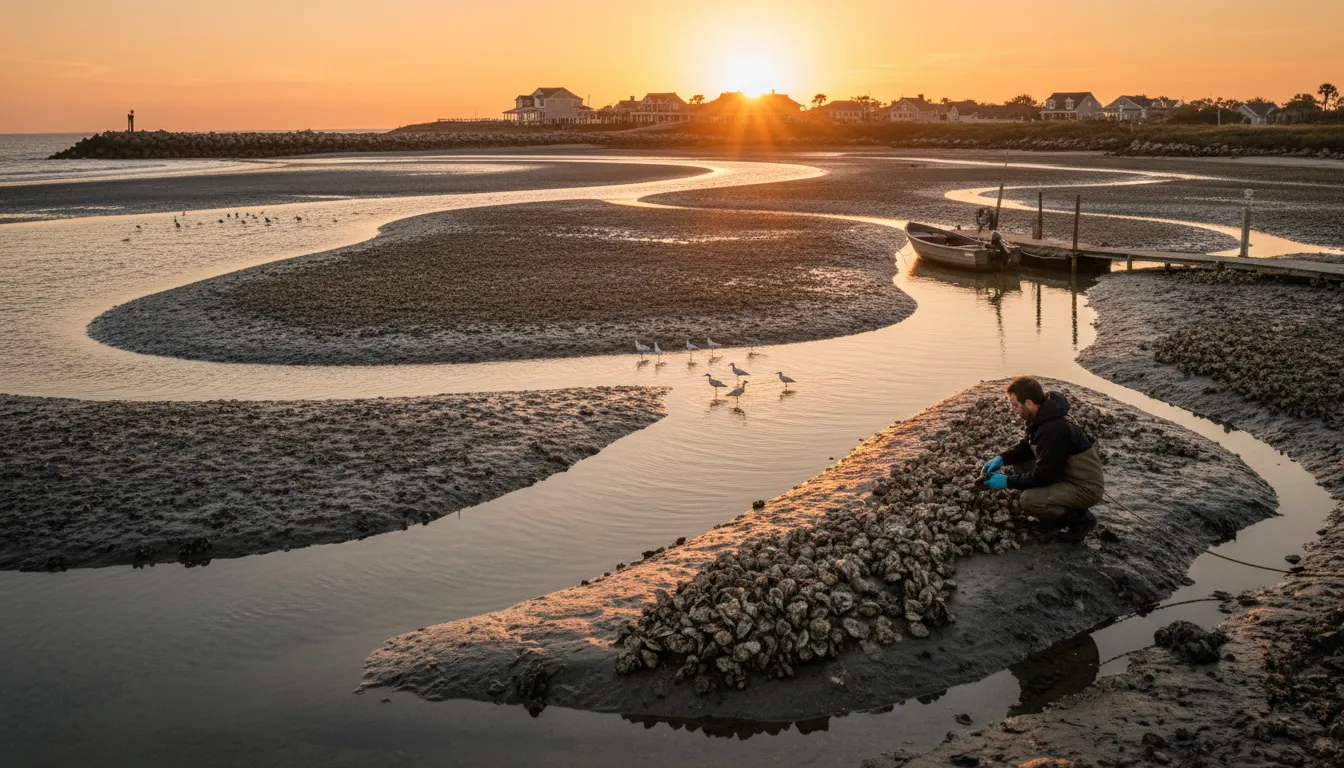
Living Breakwaters Beneath the Waves
They lack the visual drama of coral, yet oyster reefs rank among the hardest-working ecosystems on the planet. Built layer upon layer by successive generations of mollusks cementing themselves onto older shells, these underwater structures break waves, filter pollutants, and shelter hundreds of marine species. Scientists estimate that 85 percent of the world's oyster reefs have vanished, making them the most severely impacted marine habitat on Earth—and one of the most urgent targets for restoration.
How Oysters Build Reefs
An oyster reef begins when free-swimming larvae, called spat, settle onto a hard surface—typically the shells of previous generations. Each animal cements itself permanently in place and grows a rough, irregular shell that creates crevices and ridges. Over decades, this process stacks into massive three-dimensional structures that can stretch for kilometres along estuary floors.
Recent research published in Nature reveals that the geometry of these reefs is far from random. Scientists at the Australian Museum used high-resolution 3D photogrammetry to map surviving Sydney rock oyster reefs and found that specific ridge heights and micro-habitat patterns—not simply larger or taller structures—maximise the survival of juvenile oysters by shielding them from predators, overheating, and desiccation. When the team replicated those geometries on concrete tiles, recruitment rates soared compared with flat or overly complex designs.
Coastal Protection: A Natural Seawall
Oyster reefs function as living breakwaters. Their rough, porous surfaces dissipate wave energy before it reaches the shoreline, reducing erosion in much the same way as engineered rock armour—but at a fraction of the cost. Sediment accumulates in the calmer water between the reef and the shore, which can enable the establishment of salt marshes and mangroves that provide additional protection.
Research compiled by NOAA Fisheries confirms a direct correlation between oyster density and wave attenuation, making reef restoration an increasingly attractive "nature-based solution" for communities facing rising seas and stronger storms.
Filtering Entire Estuaries
A single adult oyster can filter up to 180 litres of water per day, trapping algae, sediment, and excess nitrogen as it feeds. Multiply that by millions of individuals on a healthy reef and the effect is transformational: clearer water allows sunlight to reach seagrass beds, which in turn sequester carbon and nurture fish nurseries.
A study in Estuaries and Coasts found that the filtration capacity of U.S. oyster populations has declined by a median of 85 percent since the early 1900s, contributing to turbidity, nutrient overload, and harmful algal blooms in bays from Chesapeake to the Gulf of Mexico.
Why 85 Percent Disappeared
The collapse was driven primarily by destructive overharvesting—dredges that scraped reefs down to bare mud—followed by coastal urbanisation, pollution, and introduced diseases. When Captain John Smith explored the Chesapeake Bay in 1607, oyster reefs were so massive that ships had to navigate around them. Today, roughly one percent of that population remains.
The Race to Restore Them
Restoration typically involves depositing recycled oyster shell or concrete substrate seeded with spat in strategic locations. NOAA's Restoration Center has funded more than 70 projects across 15 U.S. states, and monitoring shows that over 85 percent of restored reefs now meet minimum density and biomass targets within six years.
Yet a 2022 meta-analysis in Science Advances cautioned that even successful restoration leaves a global shortfall of about 35 percent below pre-disturbance levels, underscoring that preventing further loss is as critical as rebuilding. The latest geometry research from Australia offers a practical upgrade: by mimicking the natural architecture that evolution optimised over millennia, engineers can design artificial reefs that give baby oysters a far better chance of survival.
Why It Matters Beyond the Coast
Oyster reefs deliver ecosystem services valued at up to $99,000 per hectare per year—excluding the harvest itself. They buffer storm surges, improve water quality, support commercial fisheries, and lock away carbon. As climate change intensifies coastal flooding and ocean acidification threatens shell-building organisms worldwide, understanding and restoring these unassuming reefs may be one of the smartest investments a coastal community can make.