How Rotating Detonation Engines Work—and Why They Matter
Rotating detonation engines harness continuous supersonic explosions in a ring-shaped chamber to generate thrust far more efficiently than conventional combustion, promising lighter, simpler, and more powerful propulsion for rockets, jets, and missiles.
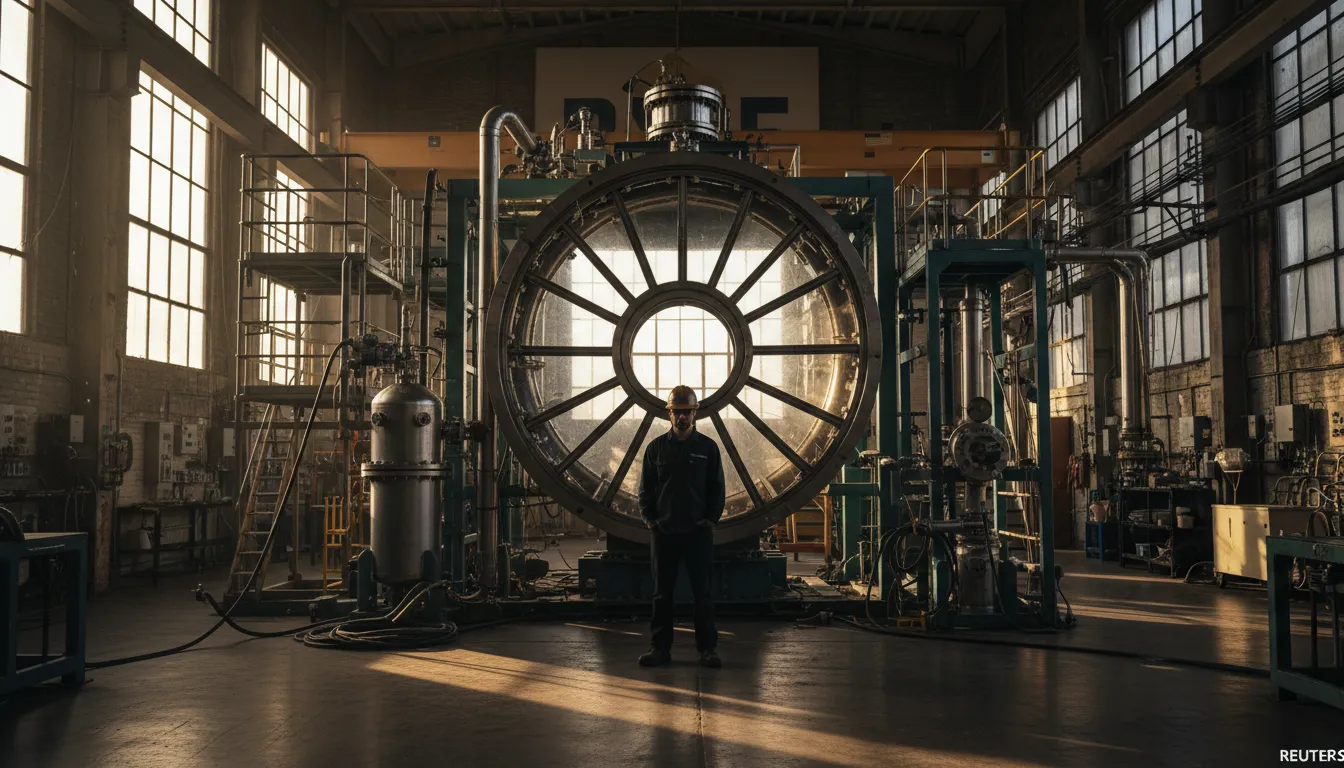
A Supersonic Explosion That Never Stops
Conventional rocket and jet engines burn fuel through deflagration—a controlled, subsonic combustion process perfected over decades. But engineers have long known that a faster, more violent form of combustion exists: detonation, where a shock wave rips through a fuel-air mixture at supersonic speed, releasing energy far more efficiently. The challenge was always harnessing it without destroying the engine.
The rotating detonation engine (RDE) solves that problem by channeling a continuous detonation wave around a ring-shaped chamber, producing thrust with no moving parts, less fuel, and dramatically less weight than traditional designs.
How It Works
An RDE consists of an annular combustion chamber—essentially two concentric cylinders forming a ring-shaped gap. Fuel and oxidizer are injected through small holes or slits at one end of the ring. An igniter starts the first detonation, and from that point on, the process is self-sustaining.
The detonation wave races around the annulus at speeds exceeding one mile per second, compressing and igniting the fresh propellant mixture as it passes. Each wave leaves roughly 100 microseconds for new propellant to fill the gap before the next pass. The superheated exhaust gases expand out through a nozzle at the other end, generating thrust.
Because the detonation is continuous and self-sustaining, the engine needs no turbines, no spark plugs firing repeatedly, and no complex moving parts. The result is a mechanically simple device that extracts more useful work from every kilogram of fuel.
Why Detonation Beats Deflagration
The efficiency advantage comes down to thermodynamics. In conventional deflagration, combustion occurs at roughly constant pressure, and much of the energy dissipates as waste heat. Detonation, by contrast, is a pressure-gain process—the shock wave compresses the mixture before burning it, extracting more mechanical energy from the same amount of fuel.
This translates to real-world gains. RDEs are theoretically up to 25% more fuel-efficient than conventional engines. An RDE producing thrust equivalent to NASA's RL-10 engine could be 40% shorter in length, according to research at Purdue University. Power density can be an order of magnitude higher than current devices.
From Theory to Hot Fire
The concept dates to the 1950s, when Soviet researcher B. V. Voitsekhovskii and American engineer J. A. Nicholls at the University of Michigan independently explored detonation-based propulsion. For decades, the idea remained largely theoretical—controlling a continuous supersonic explosion inside a small metal ring was an engineering nightmare.
Progress accelerated in the 2000s. Aerojet Rocketdyne has conducted over 520 RDE tests since 2010. In 2021, Japan's JAXA became the first agency to fly an RDE in space, using methane and oxygen propellants. NASA successfully tested a full-scale, 3D-printed, liquid-cooled RDE at Marshall Space Flight Center in 2022, achieving over 4,000 pounds of thrust.
Most recently, in April 2026, Astrobotic set a new record with its Chakram engine: a 300-second continuous burn producing over 4,000 pounds of thrust, with no visible hardware damage afterward. Meanwhile, RTX is developing RDEs for military applications, including hypersonic missiles that could fly farther and faster within existing airframe constraints.
The Engineering Challenge
RDEs are not yet ready to replace conventional engines everywhere. The biggest hurdle is fuel injection timing—propellant must be delivered with microsecond precision to meet each passing detonation wave. Too much fuel reduces efficiency or prevents ignition; too little produces insufficient thrust. Managing the extreme heat and vibration of continuous detonation also demands advanced materials and cooling strategies.
What Comes Next
Despite these challenges, the trajectory is clear. Astrobotic plans to integrate Chakram into lunar landers and orbital transfer vehicles. GE Aerospace demonstrated a Mach 2.5 turbofan with a rotating detonation ramjet in 2023, pointing toward future fighter jets and commercial aviation. For space launch, the combination of higher efficiency, lower weight, and mechanical simplicity could significantly reduce the cost of reaching orbit.
After seven decades of theory, the rotating detonation engine is finally proving that controlled explosions can be better than controlled burns.