How the White House Correspondents' Dinner Works
The annual White House Correspondents' Dinner brings together journalists, politicians, and celebrities in a century-old tradition that celebrates press freedom — and occasionally sparks controversy.
A Century-Old Tradition
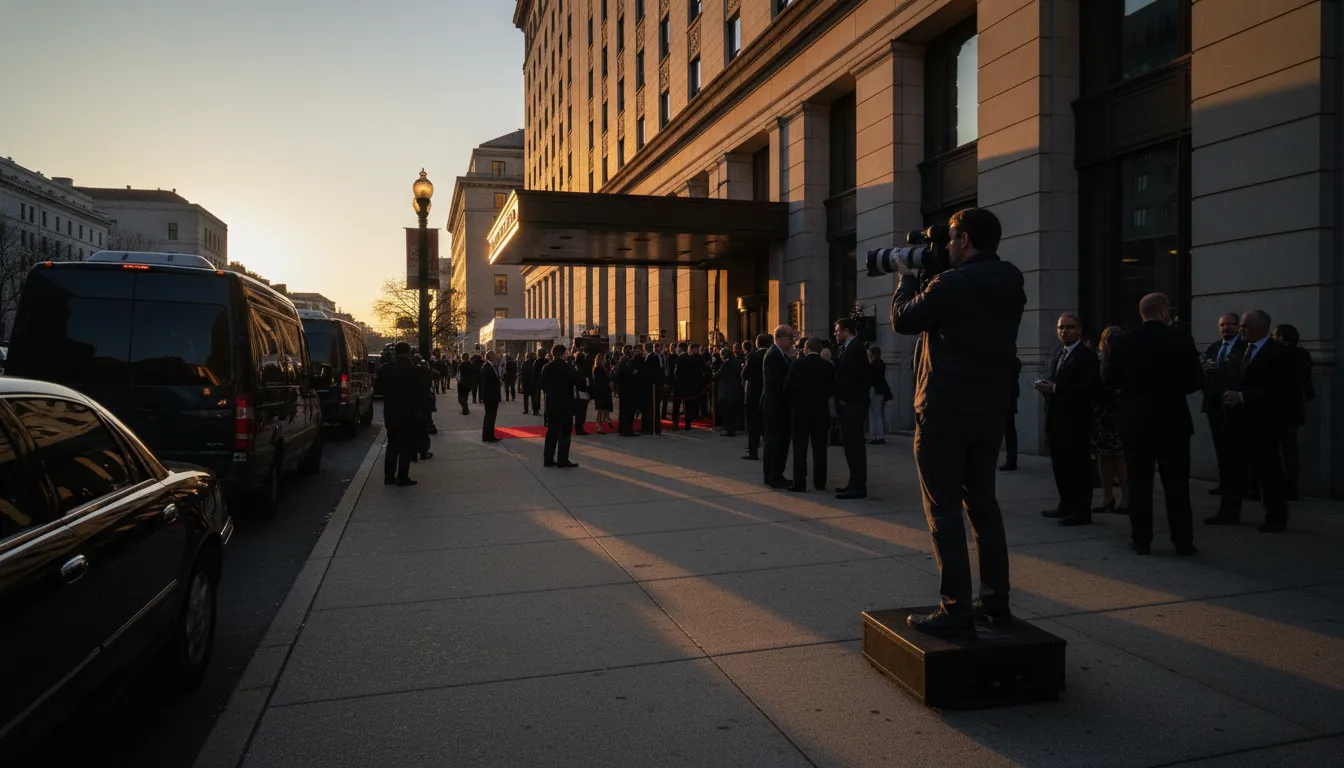
Every spring, roughly 2,600 journalists, politicians, and celebrities gather in the ballroom of the Washington Hilton for the White House Correspondents' Dinner — often dubbed "Nerd Prom." The black-tie gala is organized by the White House Correspondents' Association (WHCA), which was founded on February 25, 1914, after rumors spread that a congressional committee would decide which reporters could attend President Woodrow Wilson's press conferences. Journalists banded together to protect their own access, and the WHCA has guarded that principle ever since.
The first dinner was held in 1921, and with few exceptions, every sitting president since Calvin Coolidge in 1924 has attended at least once during their term.
What the WHCA Actually Does
The dinner is the association's most visible event, but the WHCA's year-round mission is far broader. It advocates for press access to the president and White House officials, and it assigns seating in the 49-seat James S. Brady Press Briefing Room — a small but symbolically powerful act that determines which outlets sit front and center at daily briefings.
The WHCA board allocates seats based on criteria including an outlet's long-standing service on the White House beat, geographic diversity, and ideological range. As the association has stated: "In a free country, leaders must not be able to choose their own press corps."
Revenue from the annual dinner funds journalism scholarships for college students and programs that educate the public about the value of the First Amendment and a free press.
How the Dinner Is Structured
The evening follows a well-established format. After a cocktail reception, attendees sit for a formal dinner. The program then unfolds in three acts:
- Awards and scholarships — The WHCA recognizes outstanding political journalism from the past year and announces scholarship recipients.
- The presidential address — The sitting president takes the podium, traditionally mixing policy remarks with self-deprecating humor.
- The headliner — Since 1983, a comedian has typically closed the show with a roast of both the president and the press corps.
Before World War II, the entertainment was more eclectic — singing between courses, homemade films, and big-name variety performances. The modern comedian-driven format took shape during the Reagan era, when humorist Mark Russell delivered the first dedicated comedic set.
Memorable — and Divisive — Moments
The dinner has produced some of Washington's most quoted moments. In 2006, Stephen Colbert stood feet from President George W. Bush and delivered a blistering satirical monologue that divided audiences but became a viral sensation. In 2011, President Barack Obama roasted Donald Trump — then a celebrity guest — over his promotion of the "birther" conspiracy, quipping, "Tonight, for the first time, I am releasing my official birth video," before playing the opening of Disney's The Lion King.
Not every performance lands well. In 2018, comedian Michelle Wolf's sharp personal jokes about White House press secretary Sarah Huckabee Sanders split the press corps and reignited debate about how far dinner humor should go.
Why It Matters — and Why It's Controversial
Supporters argue the dinner embodies a healthy democratic tradition: the press and the president sharing a room as equals, bound by mutual accountability. The scholarships it funds help train a new generation of journalists, and the awards spotlight courageous reporting.
Critics counter that the event has become a celebrity spectacle that undermines journalistic independence. As the guest list has grown "more Hollywood," according to observers, attention to red-carpet arrivals often overshadows the journalism the dinner is meant to celebrate. Some journalists refuse to attend, arguing that cozying up to powerful officials erodes public trust in the press.
Regardless of where one stands, the dinner remains a uniquely American ritual — a night when the First Amendment is toasted in a ballroom, and the complicated relationship between power and the press plays out in real time.