How Tokamak Fusion Reactors Work—and How Close We Are
Tokamaks use powerful magnetic fields to confine superheated plasma in a donut-shaped chamber, replicating the energy process that powers the sun. With SPARC and ITER advancing rapidly, commercial fusion power may arrive in the 2030s.
The Machine That Bottles a Star
For more than seven decades, scientists have chased a deceptively simple idea: replicate the process that powers the sun and harvest virtually limitless, clean energy. The leading device in that pursuit is the tokamak—a donut-shaped machine that uses magnetic fields to confine plasma heated to hundreds of millions of degrees. With several major tokamaks now under construction or nearing first plasma, the long-promised era of fusion energy is closer than ever.
What Is a Tokamak?
The name comes from a Russian acronym—toroidal'naya kamera s magnitnymi katushkami—meaning "toroidal chamber with magnetic coils." Conceived in the 1950s by Soviet physicists Andrei Sakharov and Igor Tamm, the tokamak quickly proved the most effective way to contain fusion plasma and remains the dominant design worldwide.
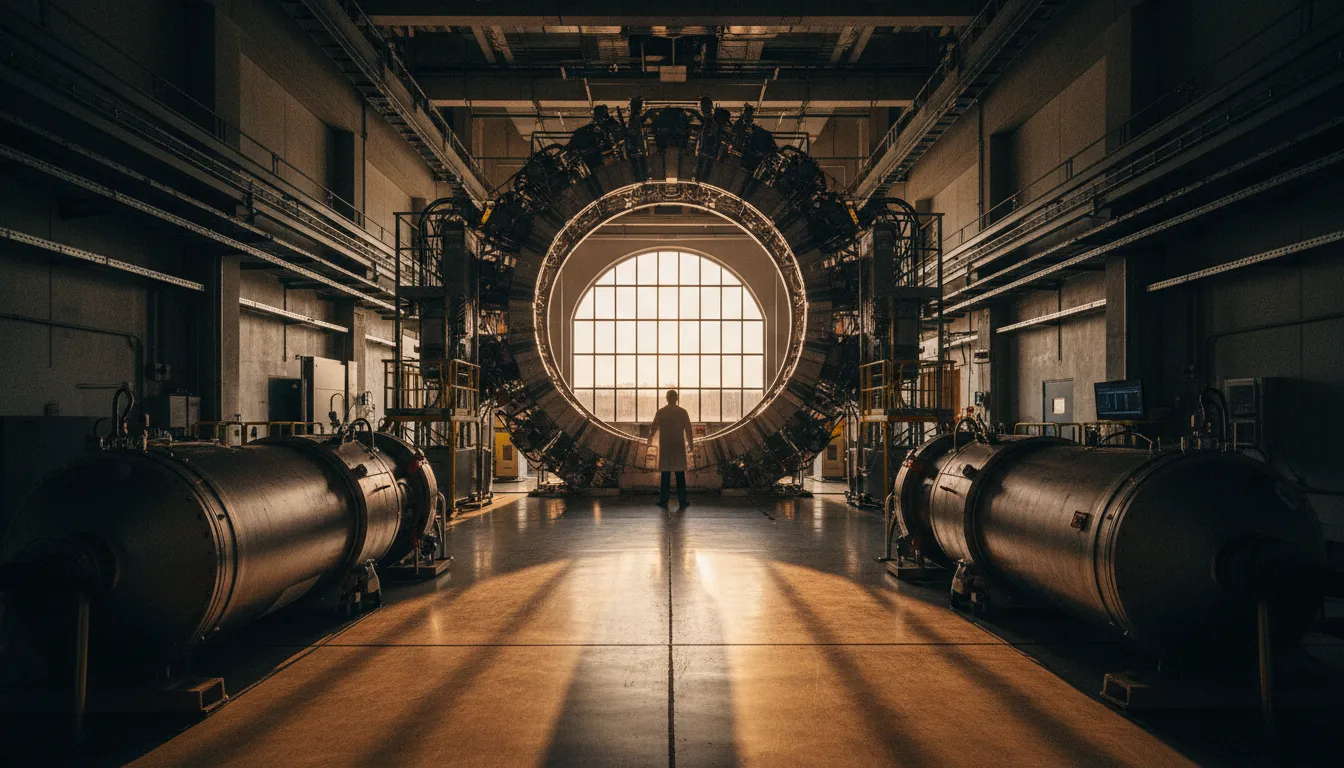
At its core, a tokamak is a hollow, ring-shaped vacuum vessel surrounded by superconducting magnets. These magnets generate overlapping fields—toroidal (running the long way around the ring) and poloidal (running the short way)—that twist together into a helical cage, keeping the superheated plasma suspended away from the vessel walls.
How It Works, Step by Step
First, air and impurities are pumped out of the vacuum chamber. A tiny quantity of hydrogen fuel—typically deuterium and tritium, two heavy isotopes of hydrogen—is injected as gas. A powerful electrical current ionizes the gas, stripping electrons from nuclei and creating plasma.
Auxiliary heating systems then push the plasma to fusion temperatures: between 150 and 300 million °C, roughly ten times hotter than the core of the sun. Methods include neutral-beam injection, which fires high-energy particles into the plasma, and radiofrequency heating, which pumps in microwave-like energy.
At these extreme temperatures, deuterium and tritium nuclei overcome their natural electrical repulsion and fuse, producing a helium nucleus, a high-energy neutron, and a burst of energy. The neutrons escape the magnetic cage, strike a surrounding blanket, and convert their kinetic energy into heat—which can then drive a conventional steam turbine to generate electricity.
Why Magnets Are the Key
Plasma at fusion temperatures would vaporize any material it touched. The tokamak's solution is to use magnetism instead of walls. The stronger the magnetic field, the tighter the plasma confinement—and the smaller the machine can be while still achieving fusion conditions. This insight has driven a revolution in high-temperature superconducting (HTS) magnets, which generate far stronger fields than older copper or low-temperature superconductors.
Commonwealth Fusion Systems, an MIT spinout, built the world's most powerful HTS fusion magnet in 2021, producing a field of 20 tesla. That breakthrough enabled the design of SPARC, a compact tokamak that aims to produce 140 MW of fusion power despite being a fraction of the size of earlier designs.
Where We Stand
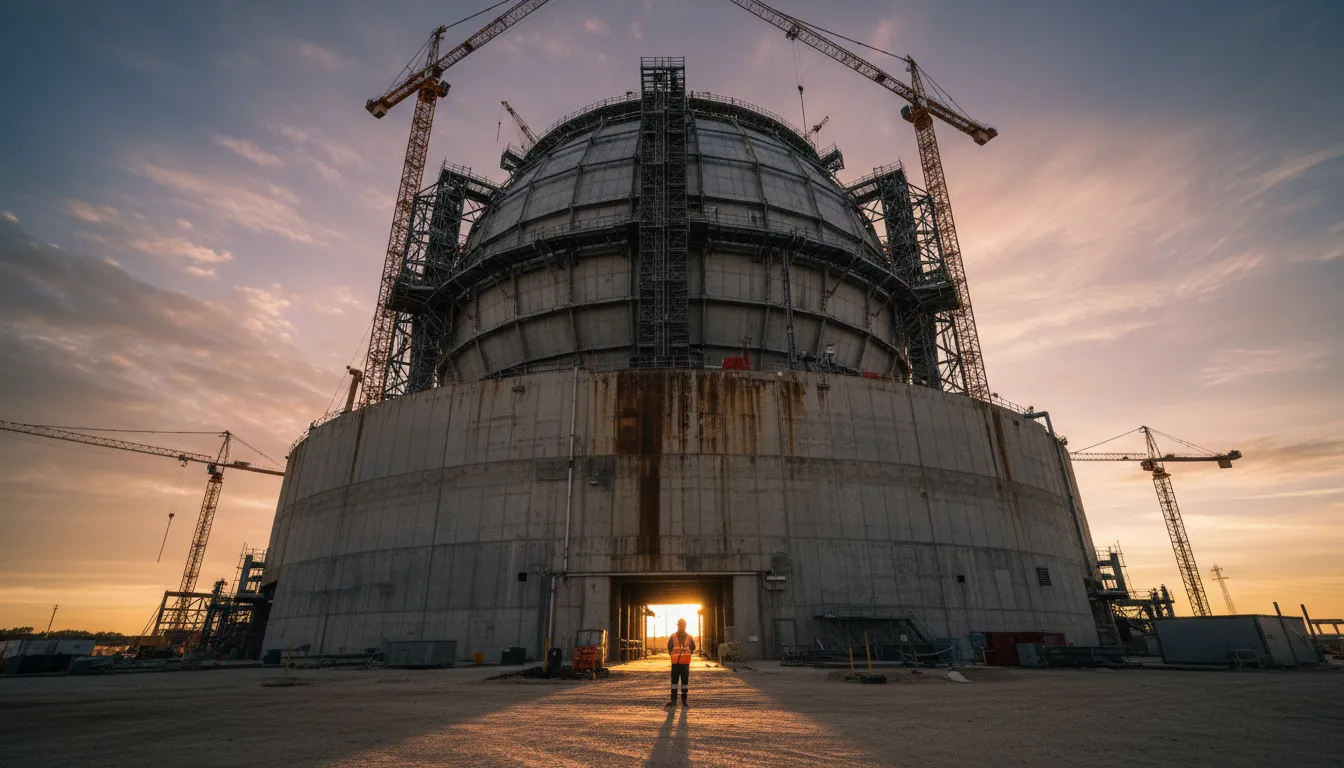
Two flagship projects anchor today's fusion landscape. ITER, the international megaproject in southern France backed by 35 nations, has completed all of its superconducting magnets—including a central solenoid powerful enough to lift an aircraft carrier—and is targeting first plasma around 2033–2034. When operational, ITER's plasma volume will be six times larger than any existing tokamak.
On the private side, CFS is assembling SPARC in Devens, Massachusetts, with first plasma expected in 2026–2027 and a goal of demonstrating net energy gain shortly after. The company has raised nearly $3 billion, with backing from Google and Nvidia, and plans to build ARC, its first commercial power plant, in the early 2030s.
They are not alone. Around 50 private companies are now pursuing commercial fusion, and several—including TAE Technologies and General Fusion—are debuting new demonstration machines. Most experts place realistic timelines at 2030–2035 for the first commercial plants supplying power to grids.
The Remaining Challenges
Engineering hurdles remain significant. Plasma-facing components must withstand extreme neutron bombardment for years without degrading. Tritium, one of the two fuels, is radioactive and scarce—future reactors will need to breed it from lithium blankets surrounding the plasma. And no tokamak has yet sustained a burning plasma long enough to generate continuous electricity.
Still, the pace of progress has accelerated dramatically. Fusion is transitioning from a physics experiment to an engineering challenge—and the machines racing to solve it are already taking shape.