How Hydrogen Fuel Cells Power Heavy-Duty Trucks
Hydrogen fuel cells convert hydrogen gas into electricity through an electrochemical reaction, producing only water as a byproduct. Here is how the technology works and why the trucking industry is betting on it.
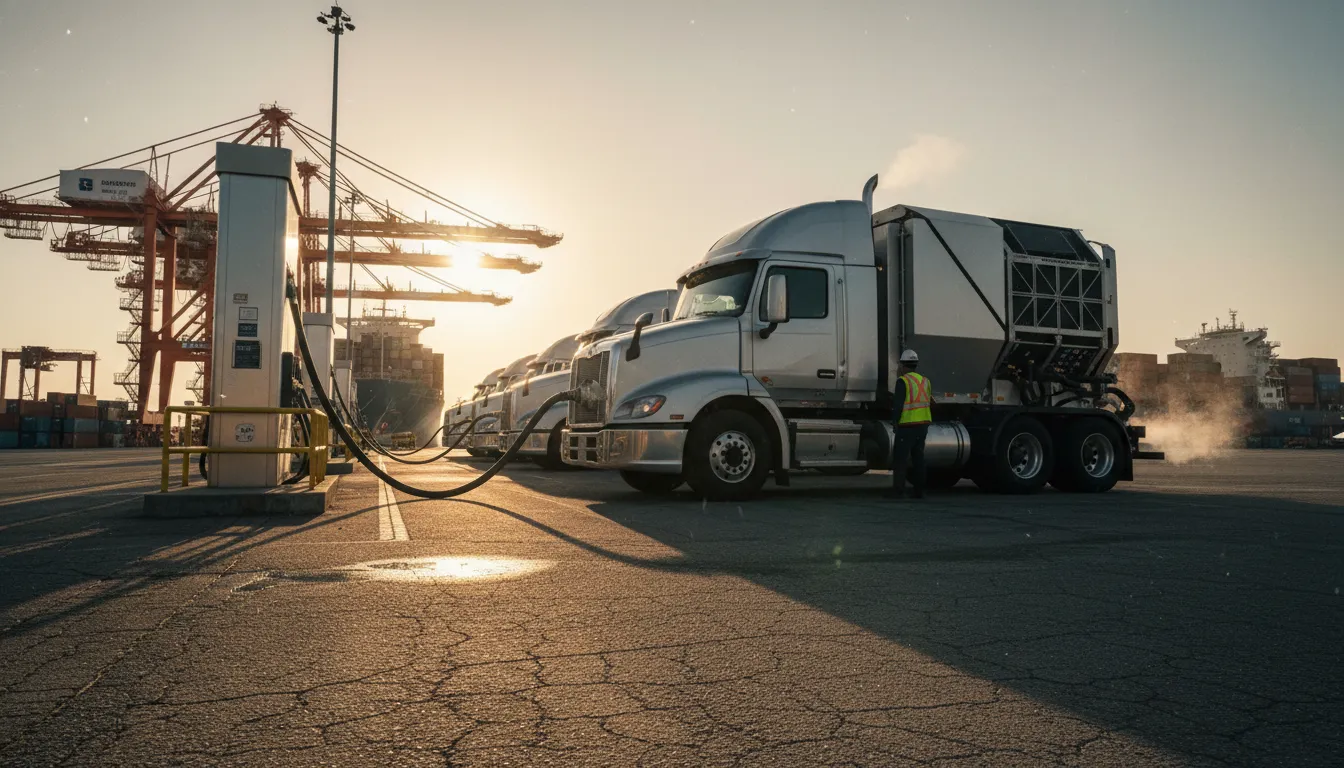
Why Trucks Need a New Power Source
Heavy-duty trucks account for a disproportionate share of transport emissions despite making up a small fraction of vehicles on the road. Battery-electric powertrains work well for cars and short-haul vans, but long-haul trucking demands something batteries struggle to deliver: high energy density, fast refueling, and the ability to haul heavy loads over hundreds of kilometers without stopping for hours to recharge.
That gap is where hydrogen fuel cell electric vehicles (FCEVs) enter the picture. They combine the zero-emission benefits of electric motors with range and refueling times comparable to diesel. Understanding how they work reveals why major manufacturers—Volvo, Daimler Truck, Toyota, and Hyundai—are investing billions in the technology.
How a PEM Fuel Cell Works
The most common type used in vehicles is the proton exchange membrane (PEM) fuel cell. It generates electricity through an electrochemical reaction between hydrogen and oxygen—essentially the reverse of electrolysis.
Inside the fuel cell, a thin polymer membrane is sandwiched between two electrodes: an anode (negative side) and a cathode (positive side). The process unfolds in three steps:
- Hydrogen splitting: Hydrogen gas enters the anode, where a platinum catalyst breaks each H₂ molecule into two protons and two electrons.
- Electron detour: The membrane allows protons to pass through but blocks electrons, forcing them to travel through an external circuit. This flow of electrons is the electric current that powers the truck's motor.
- Water formation: At the cathode, protons, electrons, and oxygen from the air recombine to form water vapor—the only tailpipe emission.
A single fuel cell produces a modest voltage, so hundreds of individual cells are stacked together into a fuel cell stack to generate enough power to drive a heavy-duty truck, according to the U.S. Department of Energy.
Performance on the Road
Fuel cell trucks store hydrogen in high-pressure tanks, typically at 350 or 700 bar. Liquid hydrogen storage is also emerging, enabling ranges well over 1,000 kilometers on a single fill at full load, according to Volvo Group. Refueling takes roughly five to fifteen minutes—comparable to diesel and dramatically faster than battery charging.
PEM fuel cells operate at relatively low temperatures (50–100 °C) and achieve 40–60 percent electrical efficiency, which is higher than a conventional internal combustion engine's roughly 25–35 percent thermal efficiency. They also deliver the instant torque characteristic of electric drivetrains, giving drivers smooth, responsive acceleration even under heavy loads.
The Green Hydrogen Challenge
A fuel cell truck is only as clean as the hydrogen it burns. Approximately 96 percent of global hydrogen is still produced from fossil fuels—so-called "grey hydrogen"—which generates significant carbon emissions during production, according to the Fuel Cell & Hydrogen Energy Association.
Green hydrogen, produced by splitting water using renewable electricity (electrolysis), eliminates those upstream emissions but remains expensive. Current costs range from roughly $2.30 to $7.40 per kilogram, compared to $0.70–$1.30 for grey hydrogen. Scaling up electrolyzer capacity and reducing renewable electricity costs are critical to closing that price gap.
Infrastructure: The Biggest Bottleneck
Even the best fuel cell truck is useless without a place to refuel. Hydrogen refueling stations remain scarce outside small clusters in California, parts of Germany, South Korea, and China. Building a continental network requires enormous capital investment in production facilities, pipelines or tanker fleets, and station hardware.
Governments are responding. The United States earmarked $8 billion through the Infrastructure Investment and Jobs Act to develop seven regional clean hydrogen hubs. Europe's H2Accelerate initiative plans to deploy 150 heavy-duty fuel cell trucks by 2029, and Daimler Truck has announced small-series production of its Mercedes-Benz NextGenH2 truck starting from late 2026, the company confirmed.
What Comes Next
Hydrogen fuel cells will not replace batteries everywhere. For short urban routes, battery-electric trucks are simpler and cheaper to operate. But for long-haul freight, refrigerated transport, and routes where weight and range matter most, fuel cells offer a compelling zero-emission alternative. As green hydrogen costs fall and refueling networks expand, the technology is positioned to become a permanent fixture of heavy-duty logistics—not a rival to batteries, but a complement.