What Is the Cambrian Explosion and Why It Matters
Around 538 million years ago, nearly every major animal group appeared in the fossil record within a geological instant. Here is how the Cambrian Explosion reshaped life on Earth and why scientists still debate its causes.
Life's Big Bang in the Fossil Record
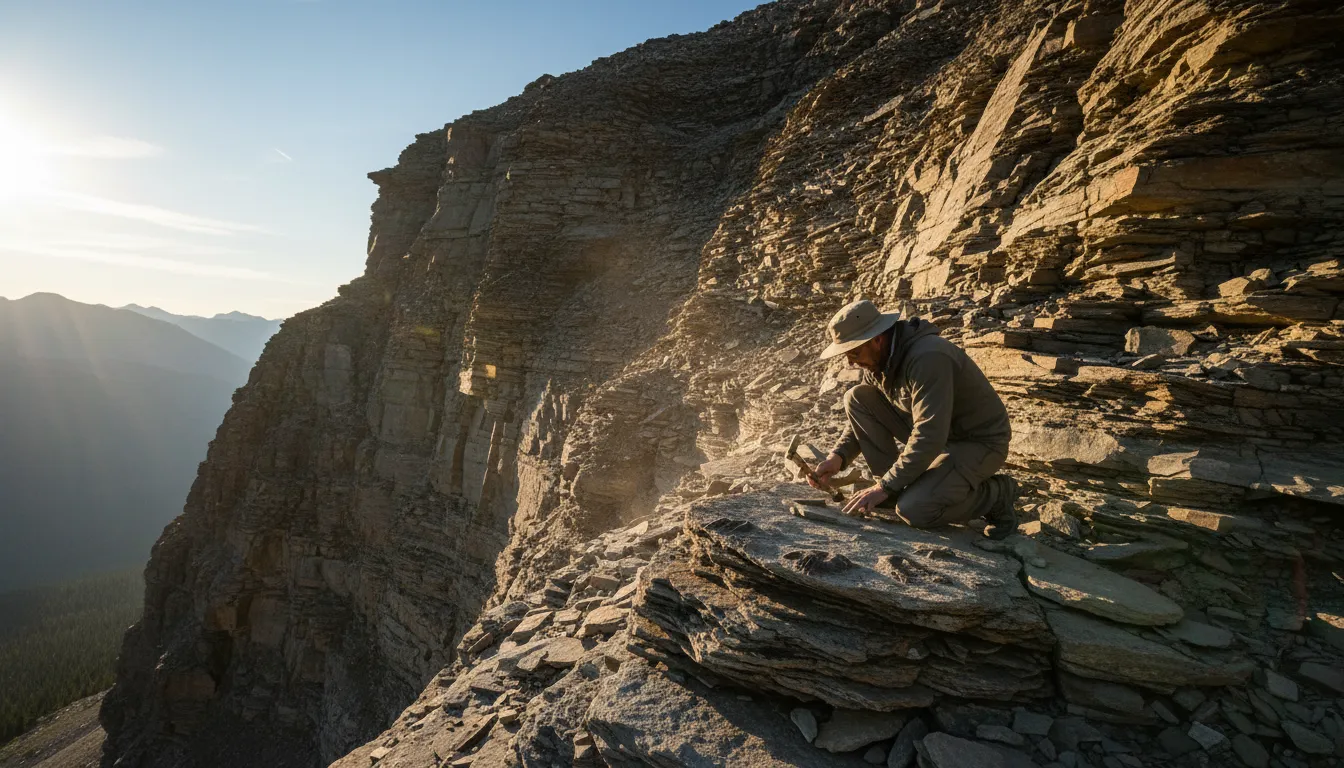
For most of Earth's 4.5-billion-year history, life was microscopic—single cells, bacterial mats, and little else visible to the naked eye. Then, roughly 538 million years ago, something extraordinary happened. In a span of perhaps 13 to 25 million years—a blink in geological time—nearly every major animal body plan that exists today appeared in the fossil record. Scientists call this burst of diversification the Cambrian Explosion, and it remains one of the most dramatic and debated events in evolutionary biology.
What Actually Happened
During the early Cambrian Period, marine ecosystems transformed from communities of simple, soft-bodied organisms into a dizzying array of complex animals. Between 20 and 35 major animal phyla—the broadest categories of animal classification—emerged in this window, according to the Encyclopaedia Britannica. Arthropods with compound eyes, worms with hardened jaws, early chordates (the group that includes all vertebrates), mollusks, and echinoderms all appeared. Many evolved hard shells, exoskeletons, and spines for the first time, leaving an unprecedented fossil record.
The most famous snapshot of this period comes from the Burgess Shale in British Columbia, Canada, discovered in 1909. Its exquisitely preserved fossils include bizarre creatures like Anomalocaris, a metre-long predator, and Hallucigenia, a spiny worm so strange that scientists initially reconstructed it upside down.
What Came Before: The Ediacaran Prelude
The Cambrian Explosion did not emerge from nothing. During the preceding Ediacaran Period (roughly 635–538 million years ago), Earth hosted the first known complex multicellular organisms—frond-shaped, disc-like, and tubular creatures preserved as impressions in sandstone worldwide. Whether most of these organisms were true animals, lichens, or something else entirely remains debated.
A recent fossil discovery in Yunnan Province, China, published in the journal Science, has pushed the timeline further back. Over 700 specimens from the Jiangchuan Biota, dating to 554–539 million years ago, reveal surprisingly complex animals—including early relatives of starfish and possible ancestors of vertebrates—already thriving before the Cambrian began. This suggests that the "explosion" may have been the culmination of a longer evolutionary buildup rather than a sudden event.
Why Did It Happen? Competing Theories
No single explanation fully accounts for the Cambrian Explosion. Scientists generally point to three categories of triggers that likely worked together:
- Rising oxygen levels. Increased atmospheric and oceanic oxygen may have crossed a critical threshold, enabling larger bodies, active metabolisms, and predatory lifestyles. However, research from the Royal Ontario Museum notes that oxygen levels did not change dramatically right at the Ediacaran–Cambrian boundary, complicating this theory.
- Genetic toolkit expansion. The evolution of Hox genes—master switches that control body-plan development—gave organisms the ability to generate radically different body structures from minor genetic tweaks. A change in one Hox gene can turn a limb into an eye. Yet molecular evidence shows these genes diversified before the explosion, meaning they were a necessary but not sufficient cause.
- Ecological arms races. The emergence of the first macroscopic predators forced prey species to evolve defences—shells, spines, burrowing behaviour—which in turn drove predators to become more sophisticated. This escalating feedback loop, sometimes called an evolutionary arms race, may have been the primary engine accelerating diversification.
Ocean chemistry also played a role. Rising alkalinity made it easier for organisms to build calcium carbonate structures like shells and exoskeletons, according to Scientific American, effectively unlocking an entire new category of body armour.
Why It Still Matters
The Cambrian Explosion is more than a chapter in deep history. It established the fundamental architecture of animal life that persists to this day—every vertebrate, insect, and mollusk alive traces its body plan back to forms that originated in this period. Understanding what drove such rapid diversification also informs modern questions about how ecosystems respond to environmental upheaval, mass extinctions, and recovery. As new fossil sites continue to rewrite the timeline, the Cambrian Explosion remains a powerful reminder that life, given the right conditions, can transform with breathtaking speed.