Merz in China: Airbus Deal and Appeal on Russia
German Chancellor Friedrich Merz concluded his inaugural visit to China with the promise of a major Airbus order for up to 120 aircraft and called on Beijing to use its influence on Moscow to end the war in Ukraine.
Major Airbus Order as First Tangible Result
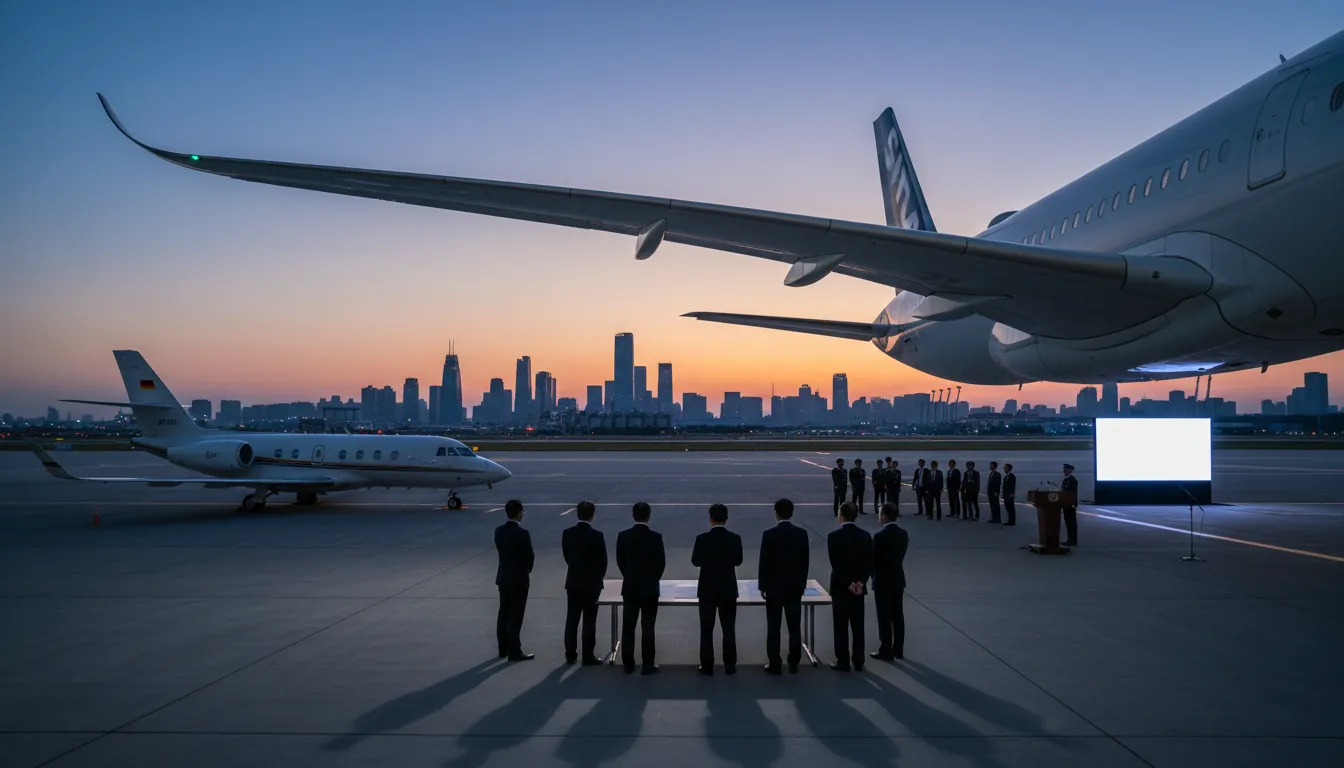
After two days of talks in Beijing and Hangzhou, German Chancellor Friedrich Merz concluded his inaugural visit to China with a concrete economic success: China has pledged to buy up to 120 Airbus aircraft. Merz announced the deal immediately after his meetings with President Xi Jinping and Premier Li Qiang in Beijing. He did not provide specific details on the model series, purchase price, or delivery dates; it also remained unclear whether these were binding orders or letters of intent. In addition to the Airbus order, more than ten other trade agreements were signed, involving around 30 German companies from the automotive, chemical, mechanical engineering, and biopharmaceutical sectors.
Record Trade Deficit and Demand for Fair Rules
The strongly asymmetrical trade imbalance is at the heart of the economic policy tensions between Berlin and Beijing. Germany's trade deficit with China recently reached a record high of 89 billion euros. In his talks, Merz blamed Chinese overcapacities and state subsidies for the imbalance and called for fair competition and transparent market access for German companies in China. Despite the existing tensions, China remains Germany's most important trading partner – ahead of the USA.
Appeal to Beijing: Use Influence on Moscow
One of the most geopolitically sensitive topics was the war in Ukraine. Merz urged Xi Jinping to use China's considerable influence on Russia to end the war of aggression. "We know that signals from China are taken very seriously in Moscow," the Chancellor stated, according to the German government. At the same time, he appealed to Beijing not to supply dual-use goods – i.e., goods with both civilian and military potential – to Russia. According to Western estimates, 80 to 90 percent of the components needed for Russia's arms production, including semiconductor chips, reach Russia via China or through Chinese intermediaries. According to Chinese state media, Xi generally advocated for negotiations but avoided directly criticizing Moscow.
Taiwan: Only a Peaceful Solution Acceptable
Merz also addressed the sensitive issue of Taiwan in his conversation with Xi. Any reunification of the self-governed island with mainland China must take place peacefully, he emphasized. China claims Taiwan as part of its territory and does not rule out the use of military force.
Hangzhou: Robotics and Technology Cooperation
On the second day of his trip, Merz visited the technology center Hangzhou, where he visited the robot manufacturer Unitree Robotics, among others – a company that has caused a stir worldwide with its humanoid robots. A visit to the German company Siemens Energy was also on the agenda. The Chancellor was accompanied by a high-ranking business delegation, including representatives from Volkswagen, BMW, and Mercedes.
Balance Sheet: Pragmatism in Turbulent Times
Both sides agreed to resume bilateral government consultations later this year – for the first time since 2023. For Merz, the trip was a balancing act: strengthening economic interests while not ignoring geopolitical warning signs. The visit fell on the fourth anniversary of the Russian invasion of Ukraine – a date that made the symbolic power of the Moscow-Beijing axis particularly clear. At a time when US President Donald Trump's protectionism is shaking the global economy, Germany is looking for new ways to diversify its trade relations – even if this requires difficult diplomatic compromises.