What Is the Strait of Hormuz and Why It Controls Oil
The Strait of Hormuz is the world's most important oil chokepoint, funneling roughly 20 million barrels per day between the Persian Gulf and global markets. Here's how it works and why it matters.
A Narrow Passage With Outsized Power
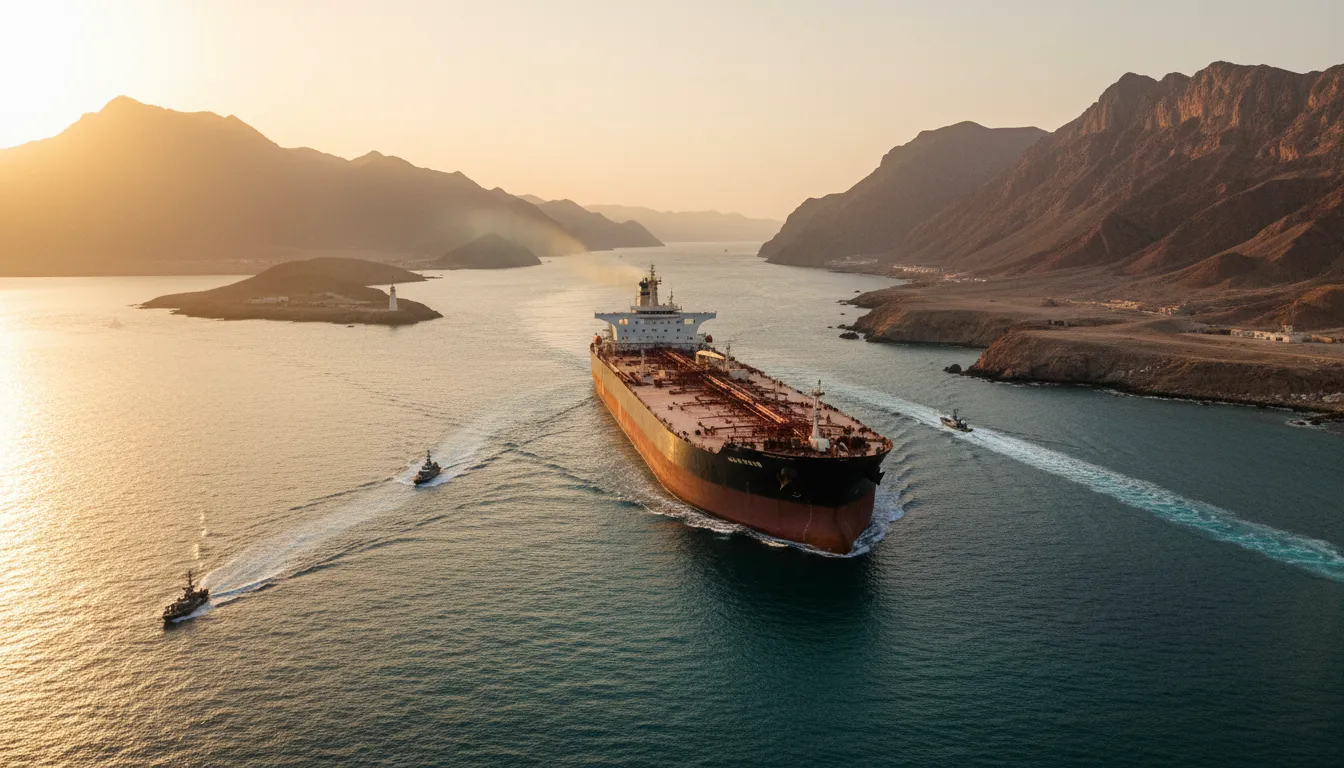
Between the rocky coasts of Iran to the north and Oman's Musandam Peninsula to the south lies a strip of water that quietly underpins the global economy. The Strait of Hormuz, at its narrowest point just 33 kilometres (21 miles) wide, is the only sea route connecting the oil-rich Persian Gulf to the open ocean. Roughly 20 million barrels per day of crude oil and petroleum products pass through it — about one-fifth of the world's total petroleum consumption and more than a quarter of all seaborne oil trade.
Geography of a Chokepoint
The strait stretches approximately 167 kilometres (104 miles) from the Persian Gulf to the Gulf of Oman and the Arabian Sea beyond. Its depth ranges from 60 to 100 metres, and shipping follows a Traffic Separation Scheme established by the International Maritime Organization in 1979 — one of the oldest in the world. Inbound and outbound vessels travel in separate two-mile-wide lanes, separated by a two-mile buffer zone. These lanes pass through both Omani and Iranian territorial waters, but are governed by international maritime law granting all nations the right of transit passage.
Who Depends on It
Nearly every major Persian Gulf oil exporter — Saudi Arabia, Iraq, Kuwait, the UAE, Qatar, Bahrain, and Iran itself — relies on the strait as its primary export route. The bulk of shipments head to Asia, with China, India, Japan, and South Korea among the largest importers. Beyond crude oil, roughly one-fifth of global liquefied natural gas (LNG) trade also transits the strait, including about 93% of Qatar's LNG exports, according to the U.S. Energy Information Administration.
Why There Are Few Alternatives
Approximately 88% of all oil leaving the Persian Gulf travels through the Strait of Hormuz. Only two countries possess operational pipeline infrastructure capable of bypassing it:
- Saudi Arabia's East-West Pipeline (Petroline) — a 1,200-kilometre system connecting the eastern Gulf coast to the Red Sea port of Yanbu, with a capacity of up to 7 million barrels per day when auxiliary lines are converted.
- The UAE's Abu Dhabi Crude Oil Pipeline (ADCOP) — a 400-kilometre pipeline from Habshan to the emirate of Fujairah on the Gulf of Oman, with a capacity near 1.8 million barrels per day.
Even at full capacity, these pipelines could handle only 3.5 to 5.5 million barrels per day — a fraction of the strait's typical flow. No other Gulf producer has a comparable workaround, which is why analysts at the International Energy Agency classify Hormuz as the single most critical oil transit chokepoint on Earth.
A History of Threats
The strait has been a flashpoint for decades. During the Iran-Iraq War (1980–1988), both sides attacked oil tankers in what became known as the Tanker War. Iran laid mines in the Persian Gulf, and the United States eventually intervened with naval escorts under Operation Earnest Will. Despite repeated threats, Iran never fully closed the strait — partly because it depended on the same sea lanes for its own exports.
In 2011 and 2012, Iranian officials again threatened closure in response to Western sanctions over Tehran's nuclear programme. Each time, oil markets reacted sharply, underscoring how even the threat of disruption can send prices surging.
What Disruption Would Mean
Any prolonged closure of the Strait of Hormuz would trigger an immediate spike in global oil prices, physical supply shortages within weeks, and cascading effects across transportation, manufacturing, and consumer prices worldwide. The Encyclopaedia Britannica notes that the strait's depth and width make a permanent blockade extremely difficult to maintain — but even a partial disruption, whether from mines, drones, or military confrontation, can rattle markets and reshape geopolitics.
Strategic petroleum reserves held by major consuming nations provide a temporary buffer. The United States, Japan, and members of the IEA collectively hold hundreds of millions of barrels in emergency stockpiles designed for exactly this scenario. But reserves buy time, not solutions.
Why It Keeps Mattering
Despite the global push toward renewable energy, petroleum remains the backbone of transportation and petrochemical industries. As long as the Persian Gulf produces roughly a third of the world's crude oil, the Strait of Hormuz will remain the narrow passage on which much of the global economy quietly depends — a geographic bottleneck where geology, geopolitics, and energy markets converge.