Bratislava on the high-speed train route: VRT V4 for 3 billion
Slovak Railways has completed a feasibility study for the V4 high-speed rail line. Trains will travel at speeds of up to 320 km/h, with the journey from Bratislava to Brno taking 33 minutes and to Vienna just 24 minutes. The costs exceed €3 billion.
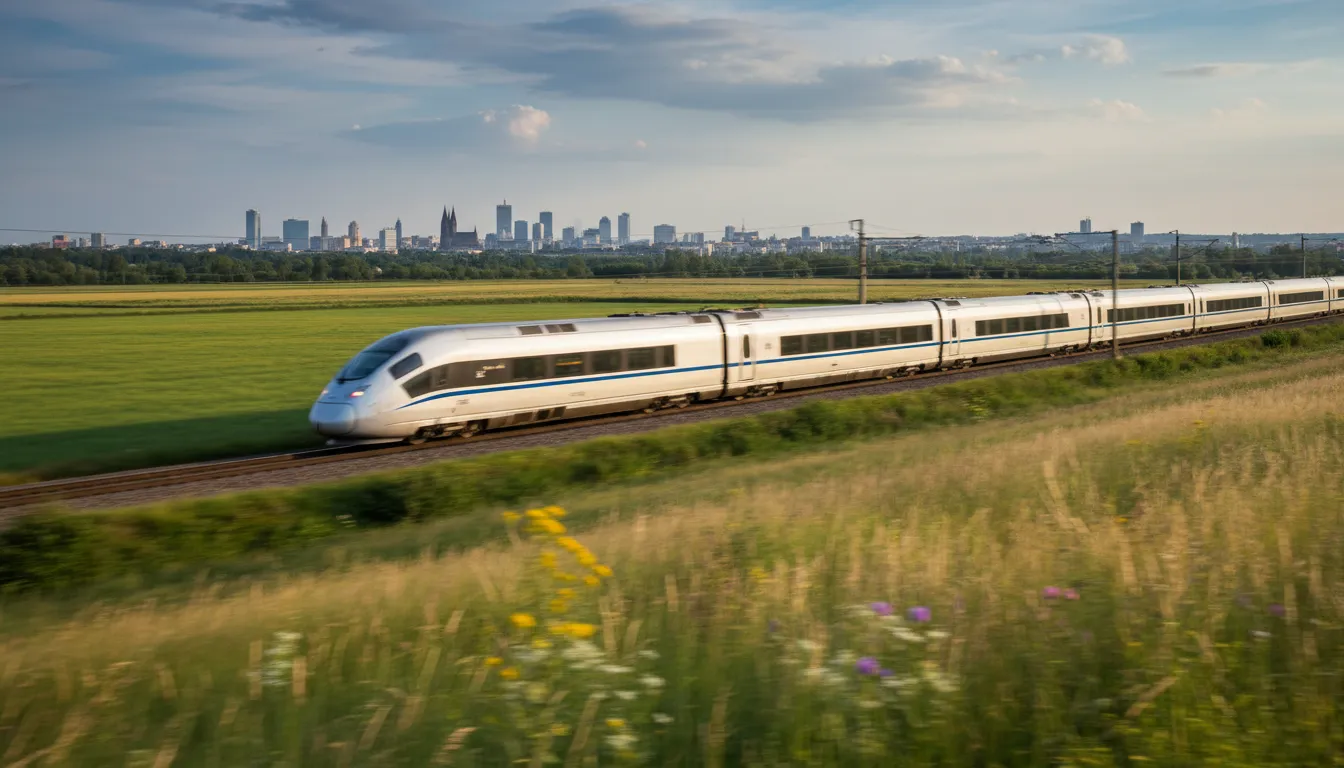
Slovakia enters the era of high-speed rail
In January 2026, Železnice Slovenskej republiky (ŽSR) presented the results of the National Feasibility Study for the V4 high-speed rail line. The study confirmed that connecting Bratislava to the network of high-speed trains linking the capitals of the Visegrad Four countries is technically feasible and territorially viable. The total investment costs are estimated at €3.062 billion.
The project aims to fundamentally change travel in Central Europe. The high-speed line will connect Budapest, Bratislava, Brno, Prague and Warsaw, with trains on the new section between Bratislava West station and the Czech border reaching speeds of up to 320 km/h.
Travel times like nothing you've ever seen
The most significant change will be dramatically reduced travel times. According to the results of the study, the journey from the new Bratislava West station to Brno will be reduced to 33 minutes, and to Vienna to just 24 minutes. The journey from Budapest to Bratislava will take approximately 102 minutes, and the Vienna-Brno route will take less than an hour.
Compared to the current situation, this is a revolutionary leap forward. Today, the train journey from Bratislava to Prague takes over four hours. Once the V4 high-speed rail link is completed, this time could be reduced by roughly half.
New station and three variants
The study analysed 38 technical alternatives in three main scenarios. Two development variants envisaged a completely new route, while the third – conservative – variant makes maximum use of the existing infrastructure. The conservative variant was chosen as the optimal one. It combines new construction with a systematic increase in the capacity of existing lines, especially on the south bank of the Danube.
A key element of the project is the construction of a new Bratislava West station in the Stupava area, which will become a hub for train maintenance and transfers between domestic and international connections. The plan also includes the modernisation of the main station in Bratislava, the extension of the tracks to 750 metres and the construction of a double-track tunnel between the main station and Lamač.
A billion-euro project in two phases
The implementation will be divided into two stages. The first phase (2030–2040) includes the modernisation of the Bratislava hub, the doubling of the Rusovce–Petržalka section and the construction of the Bratislava West station. The second phase, to be completed between 2046 and 2050, will bring the high-speed line itself towards the Czech border and a connection to the Vienna corridor via Marchegger Ast.
In addition to construction costs of €3.062 billion, the project will require an additional €360 million for project preparation and land acquisition. Financing will largely depend on EU funds – the completion of the national study was a prerequisite for drawing funds from the EU budget.
A project of pan-European significance
The V4 VRT initiative was launched in 2018 and gradually gained the support of all four Visegrad countries. Hungary completed its study in 2019, while Slovakia was the last to receive government approval in September 2021. Without participation in the project, there was a risk that the route would bypass Slovakia via Vienna.
The next steps include finalising transport simulations, incorporating the route into spatial planning documents and coordinating with partners in the Czech Republic, Hungary and Austria. If everything goes according to plan, high-speed trains between Bratislava and Brno could be running by around 2050.