Four Years of War: Europe Mobilizes for Ukraine
On February 24, 2026, four years after the Russian invasion, Costa and Von der Leyen visit Kyiv to display European solidarity, while a Hungarian veto blocks a €90 billion loan and the cost of reconstruction reaches nearly $588 billion.
Four Years On, Kyiv Still Stands
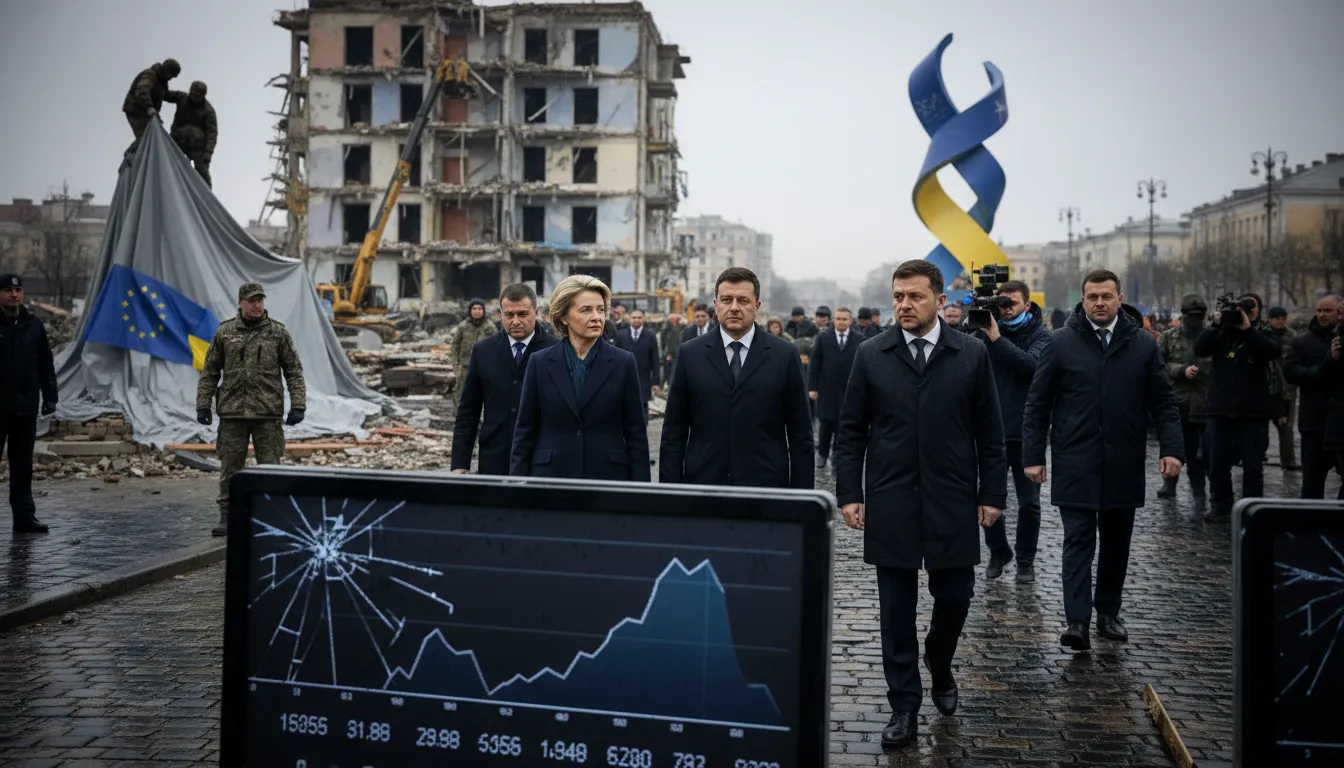
February 24, 2026, marks the fourth anniversary of Russia's full-scale invasion of Ukraine. To mark this significant date, the presidents of the two main European institutions traveled to Kyiv. António Costa, President of the European Council, and Ursula von der Leyen, President of the Commission, participated in the official commemorative ceremony, visited an energy infrastructure site destroyed by Russian missiles, and then held a trilateral meeting with Ukrainian President Volodymyr Zelensky.
The two leaders also took part in a meeting of the "Coalition of Volunteers," co-chaired by Emmanuel Macron and British Prime Minister Keir Starmer. Thirty-five states reaffirmed their commitment to supporting Ukraine with the aim of achieving a lasting peace. Since 2022, Europe has provided a total of €194.9 billion in aid to Kyiv, including €70 billion for military purposes, according to the European Commission.
€90 Billion Loan Blocked by Budapest
Costa and Von der Leyen had hoped to bring Kyiv good news: the unblocking of a €90 billion loan to finance Ukraine in 2026 and 2027. The European Parliament had adopted the text on February 11 with 458 votes in favor, 140 against, and 44 abstentions. But Hungary vetoed it on February 23, citing a dispute over the transit of Russian oil via the Druzhba pipeline. Hungarian Foreign Minister Péter Szijjártó simultaneously blocked the 20th package of European sanctions against Moscow, preventing both measures from coming into effect.
Without this funding, Kyiv could face budgetary difficulties as early as the end of the first quarter of 2026. Alternative mechanisms are being studied to circumvent Budapest's blockade, but no concrete solution had yet been finalized at the time of publication.
Macron: "Peace Without the Europeans is Not Possible"
President Emmanuel Macron reaffirmed, on the occasion of this fourth anniversary, that "peace without the Europeans is not possible." He called on his partners to move forward on the sanctions package blocked by Hungary and to maintain firm military support for Kyiv. Macron also revealed that he had opened a direct communication channel with Moscow, in full transparency with Ukraine and European and American allies, with the aim of exploring the conditions for a negotiated settlement of the conflict.
588 Billion: The Price of Reconstruction
A joint report by Kyiv, the World Bank, the EU, and the United Nations, published on February 23, estimates the cost of Ukraine's reconstruction at $587.7 billion over ten years—equivalent to three times Ukraine's GDP. This figure is up 12% from the previous estimate, mainly due to a 21% increase in needs related to energy infrastructure, a prime target for Russian strikes. Transport ($96 billion), energy, and housing ($77 billion each) account for the main identified needs.
Solidarity Put to the Test
Four years after the start of the war, Europe finds itself at a crossroads. The collective dynamic remains strong, driven by Paris, Brussels, and the vast majority of European capitals. But the repeated blockades by Budapest and the uncertainties surrounding American support serve as a reminder that nothing is ever guaranteed. The question is no longer whether the EU will commit, but how far it is willing to go—financially, militarily, and politically—to guarantee a just and lasting peace in Ukraine.