How AI Drought Forecasting Works—and Why It Matters
Machine learning models trained on decades of streamflow, satellite, and climate data can now predict droughts weeks or months in advance, giving farmers, cities, and ecosystems crucial lead time to prepare.
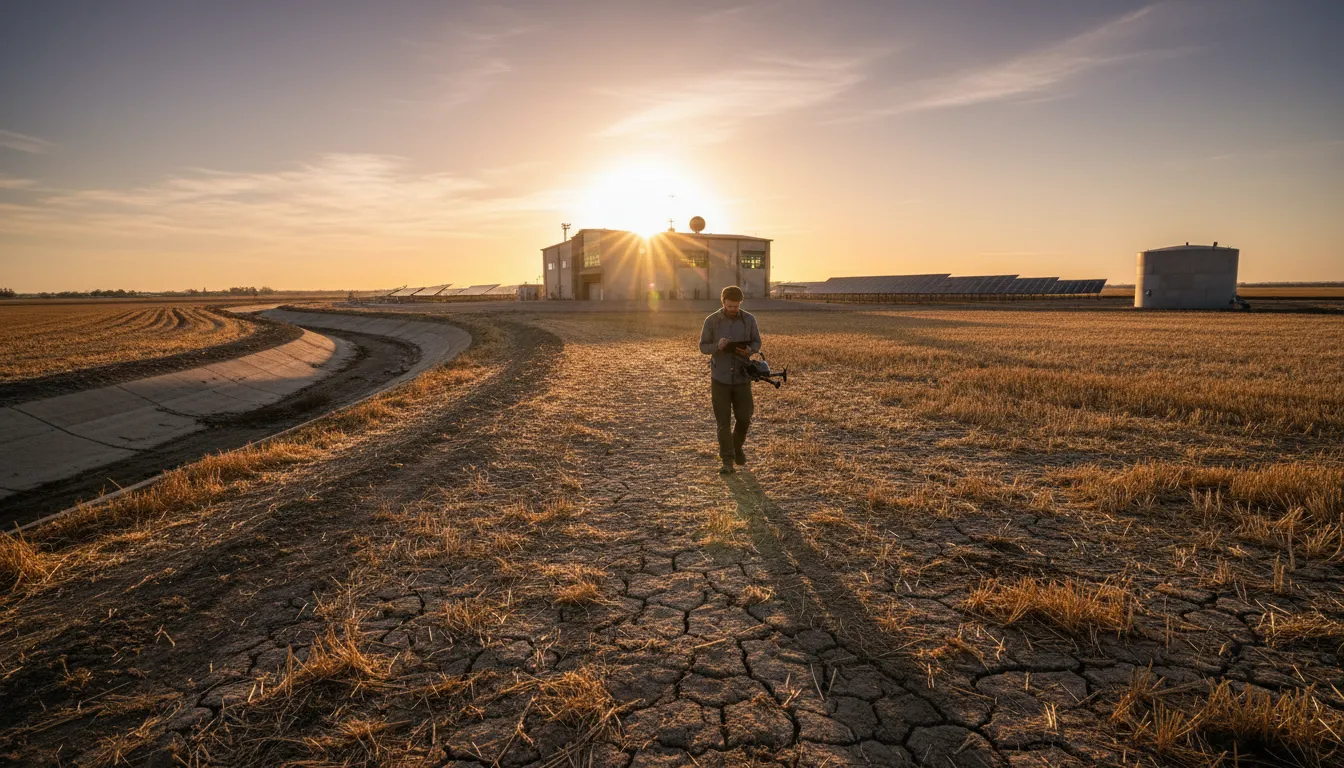
Why Drought Is So Hard to Predict
Drought is not a single event but a slow-motion crisis. Unlike a hurricane or earthquake, it creeps in over weeks or months, driven by a tangle of variables—rainfall deficits, soil moisture, snowpack levels, groundwater reserves, and atmospheric patterns. Traditional forecasting relies on physics-based climate models that simulate these interactions, but they demand enormous computing power and still struggle with accuracy beyond a few weeks.
That is changing. A new generation of artificial intelligence tools is learning to spot drought signals that conventional models miss, pushing reliable forecasts from days out to weeks and even months ahead.
From Streamgages to Satellites: The Data Behind the Models
AI drought models are only as good as the data they consume, and modern systems draw from a remarkable range of sources. The U.S. Geological Survey's River DroughtCast, released in March 2026, trains its machine-learning algorithms on streamflow records from more than 3,000 gauging stations—some with over a century of continuous measurements. By combining those historical patterns with current soil moisture, snowpack, and groundwater readings, the tool forecasts when rivers and streams will drop to abnormally low levels up to 13 weeks ahead.
Satellite data offers another powerful input. MIT Lincoln Laboratory has developed neural networks that process temperature and humidity measurements from NASA's Atmospheric Infrared Sounder (AIRS) to detect early drought signatures from orbit. Meanwhile, a team at Spain's Universitat Politècnica de València combines four international seasonal climate models with the open-access ERA5 reanalysis dataset and AI to produce drought indices across multiple timeframes.
How the AI Actually Learns
Most drought-prediction systems rely on a handful of proven machine-learning architectures. Long short-term memory (LSTM) networks excel at capturing how climate variables evolve over time—learning, for example, that a dry February followed by low snowpack in March raises the probability of summer streamflow drought. Random forests and gradient-boosting machines (such as XGBoost) identify which predictors matter most, filtering out noise before the temporal model takes over.
Newer hybrid approaches combine these techniques. A random forest first ranks the most critical climate inputs, then an LSTM models their evolution forward in time. The result is a forecast that captures both which variables matter and how they interact over weeks and months.
How Accurate Are the Forecasts?
Accuracy depends on the forecast horizon. The USGS River DroughtCast correctly predicts the onset of severe or extreme drought conditions in the first week roughly 75 percent of the time, declining to about 55 percent by week 13. The Spanish system achieves reliability near 90 percent for the month a forecast is issued and retains predictive power above 60 percent three months out.
All modern systems attach confidence estimates to every prediction, letting water managers weigh the certainty of a forecast before acting on it.
Why Early Warning Changes Everything
Even a few extra weeks of lead time can transform drought response. Farmers can switch to less water-intensive crops or adjust irrigation schedules. Municipal water agencies can launch conservation campaigns before reservoirs hit critical levels. Recreation managers can prepare for reduced river flows that affect fishing and boating. Ecologists can prioritize habitat protection in at-risk watersheds.
AI drought forecasts also feed into the U.S. Drought Monitor, the authoritative weekly assessment that triggers public warnings and disaster declarations affecting billions of dollars in federal aid.
Challenges Ahead
Despite rapid progress, significant hurdles remain. AI models trained on historical data may struggle as climate change pushes weather patterns outside the range of past experience. Data gaps in developing nations—where drought hits hardest—limit model coverage. And deep-learning systems can behave as "black boxes," making it difficult for water managers to understand why a forecast was issued, which can erode trust.
Researchers are tackling these problems with explainable-AI techniques and by building models on globally available, open-access datasets. The goal: reliable, transparent drought warnings for every region on Earth, not just the best-monitored rivers in wealthy nations.