How Humanoid Robots Work—and Why They're Entering Factories
Humanoid robots combine advanced actuators, AI vision systems, and reinforcement learning to walk, grip, and navigate spaces built for people. Here is how the technology works and why factories are adopting it.
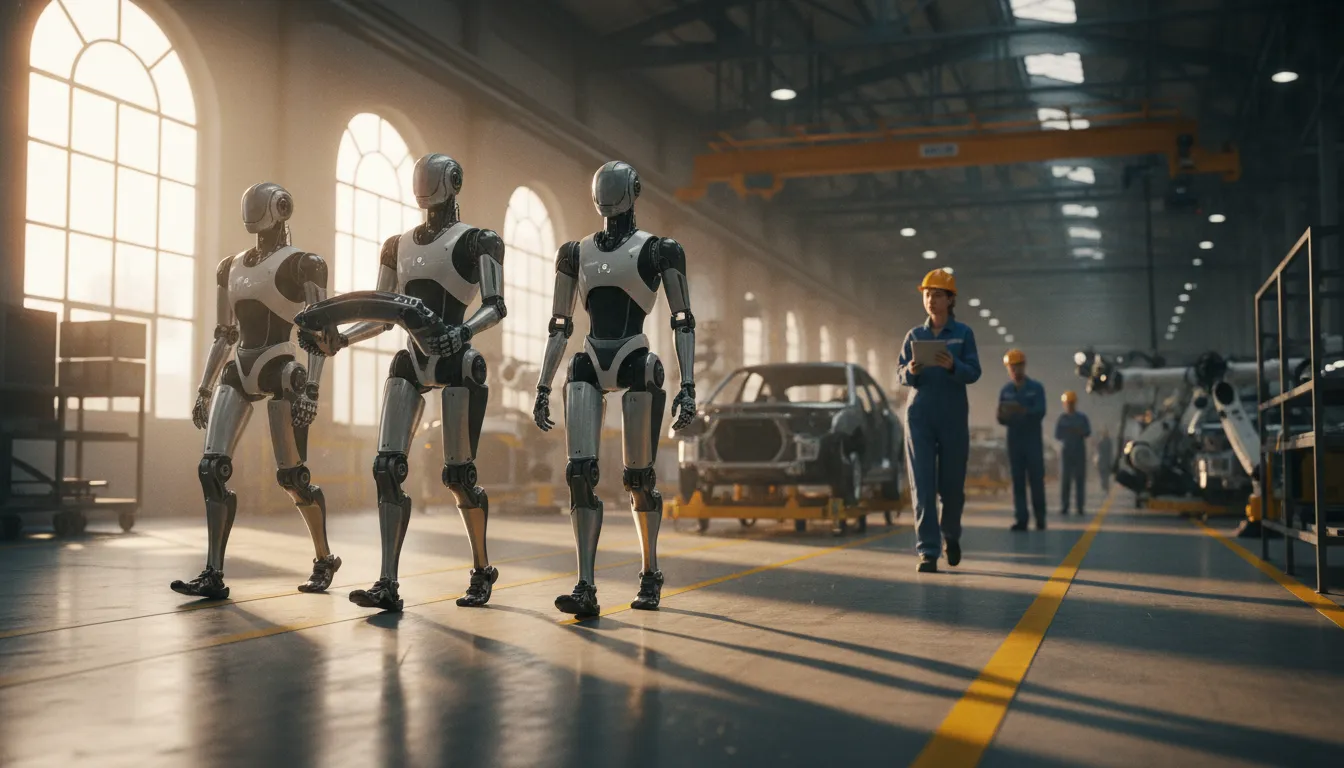
Machines Built in Our Image
A new generation of robots is walking onto factory floors—literally. Unlike the stationary robotic arms that have welded car panels for decades, humanoid robots are designed to look and move like people, with a head, torso, two arms, and two legs. The goal is straightforward: navigate environments built for humans without redesigning the environment itself.
Companies like Tesla, Figure AI, Boston Dynamics, and China's Unitree Robotics are racing to scale production. Goldman Sachs and UBS project the humanoid robot market could reach $30–50 billion by 2035 and potentially $1.4 trillion by 2050. But what actually makes these machines stand upright, grip a box, or follow a spoken command?
The Hardware: Actuators, Sensors, and Power
Every humanoid robot rests on three hardware pillars: actuators, sensors, and a power system.
Actuators are the robot's muscles. Electric servo motors sit at each joint—hips, knees, elbows, wrists—converting electrical energy into rotational force (torque). A typical humanoid has 20 to 50 actuated joints, called degrees of freedom, each controlled by its own motor-and-gear assembly. Electric actuators have become the dominant technology because they offer high precision, fast response, and reasonable cost compared to hydraulic alternatives.
Sensors give the robot spatial awareness. Stereo cameras in the head provide depth perception; LiDAR or time-of-flight sensors map the surrounding geometry; inertial measurement units (IMUs) in the torso track tilt and acceleration; and force-torque sensors in the hands gauge grip pressure down to fractions of a newton. Together, this sensor suite lets a humanoid build a real-time 3D picture of its environment.
Power remains the biggest constraint. Lithium-ion battery packs stored in the torso deliver one to eight hours of operation, depending on workload. Walking and balancing are energy-intensive, so thermal management systems prevent overheating during sustained use.
The Brain: AI That Sees, Decides, and Moves
Hardware alone produces an expensive mannequin. What turns a humanoid into a useful worker is a layered AI control architecture.
At the top layer, vision-language-action models process camera feeds and spoken instructions simultaneously. These neural networks—cousins of the large language models behind chatbots—let a robot interpret a command like "pick up the red bin on the left shelf" by fusing visual recognition with language understanding.
A middle planning layer breaks high-level goals into movement sequences, using techniques like model predictive control to calculate the safest, most efficient path in real time.
At the lowest layer, fast motor-control loops running on microcontrollers near each joint execute movements at millisecond intervals, constantly adjusting torque to maintain balance. This distributed design means the robot doesn't fall over while its "brain" is busy planning the next step.
Crucially, many humanoids now learn through reinforcement learning in simulation—practicing millions of movements in a virtual world before transferring skills to physical hardware. As roboticist Jonathan Hurst has noted, humans are "very compliant in how they interact with the world," constantly making light contact with surfaces. Replicating that intuitive physical intelligence in a machine remains one of the field's hardest challenges.
Where They're Working Now
In 2026, humanoid deployments are concentrated in three sectors:
- Manufacturing and automotive assembly (~35% of deployments) — BMW is testing humanoids for precision gripping and two-handed coordination at its South Carolina plant.
- Logistics and warehousing (~25%) — Agility Robotics' Digit lifts and moves bins in distribution centers, while Figure AI's Figure 02 handles warehouse tasks.
- Research and healthcare (~15%) — Pilot programs use humanoids to assist rehabilitation therapists with repetitive physical exercises.
Tesla has deployed over 1,000 Optimus units across its own factories for parts handling and aims to produce 50,000 units by the end of 2026, with a long-term target price of $20,000–$30,000 per unit. Manufacturing costs have already dropped roughly 40% between 2023 and 2024, and material costs are projected to fall from about $35,000 today to $13,000–$17,000 within a decade.
Why It Matters—and What's Still Missing
The promise of humanoid robots is flexibility. A single machine that can walk through a warehouse, climb stairs, and use standard tools could replace dozens of specialized fixed robots. But significant gaps remain. Battery life is short. Dexterous manipulation—tying a knot, handling fragile objects—is still unreliable. And as Ayanna Howard, dean of engineering at Ohio State University, has cautioned, skills learned in simulation don't always transfer cleanly to the real world.
Household humanoids remain at least a decade away, according to industry analysts at Deloitte. For now, the factory floor is the proving ground—and the robots are just clocking in.