Microsoft: Data on Glass to Last 10,000 Years
Microsoft Research has published the results of Project Silica in the journal Nature: data written into ordinary borosilicate glass using a femtosecond laser will survive for more than 10,000 years. The research phase is complete, and the company is considering commercial deployment in data centers.
Eternal Storage Made from Kitchen Glass
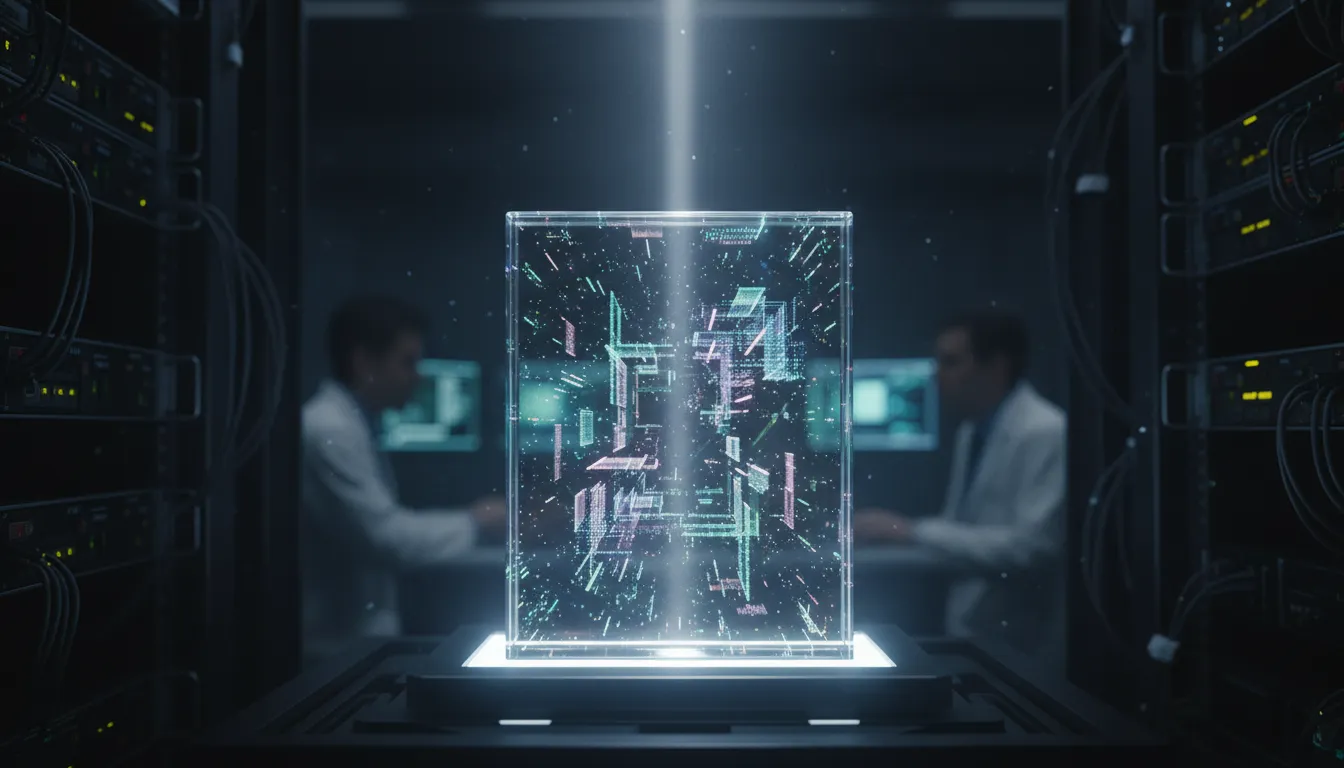
On February 19, 2026, Microsoft's research team published the results of the long-term Project Silica in the prestigious journal Nature: they succeeded in storing over 2 terabytes of data on a thin plate of borosilicate glass—the same material used to make Pyrex kitchenware. They estimate the lifespan of this medium to be at least 10,000 years. This marks a breakthrough in digital archiving, which has so far struggled with the limited lifespan of hard drives and magnetic tapes.
How Does Writing to Glass Work?
The key to the technology lies in femtosecond lasers—devices that generate extremely short light pulses—which researchers use to create microscopic 3D points called voxels inside the glass plate. The new generation of Project Silica introduces a major innovation in the form of so-called phase voxels: instead of two laser pulses, only a single discharge is needed to encode one bit, which slightly changes the physical structure of the glass and thus affects the passage of light through the material.
On a plate measuring 120 × 120 mm and 2 mm thick, it was possible to layer 258 data layers with a total capacity of 2.02 TB. The writing speed ranges between 18.4 and 65.9 megabits per second, with the upper limit surpassing previous experiments with more expensive quartz glass. Data reading is ensured by machine learning, which compensates for minor imperfections in the structure of the glass.
Why Borosilicate?
Previous iterations of Project Silica relied on expensive quartz glass available only from a handful of specialized manufacturers. Borosilicate, on the other hand, is a mass-produced industrial material—cheap, readily available, and resistant to temperature fluctuations. The transition to this material dramatically reduces costs and paves the way for truly large-scale commercial deployment.
Accelerated aging tests have shown that voxels remain stable even at temperatures around 290 °C. Under normal room temperature conditions, the data should therefore last for more than 10,000 years—compared to magnetic tapes, whose lifespan is around 10 to 30 years, this is an incomparable difference.
The End of Digital Oblivion?
The problem of long-term digital archiving is pressing not only for large corporations, but also for cultural institutions, scientific institutes, and healthcare. Archives, libraries, and museums around the world—including those in the Czech Republic—regularly face the costly migration of data to new media because the old ones become obsolete or physically disintegrate. Project Silica technology could solve this recurring problem once and for all.
Potential applications include archiving medical records, scientific measurements, training data for artificial intelligence, film archives, or financial records. Moreover, the glass medium does not require an air-conditioned environment or constant power supply, which significantly reduces the operating costs of data centers.
Commercial Deployment: Not Yet
Microsoft has announced that the research phase of Project Silica is complete. However, the company remains cautious—in a press release, it states that it is "considering the insights from the project and exploring options for long-term storage of digital information." Remaining challenges include scaling production to an industrial level, reducing the cost of laser writing systems, and developing efficient mechanisms for searching for specific data from vast archives. So, glass disks are unlikely to arrive in ordinary server rooms this year—but the foundation for a revolution in data archiving has been laid.